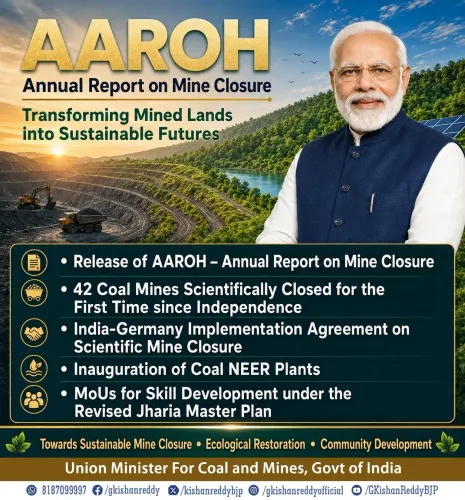
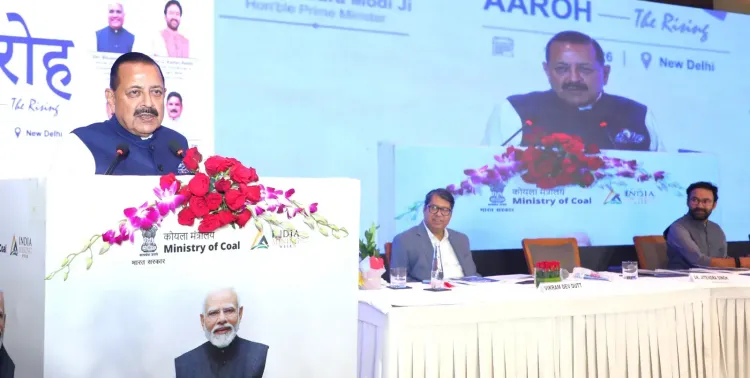
Dr. Jitendra Singh at AAROH: Mine Closure as Wealth Creation
Synopsis
Union Minister Dr. Jitendra Singh addressed the release of 'AAROH', the Ministry of Coal's annual report on mine closure, in New Delhi on 25 July 2026, framing exhausted mines as new centres of wealth creation, environmental restoration and sustainable livelihoods under India's circular economy push.
Key Takeaways
Jitendra Singh addressed the AAROH report launch organised by the Ministry of Coal in New Delhi on 25 July 2026 .
The minister described mine closure as 'like closing one coal mine and opening another mine of wealth,' signalling a shift from liability to asset thinking.
The initiative advances national priorities including waste-to-wealth , resource efficiency, environmental conservation, sustainable land use and community development.
India's mine closure framework is anchored in the National Mineral Policy 2019 and the Mines and Minerals (Development and Regulation) Amendment Act 2021 .
The policy aligns with India's 2070 net-zero pledge and just-transition frameworks for coal-dependent communities.
Implementation of specific mine-repurposing pilots in major coal states will be the key metric to watch in coming months.
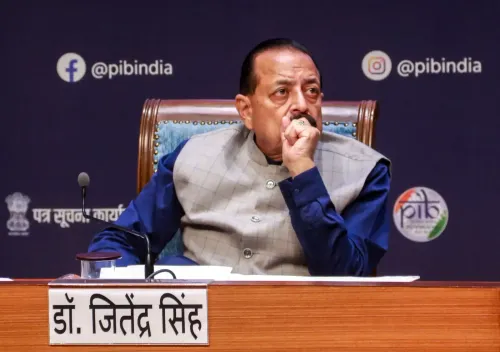
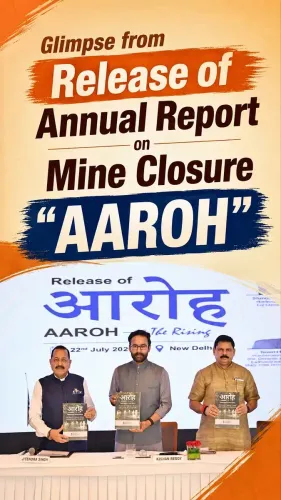
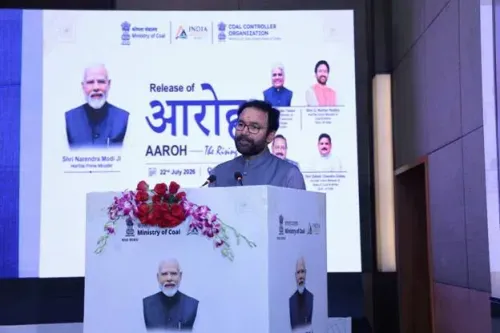
Union Minister of State (Independent Charge) for Science and Technology Dr. Jitendra Singh addressed the release ceremony of 'AAROH — Annual Report on Mine Closure', organised by the Ministry of Coal in New Delhi on Friday, 25 July 2026, calling India's mine closure journey a landmark step toward a circular economy.
Context
Speaking at the event, Dr. Singh framed mine closure not as an end but as a new beginning. 'This is like closing one coal mine and opening another mine of wealth,' he said, encapsulating the government's pivot toward treating exhausted mining sites as assets rather than liabilities. He described the initiative as proof that 'science can transform environmental challenges into development opportunities.'
The AAROH report, released by the Ministry of Coal, documents India's evolving approach to repurposing depleted mines for economic, environmental and livelihood purposes. The minister noted that the initiative simultaneously advances national priorities including waste-to-wealth, resource efficiency, environmental conservation, sustainable land use and community development.
Policy Backdrop
India's mine closure framework has been shaped by two key legislative milestones. The National Mineral Policy 2019 made scientific mine closure planning and environmental restoration core objectives of the mining sector. The Mines and Minerals (Development and Regulation) Amendment Act 2021 further strengthened closure and rehabilitation norms while accelerating broader mining reforms.
These measures sit within India's wider commitment to a 2070 net-zero target and its resource-efficiency strategies. The government's approach aligns with just-transition frameworks that seek to balance energy security with environmental and social outcomes in coal-dependent regions.
Stakeholders and Impact
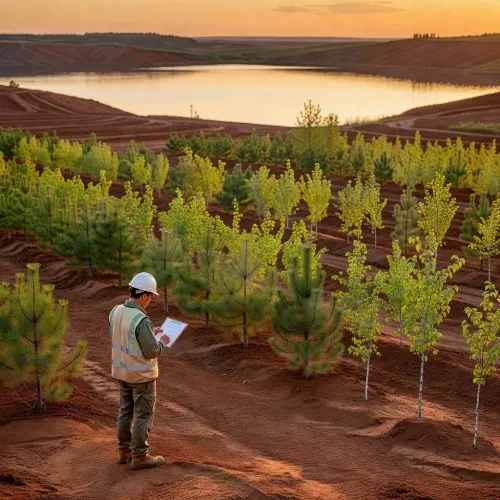
The communities most directly affected are those living in and around India's major coal belts — regions where livelihoods have historically depended on active mining operations. By converting exhausted sites into centres of wealth creation, the policy aims to provide alternative employment and economic activity once coal extraction ceases.
Environmental restoration at closed mine sites also carries significance for local ecosystems, groundwater recharge and land productivity. Dr. Singh's framing of the initiative as part of a circular economy transition signals that the government views ecological rehabilitation and economic development as complementary rather than competing goals.
What's Next
Attention will now turn to the implementation of specific mine-repurposing pilots in major coal-producing states and any follow-up policy or budgetary support announced in the next parliamentary session or Union Budget. The release of the AAROH report is expected to serve as a reference document for state governments and mining companies as they design site-specific closure and rehabilitation plans.
If the momentum from the AAROH launch translates into concrete pilot projects and measurable restoration outcomes, India's mine closure model could emerge as a replicable framework for other resource-dependent economies navigating the global energy transition.
Point of View
Lending inter-ministerial visibility to the mine closure agenda. The 'waste-to-wealth' framing is a recurring motif in the current administration's communication playbook, and its application to coal closure signals an effort to soften the political optics of winding down a sector that employs millions. The AAROH report's launch ahead of a potential Union Budget cycle also suggests the government may be laying the groundwork for budgetary or policy announcements on mine rehabilitation. Whether this rhetorical momentum converts into measurable on-ground pilots will determine how seriously the circular economy framing is received by coal-state stakeholders.
NationPress
23 Oct 2026
Frequently Asked Questions
What is the AAROH report released by the Ministry of Coal?
AAROH — Annual Report on Mine Closure — is a document released by India's Ministry of Coal that outlines the country's approach to repurposing exhausted mines for economic activity, environmental restoration and sustainable livelihoods, rather than simply abandoning them after coal extraction ends.
What did Dr. Jitendra Singh say at the AAROH mine closure event?
Dr. Jitendra Singh said India is 'redefining the very idea of mine closure' and described the initiative as 'like closing one coal mine and opening another mine of wealth,' framing exhausted mines as assets for wealth creation rather than environmental liabilities.
How does India's mine closure policy relate to the circular economy?
India's mine closure policy treats depleted mining sites as resources for alternative economic uses — including land restoration, community development and waste-to-wealth projects — which are core principles of a circular economy that minimises waste and maximises resource value.
What laws govern mine closure in India?
India's mine closure framework is primarily governed by the National Mineral Policy 2019, which made scientific closure planning a core objective, and the Mines and Minerals (Development and Regulation) Amendment Act 2021, which strengthened rehabilitation norms alongside broader mining reforms.
How does mine closure connect to India's net-zero target?
Transforming exhausted coal mines into sites of environmental restoration and alternative economic activity is part of India's just-transition strategy, which aims to balance energy security with social and ecological outcomes as the country works toward its 2070 net-zero emissions commitment.