Dr. Jitendra Singh: Article 370 removal gave J&K equal citizenship
Synopsis
Union Minister Dr. Jitendra Singh, marking #12YearsOfSeva, says the abrogation of Article 370 in 2019 has given Jammu and Kashmir's daughters property rights, West Pakistan refugees voting rights, and students from small towns a new sense of equal Indian citizenship.
Key Takeaways
Jitendra Singh posted on 21 June 2026 under #12YearsOfSeva , attributing social and educational gains in J&K to the removal of Article 370 in August 2019 .
The Jammu and Kashmir Reorganisation Act, 2019 bifurcated the former state into two Union Territories and extended central laws including succession and citizenship statutes.
Extension of the Hindu Succession (Amendment) Act, 2005 gave daughters in J&K equal coparcenary rights in ancestral property for the first time.
West Pakistan refugees settled in J&K for decades gained voting rights following post-2019 legal changes.
Singh highlighted rising educational performance among students from small towns as evidence of a new 'sense of belongingness' among J&K residents.
The J&K Legislative Assembly, reconstituted after 2024 elections, and future board exam data will be key indicators of whether these gains persist.
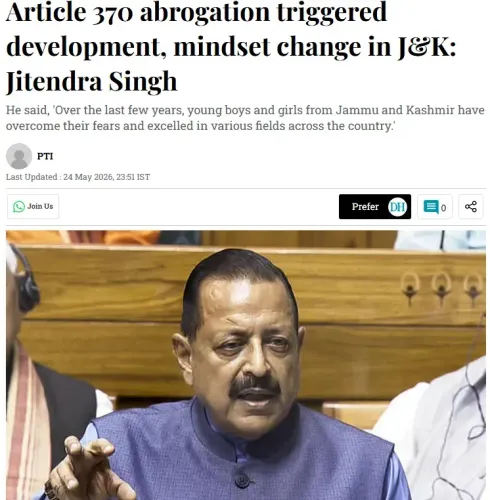
Union Science and Technology Minister Dr. Jitendra Singh on Sunday, 21 June 2026 highlighted what he described as a transformation in Jammu and Kashmir's social fabric since the abrogation of Article 370, pointing to rising educational aspirations, restored property rights for daughters, and the integration of long-settled communities as markers of a new era of equal citizenship.
Context
Posting under the hashtag #12YearsOfSeva, Dr. Singh said that children from small towns in Jammu and Kashmir are now topping examinations — a shift he attributed to a newly felt 'sense of belongingness.' He quoted residents as saying: 'Because of Article 370, they subconsciously considered themselves different, and the people from other parts of the country also saw them differently.' The remarks were accompanied by a video and form part of a broader series of posts marking what appears to be a political milestone.Policy Backdrop
In August 2019, the central government issued a presidential order and pushed through the Jammu and Kashmir Reorganisation Act, 2019, ending the region's special constitutional status and bifurcating it into two Union Territories — Jammu and Kashmir and Ladakh. The move extended scores of central laws to the region that had previously been excluded or modified under the earlier framework. Among the most consequential extensions was the application of the Hindu Succession (Amendment) Act, 2005, which granted daughters equal coparcenary rights in ancestral property — rights that had been denied to women in J&K under the earlier constitutional arrangement. Dr. Singh's post directly referenced this: 'Daughters didn't have the right over their property.' Separately, central government orders post-2019 moved to confer voting rights and citizenship benefits on West Pakistan refugees — communities that had been settled in the region for decades but remained excluded from the state's electoral and property frameworks under the previous regime.Stakeholders and Impact
The groups most directly affected by the post-2019 legal changes include J&K students, particularly those from smaller towns and rural districts who now have access to the full range of centrally sponsored education and welfare schemes. Women in the Union Territory are among the most significant beneficiaries of the property-rights extension, which aligns J&K with the rest of India on succession law. West Pakistan refugees — estimated to number in the lakhs — gained the right to vote in local and national elections for the first time following the reorganisation. Dr. Singh's framing emphasises psychological integration alongside legal change: 'Now, they feel that they too are equal citizens of India.' This narrative connects legal parity with a shift in social identity, a theme the central government has consistently advanced since 2019.What's Next
The Jammu and Kashmir Legislative Assembly, reconstituted after elections held in 2024, will be a key arena for testing whether the integration narrative translates into durable political participation and governance outcomes. Board examination results and higher-education enrolment data from the Union Territory over the coming academic cycles will provide measurable indicators of the educational surge Dr. Singh described. The central government's ability to sustain investment in schools, welfare infrastructure, and legal implementation in J&K will determine whether the gains highlighted in this post become entrenched or remain contested.Point of View
Voting rights, educational access — to an emotional narrative of national integration, timed to a milestone hashtag. The framing is consistent with the ruling dispensation's long-standing effort to present the August 2019 constitutional changes as irreversible and broadly beneficial, particularly ahead of continued administrative consolidation in J&K. By foregrounding daughters' property rights and refugee enfranchisement, the post seeks to broaden the perceived base of beneficiaries beyond any single community. The unverified nature of specific exam-topper claims, however, means the post functions more as political signalling than as a data-driven policy report.
NationPress
21 Jun 2026
Frequently Asked Questions
What rights did daughters in Jammu and Kashmir gain after Article 370 was removed?
After the abrogation of Article 370 in August 2019 , the Hindu Succession (Amendment) Act, 2005 was extended to Jammu and Kashmir , granting daughters equal coparcenary rights in ancestral property — a right they had previously been denied under the region's separate legal framework.
Did West Pakistan refugees get voting rights in J&K after 2019?
Yes. Following the reorganisation of Jammu and Kashmir in 2019 , central government orders moved to confer voting rights and citizenship benefits on long-settled West Pakistan refugees who had been excluded from the state's electoral rolls under the earlier constitutional arrangement.
What is the Jammu and Kashmir Reorganisation Act 2019?
The Jammu and Kashmir Reorganisation Act, 2019 is a parliamentary law that ended J&K 's special status, bifurcated it into the Union Territories of Jammu and Kashmir and Ladakh , and extended scores of central Indian statutes — including those on property rights and citizenship — to the region.
What does #12YearsOfSeva mean in Jitendra Singh's post?
The hashtag #12YearsOfSeva ('12 years of service') appears to mark a political milestone for Dr. Jitendra Singh or the BJP -led government, used to frame a series of posts highlighting governance achievements, including changes in Jammu and Kashmir since 2014 .
Has education improved in Jammu and Kashmir after Article 370 abrogation?
Dr. Jitendra Singh has claimed that children from small towns in J&K are now topping examinations, attributing this to greater integration and access to central schemes. However, specific exam-topper statistics and precise enrolment data for the post-2019 period require verification from official board results and government reports.