Dr. Jitendra Singh Backs India's Vikram Mission
Synopsis
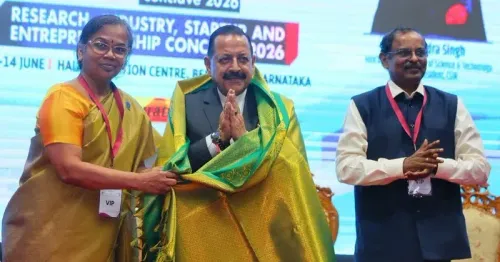
Union Science and Technology Minister Dr. Jitendra Singh rallied behind India's lunar programme on 18 July 2026 with the hashtag #IndiaWithVikram1, reaffirming political support for ISRO's Vikram lander legacy following Chandrayaan-3's historic 2023 Moon landing.
Key Takeaways
Jitendra Singh , Union Minister of State (Independent Charge) for Science and Technology, posted #IndiaWithVikram1 on 18 July 2026 .
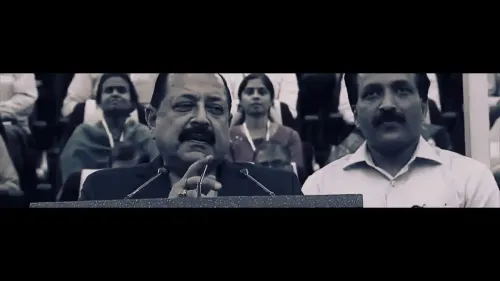
The post included a video and signals continued ministerial backing for India's lunar exploration programme.
Chandrayaan-3 achieved India's first successful soft landing near the lunar south pole on 23 August 2023 .
India became the fourth nation in the world to soft-land on the Moon and the first to do so at the south pole.
The Science and Technology Ministry oversees ISRO 's mission approvals, funding, and international cooperation frameworks.
India's lunar roadmap spans from Chandrayaan-1 (2008) through Chandrayaan-2 (2019) to Chandrayaan-3 (2023), reflecting sustained indigenous capability building.
Union Science and Technology Minister Dr. Jitendra Singh on Saturday, 18 July 2026, expressed solidarity with India's ongoing lunar efforts by posting the hashtag #IndiaWithVikram1 on X, signalling continued ministerial support for the country's space exploration programme anchored by the Vikram lander legacy.
Context
The hashtag #IndiaWithVikram1 is a public rallying call around the Vikram lander — the spacecraft that made history on 23 August 2023 when Chandrayaan-3 achieved India's first successful soft landing near the lunar south pole. The minister's post, accompanied by a video, appears to reinforce national pride and institutional backing for India's lunar programme at a moment when the next phase of exploration is being watched closely. Dr. Jitendra Singh, as the minister holding independent charge of the Ministry of Science and Technology and Ministry of Earth Sciences, is the political custodian of ISRO's mission approvals and funding pipeline.
Policy Backdrop
India's lunar roadmap stretches back to Chandrayaan-1 in 2008, which confirmed the presence of water molecules on the Moon. Chandrayaan-2 in 2019 achieved partial success — its orbiter remains operational — but the Vikram lander of that mission did not survive touchdown. Chandrayaan-3 corrected that, delivering a flawless landing and deploying the Pragyan rover, cementing India's place as the fourth nation to soft-land on the Moon and the first to do so near the south pole. The Science and Technology Ministry coordinates with ISRO on mission design, international data-sharing frameworks, and budget allocations that flow through Parliament.
Stakeholders and Impact
ISRO scientists and engineers who built the Vikram lander are the primary community this expression of solidarity addresses. Space research institutions, academic bodies, and the broader Indian scientific community have consistently drawn motivation from political-level acknowledgement of their work. For the general public, ministerial posts of this nature serve as a signal that the government remains committed to space self-reliance — a theme that has defined India's indigenous space strategy across successive administrations. International partners and agencies tracking India's lunar ambitions also read such signals as indicators of sustained political will.
What's Next
Parliamentary updates on funding for the next lunar mission and any new memoranda of understanding with foreign space agencies will be key milestones to watch. As India's space programme expands — with missions targeting deeper lunar exploration and beyond — the Science and Technology Ministry's continued public engagement underscores that space remains a national-priority domain. The minister's post may also presage formal announcements or events tied to the Chandrayaan legacy in the weeks ahead.
Point of View
But for India's space establishment it carries real political weight — ministerial visibility keeps ISRO's budget and mission timelines in the public eye and signals to Parliament that space spending enjoys executive endorsement. The timing in mid-2026, well after Chandrayaan-3's 2023 triumph, suggests the government is either building narrative momentum ahead of a new mission announcement or marking an institutional milestone tied to the Vikram programme. Dr. Jitendra Singh has consistently used social media to amplify science ministry achievements, making this post part of a deliberate communication strategy that links national prestige to indigenous space capability. The broader arc points to India positioning its lunar programme as a soft-power asset alongside its growing role in commercial launch services.
NationPress
18 Jul 2026
Frequently Asked Questions
What is #IndiaWithVikram1?
#IndiaWithVikram1 is a hashtag used to express public and institutional solidarity with India's Vikram lander, the spacecraft that achieved the country's first successful soft landing on the Moon as part of the Chandrayaan-3 mission in August 2023.
Who is Dr. Jitendra Singh?
Dr. Jitendra Singh is the Union Minister of State (Independent Charge) for Science and Technology and Earth Sciences, and also a Minister of State in the Prime Minister's Office. He is the political head overseeing ISRO's mission approvals and India's broader science and technology policy.
What did the Vikram lander achieve?
The Vikram lander, part of the Chandrayaan-3 mission, made a successful soft landing near the lunar south pole on 23 August 2023, making India the fourth nation to soft-land on the Moon and the first to do so at the south pole.
What is India's Chandrayaan programme?
The Chandrayaan programme is India's series of lunar exploration missions conducted by ISRO. It began with Chandrayaan-1 in 2008, which confirmed water molecules on the Moon, followed by Chandrayaan-2 in 2019 and the landmark Chandrayaan-3 mission in 2023.
What comes after Chandrayaan-3 for India's space programme?
India is expected to pursue further lunar and deep-space missions, with parliamentary updates on funding and new international cooperation agreements with foreign space agencies being the key indicators of the programme's next steps.