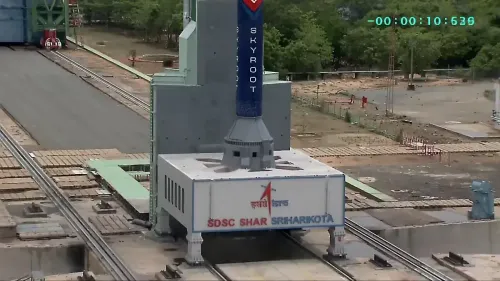
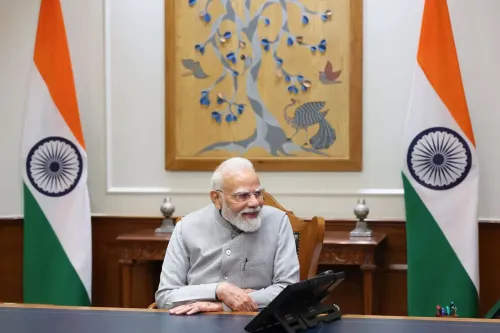
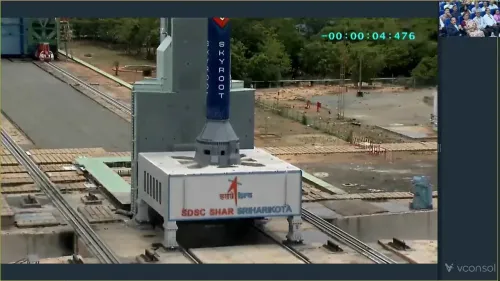
Dr. Jitendra Singh hails Vikram-1 as India's private space milestone
Synopsis
Union Science and Technology Minister Dr. Jitendra Singh amplified PM Modi's Mann Ki Baat praise for Vikram-1, India's first privately built rocket, calling it a historic moment driven by young innovators' skill, passion, and patience — a landmark for India's commercial space ambitions.
Key Takeaways
Vikram-1 is described as India's first rocket developed entirely by the private sector , marking a structural shift in the country's space programme.
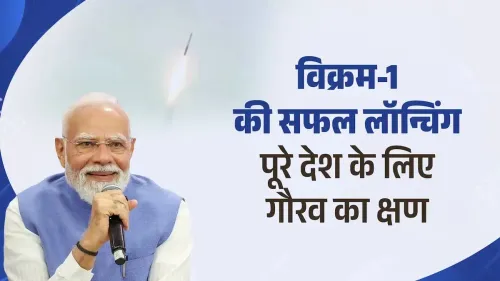
PM Narendra Modi highlighted the achievement in his monthly Mann Ki Baat address, crediting young Indian innovators.
Jitendra Singh amplified the remarks on 26 July 2026 , underscoring ministerial backing for private space enterprise.
The milestone is a direct outcome of the IN-SPACe regulatory framework established in 2020 to enable private participation in space activities.
The achievement aligns with the government's Atmanirbhar Bharat push to build domestic capability in strategic technology sectors.
Subsequent private launch missions and potential updates to the Indian Space Policy framework are the key developments to watch.
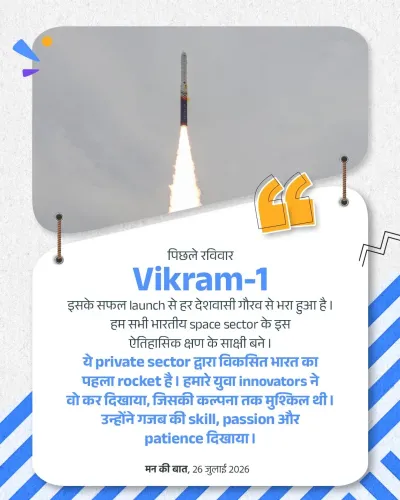
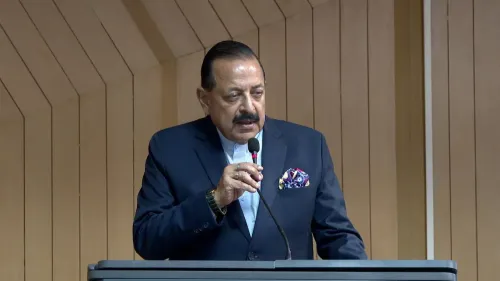
Union Science and Technology Minister Dr. Jitendra Singh on Sunday, 26 July 2026, shared remarks by Prime Minister Narendra Modi from Mann Ki Baat, celebrating the successful launch of Vikram-1 — described as India's first rocket developed entirely by the private sector — as a historic moment for the nation's space programme.
Context
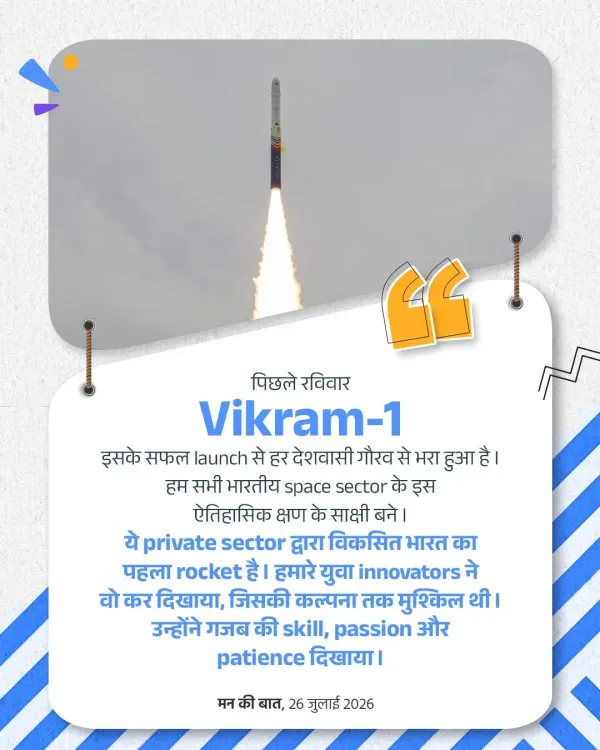
The post quotes PM Modi as saying: 'Pichle Ravivar Vikram-1 ke safal launch se har deshvasi gaurav se bhara hua hai' — 'Every citizen of the country is filled with pride following the successful launch of Vikram-1 last Sunday.' Modi credited the achievement to India's young innovators, noting they had demonstrated remarkable 'skill, passion and patience' to accomplish what was once considered unimaginable.
The remarks were made during Mann Ki Baat, the Prime Minister's monthly radio address, and were amplified by Dr. Jitendra Singh in his capacity as the minister overseeing India's science and technology portfolio.
Policy Backdrop
The Vikram-1 launch is the most visible outcome yet of India's deliberate push to open its space sector to private players. The government established IN-SPACe (Indian National Space Promotion and Authorisation Centre) in 2020 to provide a regulatory framework enabling non-government entities to design, build, and launch rockets and satellites.
This shift moved India away from a state-monopoly model anchored entirely in ISRO, aligning the sector with the broader Atmanirbhar Bharat — or 'self-reliant India' — agenda that has similarly reshaped defence manufacturing and semiconductor policy. The success of Vikram-1 represents a concrete proof-of-concept for that regulatory architecture.
Stakeholders and Impact
The primary beneficiaries of this milestone are India's private space startups and the ecosystem of young engineers and entrepreneurs who have invested years in building indigenous launch capability. A successful private orbital or sub-orbital mission signals to domestic and international investors that India's commercial space sector is operationally credible.
For ISRO, the development is complementary rather than competitive — the space agency has been repositioned as a facilitator and anchor customer, freeing it to focus on deep-space and strategic missions while private players address commercial launch demand. The Vikram-1 milestone could also attract foreign satellite operators looking for cost-competitive Indian launch services.
What's Next
Attention will now turn to whether the Vikram-1 launch catalyses further private launch attempts and accelerates updates to the Indian Space Policy framework. Policymakers are expected to assess whether IN-SPACe's regulatory architecture requires refinement to support a growing pipeline of private missions.
Dr. Jitendra Singh's public endorsement of the achievement signals continued ministerial support for private sector participation in space — a policy posture that is likely to shape budget allocations and regulatory priorities in the months ahead.
Point of View
Not merely a technical one. By tying the achievement to young innovators' grit, the messaging frames commercial space as an extension of the Atmanirbhar Bharat narrative — domestically resonant and electorally useful. Dr. Jitendra Singh's role as the amplifier is strategic: his ministry owns the IN-SPACe architecture, so the Vikram-1 success is institutional validation for his portfolio. The broader arc suggests India is consciously building a 'new space' identity to compete with commercial launch markets dominated by private players in the United States and Europe.
NationPress
26 Jul 2026
Frequently Asked Questions
What is Vikram-1 and why is it significant?
Vikram-1 is India's first rocket developed entirely by the private sector, representing a landmark shift from the state-led model anchored in ISRO toward a commercially driven space ecosystem enabled by the IN-SPACe regulatory framework.
What did PM Modi say about Vikram-1 in Mann Ki Baat?
PM Narendra Modi said every Indian citizen is filled with pride following Vikram-1's successful launch, and praised the young innovators behind it for showing exceptional skill, passion, and patience to achieve what was once considered unimaginable.
What is IN-SPACe and what role did it play?
IN-SPACe, or the Indian National Space Promotion and Authorisation Centre, was established in 2020 to provide a regulatory framework allowing private companies to design, build, and launch rockets and satellites — the policy foundation that made Vikram-1 possible.
Who is Dr. Jitendra Singh and why did he share this post?
Dr. Jitendra Singh is the Union Minister of State (Independent Charge) for Science and Technology and Earth Sciences. He shared PM Modi's Mann Ki Baat remarks on Vikram-1 in his capacity as the minister overseeing India's space and technology policy portfolio.
What does Vikram-1's launch mean for India's commercial space sector?
A successful private rocket launch signals operational credibility to domestic and international investors, positions India as a cost-competitive launch destination, and is expected to spur further private missions and potential updates to the Indian Space Policy framework.