Dr. Jitendra Singh Launches Commercial PLA Biodegradable Plastic
Synopsis
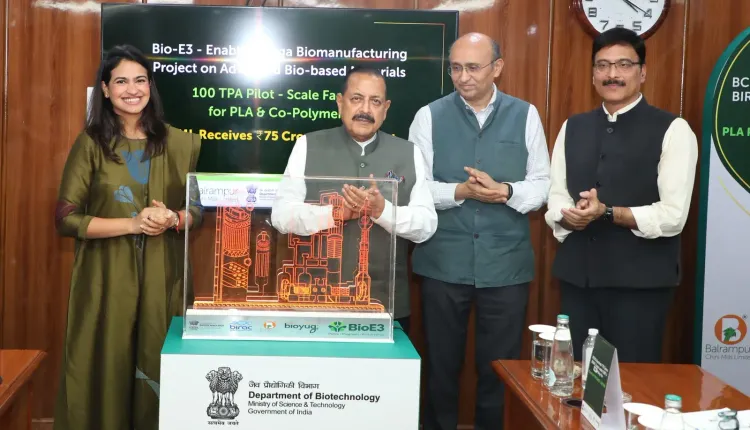
Union Minister Dr. Jitendra Singh formally launches commercial PLA biodegradable plastic on September 24, 2026, marking a milestone in India's BioE3-driven bioeconomy — which has grown from $10 billion in 2014 to nearly $195 billion — and positioning India as a potential global exporter of sustainable bio-material solutions.
Key Takeaways
Jitendra Singh formally launched the commercial use of Polylactic Acid (PLA) bio-based biodegradable plastic on September 24, 2026 .
The launch marks a transition from laboratory research to industrial-scale production of an indigenously developed bio-material.
India's bioeconomy has grown from approximately US$10 billion in 2014 to nearly US$195 billion , driven by biotechnology-led activity.
The BioE3 policy , launched by Prime Minister Narendra Modi , is the governing framework accelerating this biotech-to-commerce pipeline.
The initiative is positioned to support employment generation and reduce dependence on conventional single-use plastics.
India aims to develop globally exportable solutions in bioeconomy and biodegradable materials, leveraging its experience with biological resources and biomass conversion.
India's single-use plastic problem may have just met its most credible challenger yet. Union Science and Technology Minister Dr. Jitendra Singh on Thursday, September 24, 2026, formally launched the commercial use of bio-based biodegradable plastic developed from Polylactic Acid (PLA) — a milestone he described as an important step in the country's transition towards next-generation sustainable manufacturing.
From lab to factory floor: what PLA biodegradable plastic means
PLA plastic is derived from biological feedstocks — typically plant-based sugars — and breaks down far more readily in the environment than conventional petroleum-based plastics. The commercial launch signals that an indigenously developed bio-material has cleared the critical threshold from laboratory research to industrial-scale production. Dr. Singh told collaborating partners: 'In today's world, there is no such thing as waste; materials described as waste often contain significant underlying value that can be unlocked through technology.'
He argued that India's deep experience with biological resources, recycling and biomass conversion gives the country a structural edge — not merely to solve a domestic problem, but to export solutions. 'The project demonstrates how indigenous scientific capabilities can be connected with industrial production to create high-value materials while addressing environmental concerns,' he said, adding that the initiative could contribute to India's emergence as 'a global leader in bioeconomy and as a source of practical solutions for other countries.'
A bioeconomy that grew from $10 billion to $195 billion
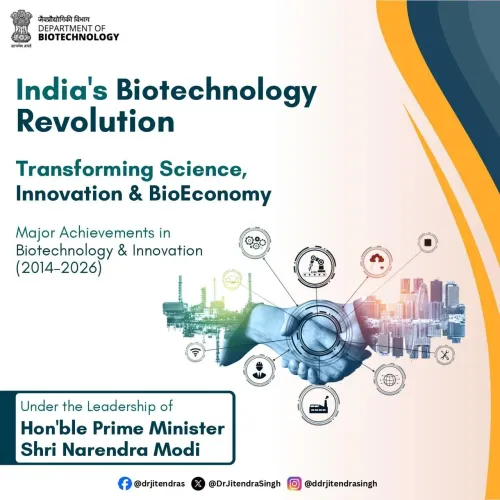
The numbers the Minister cited are staggering. India's bioeconomy, he noted, stood at around US$10 billion in 2014 and has since grown to nearly US$195 billion — a near-20-fold expansion in roughly a decade. That trajectory, he argued, reflects the rapid acceleration of biotechnology-led economic activity, and he attributed its momentum in particular to Prime Minister Narendra Modi's launch of the BioE3 policy.
BioE3 — short for Biotechnology for Economy, Environment and Employment — is the government's flagship framework for moving biotechnology applications out of research institutions and into commercial reality. The PLA launch is precisely the kind of outcome the policy was designed to produce: a domestically developed, scientifically grounded product that simultaneously addresses environmental goals and generates economic activity.
Why biodegradable plastic matters right now
India banned several categories of single-use plastics in 2022, creating both a regulatory push and a market vacuum that bio-based alternatives are positioned to fill. The PLA commercial launch arrives at a moment when the plastics industry is under sustained pressure — from domestic regulation, international scrutiny, and growing consumer demand for sustainable materials.
For the biotech sector, the signal is equally clear. 'Biotechnology is moving beyond laboratory research towards commercial products and employment generation,' Dr. Singh said — framing the PLA initiative not just as an environmental win, but as a jobs-and-industry story. The participation of collaborating industrial partners at Thursday's launch underscores that the private sector is already at the table.
India's bet: that turning biomass into high-value materials can become a scalable export not only of products, but of policy templates that other developing nations can adapt. If the PLA rollout holds, that bet just got its first proof of concept.
Point of View
Demonstrating that India's biotechnology policy is producing industrial outputs and not just research papers. The near-20-fold bioeconomy growth figure, if sustained by independent verification, would be a formidable data point in the government's narrative of science-driven economic transformation. Politically, Dr. Singh is simultaneously addressing a regulatory gap — India's single-use plastic ban created demand that domestic bio-alternatives now need to fill — and staking a global positioning claim. The 'solutions exporter' framing is a calculated elevation of India's biotech story from domestic policy to soft-power currency.
NationPress
24 Sept 2026
Frequently Asked Questions
What is PLA biodegradable plastic and why is India launching it commercially?
PLA, or Polylactic Acid, is a bio-based plastic derived from plant feedstocks that biodegrades more readily than conventional petroleum plastics. India launched it commercially on September 24, 2026 as part of its strategy to replace single-use plastics using indigenously developed biotechnology.
What is India's BioE3 policy?
BioE3 stands for Biotechnology for Economy, Environment and Employment. It is India's policy framework, launched by Prime Minister Narendra Modi, to accelerate the commercialisation of biotechnology applications across sectors including sustainable materials, agriculture and energy.
How much has India's bioeconomy grown?
According to Union Minister Dr. Jitendra Singh, India's bioeconomy grew from approximately US$10 billion in 2014 to nearly US$195 billion, reflecting rapid expansion of biotechnology-led economic activity over roughly a decade.
How does PLA plastic help India's single-use plastic ban?
India banned several categories of single-use plastics in 2022, creating both a regulatory requirement and a market gap. Commercially available PLA biodegradable plastic provides a domestically produced, bio-based alternative to fill that gap without relying on imported solutions.
Can India export its bio-based plastic solutions to other countries?
Dr. Jitendra Singh stated that India's experience with biological resources, recycling and biomass conversion positions the country to develop solutions with 'wider global relevance,' potentially making India a source of practical bioeconomy templates for other developing nations.