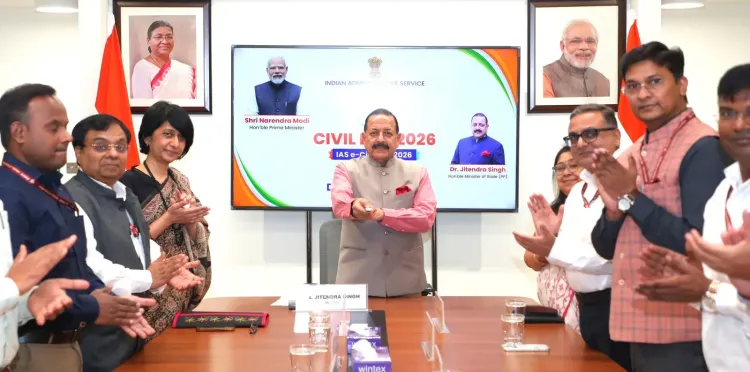
Dr. Jitendra Singh Launches IAS e-Civil List 2026
Synopsis
Union Minister Dr. Jitendra Singh launched the IAS e-Civil List 2026, the 71st edition of DoPT's annual IAS directory and its sixth as a PDF e-book. The searchable digital publication covers officer postings, qualifications, pay levels, and five-year retirement projections, supporting evidence-based cadre management under the Digital India mission.
Key Takeaways
Jitendra Singh launched the IAS e-Civil List 2026 on 22 June 2026 .
This is the 71st edition of the Civil List and the 6th edition released as a PDF e-book.
The list includes officer batch, cadre, posting, pay level, educational qualifications, and date of superannuation.
It provides five-year retirement projections and cadre-wise strength data to aid administrative planning.
Advanced search and hyperlinking features replace the need to scan voluminous printed volumes.
The initiative is aligned with the government's Digital India mission launched in 2015 .
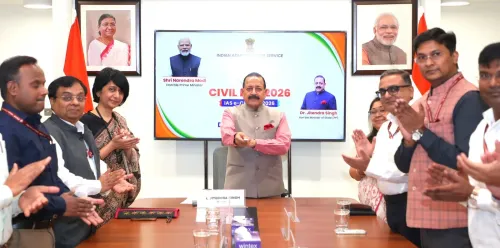
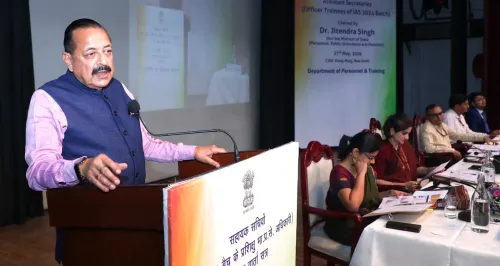
Union Minister of State (Independent Charge) for Science and Technology and Personnel Dr. Jitendra Singh on Monday, 22 June 2026 launched the IAS e-Civil List 2026, the 71st edition of the annual Civil List published by the Department of Personnel and Training (DoPT), marking the sixth consecutive year the directory has been released as a downloadable PDF e-book.
Context
The IAS e-Civil List 2026 consolidates comprehensive details on every serving Indian Administrative Service (IAS) officer, covering batch, cadre, present posting, pay level, educational qualifications, and date of superannuation. The edition also includes cadre-wise strength figures, the number of officers retiring over the next five years, and statistics on officers appointed through the UPSC Civil Services Examination.
Announcing the launch, Dr. Jitendra Singh described the e-Civil List as 'a brilliant option for technology-driven talent mapping of IAS officers from across the country that is expected to strengthen governance and administrative planning.' He added that it 'serves as a vital governance tool for identifying expertise, improving cadre management and supporting evidence-based decision making.'
Policy Backdrop
DoPT has published the IAS Civil List without interruption since Independence, making the 2026 release the 71st edition in an unbroken series. The shift to a PDF e-book format — now in its sixth year — is positioned as a direct extension of the Digital India mission launched in July 2015, which set out to digitise government records, directories, and citizen-facing services.
Dr. Jitendra Singh underlined that 'moving away from the traditional practice of printing voluminous physical copies of the Civil List, this initiative is aligned with the Government's Digital India mission,' adding that 'digitalisation of the Civil List improves accessibility, transparency and administrative efficiency.' The e-book format is equipped with advanced search facilities and hyperlinking features, enabling users to retrieve officer-specific information with a single click rather than manually scanning printed volumes.
Stakeholders and Impact
The primary users of the Civil List are central and state government departments, cadre-controlling authorities, and IAS officers themselves, who rely on it for postings, seniority verification, and cadre-strength planning. Digital access removes geographic and logistical barriers that previously slowed the distribution of printed copies to state capitals and district headquarters across India.
The inclusion of five-year retirement projections is particularly significant for administrative planning, allowing ministries and state governments to anticipate vacancies and initiate succession or recruitment processes in advance. Easy access to officers' qualifications and experience data also supports more informed deputation and lateral-assignment decisions across the federal structure.
What's Next
Attention will now turn to whether the e-Civil List is integrated with DoPT's e-HRMS (Electronic Human Resource Management System) or other digital dashboards to create a live, continuously updated personnel record — a step that would take the initiative beyond an annual snapshot. The 2027 edition will be watched to see whether additional data fields or real-time search capabilities are introduced.
Broader administrative reform discussions in Parliament and in government committees on digitisation of other All India Service lists — the Indian Police Service and Indian Forest Service — may also gain momentum following this launch, as the e-Civil List model demonstrates a replicable template for modernising government personnel directories.
Point of View
DoPT is nudging cadre management from reactive to anticipatory — a shift that reform committees have recommended for years. For Dr. Jitendra Singh, who oversees both the science portfolio and the Personnel ministry, the release reinforces a consistent messaging thread: that technology adoption within government machinery is as important as technology promotion to the public. The real test will be whether this annual PDF evolves into a live, API-accessible system integrated with e-HRMS, or remains a digital replica of a paper directory.
NationPress
22 Jun 2026
Frequently Asked Questions
What is the IAS e-Civil List 2026?
The IAS e-Civil List 2026 is the 71st edition of the annual directory of Indian Administrative Service officers published by the Department of Personnel and Training (DoPT). It is the sixth edition released as a downloadable PDF e-book, containing details on each officer's batch, cadre, posting, pay level, qualifications, and superannuation date.
Who launched the IAS e-Civil List 2026?
Union Minister of State (Independent Charge) for Science and Technology and Personnel Dr. Jitendra Singh launched the IAS e-Civil List 2026 on 22 June 2026.
How is the e-Civil List different from the printed Civil List?
Unlike the traditional printed volumes, the e-Civil List is a PDF e-book equipped with advanced search facilities and hyperlinking features, allowing users to retrieve officer information instantly. It eliminates the cost and logistical burden of printing and distributing large physical directories.
What information does the IAS Civil List contain?
The list contains comprehensive details on IAS officers including their batch, cadre, present posting, pay level, educational qualifications, and date of superannuation. It also includes cadre-wise strength, five-year retirement projections, and data on officers appointed through the UPSC Civil Services Examination.
How does the e-Civil List support Digital India?
By replacing printed directories with a searchable digital document, the e-Civil List aligns with the Digital India mission launched in 2015, improving accessibility, transparency, and administrative efficiency in government personnel management.