Dr. Jitendra Singh: Mission Karmayogi crosses 2 crore mark

Synopsis
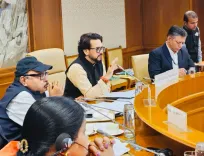
Union Minister Dr. Jitendra Singh on November 12, 2026 announced that Mission Karmayogi — India's civil-service capacity-building programme launched in 2020 — has enrolled 2 crore government officials, marking a landmark moment in PM Modi's push to shift the bureaucracy from rule-based to role-based governance.
Key Takeaways
Mission Karmayogi has reached 2 crore enrolled civil servants, a milestone celebrated by Union Minister Dr.
Jitendra Singh on November 12, 2026 .
The programme — formally the National Programme for Civil Services Capacity Building (NPCSCB) — was approved by the Union Cabinet in September 2020 .
Its core philosophy is a shift 'from rule to role': competency-based, role-mapped training replacing procedural compliance.
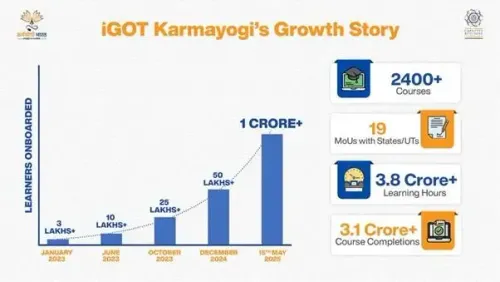
Training is delivered digitally through the iGOT (Integrated Government Online Training) platform across ministries and departments.
Singh credited PM Narendra Modi's insistence on regular, domain-specific capacity building as the founding inspiration for the mission.
Progress on iGOT enrolments and outcomes is expected to be reviewed in upcoming parliamentary sessions.
Two crore civil servants enrolled, trained, and counted — Union Science and Technology Minister Dr. Jitendra Singh on Thursday, November 12, 2026, hailed the milestone as a landmark moment for India's bureaucratic transformation under Mission Karmayogi.
From 2020 vision to 2 crore Karmayogis
Mission Karmayogi — formally the National Programme for Civil Services Capacity Building (NPCSCB) — was approved by the Union Cabinet in September 2020 with a single, ambitious brief: shift India's vast civil services apparatus away from procedural rule-following toward outcome-driven, role-based governance. The idea, as Dr. Singh put it, 'was inspired by PM Sh Narendra Modi's insistence on regular capacity building in all domains, with a focus on shift from rule to role.' Six years on, the numbers have crossed a threshold the architects of the programme set as a proof-of-concept for scale.
What the 'rule to role' shift actually means for the bureaucracy
The philosophical pivot embedded in Mission Karmayogi is more consequential than a training-hours count suggests. Traditional civil-service development rewarded compliance with procedure; the Mission's design rewards demonstrated competency in specific roles — district collector, revenue officer, health administrator — using digital learning modules deployed through the iGOT (Integrated Government Online Training) platform. Each Karmayogi's learning path is mapped to their actual functional responsibility, not a generic syllabus. That design choice is what makes the 2 crore figure meaningful: it represents targeted, role-mapped capacity building, not a passive e-learning headcount.
Administrative reform as a long-term government project
Mission Karmayogi sits within a broader, multi-year push by the central government to modernise public administration — a project that spans PM Modi's emphasis on minimum government, maximum governance, digital public infrastructure, and performance-linked outcomes. The programme draws civil servants from across ministries and departments, making it one of the largest structured public-sector learning initiatives in the world by enrolment. Progress on iGOT enrolments and outcome assessments is expected to feature in upcoming parliamentary sessions as the government frames the next phase of administrative reform.
Two crore trained. The question the next phase must answer is not how many enrolled — but how many governing differently.
Point of View
Scalable number to anchor its long-running 'governance reform' narrative heading into future electoral cycles. Mission Karmayogi's design, which ties training to functional roles rather than generic modules, represents a structural departure from earlier civil-service development models, and the iGOT platform's growth signals serious digital-public-infrastructure ambition. The real test, however, lies in outcome data: whether role-mapped training translates to measurable improvements in service delivery at the district level. If the government can demonstrate that link in parliamentary disclosures, Mission Karmayogi becomes a replicable model for public-sector reform well beyond India.
NationPress
12 Nov 2026
Frequently Asked Questions
What is Mission Karmayogi?
Mission Karmayogi is India's National Programme for Civil Services Capacity Building (NPCSCB) , approved by the Union Cabinet in September 2020 . It provides competency-based, role-mapped training to government officials across ministries through the digital iGOT platform , with the goal of shifting the bureaucracy from rule-based to role-based governance.
How many people have enrolled in Mission Karmayogi?
Union Minister Dr. Jitendra Singh announced on November 12, 2026 that 2 crore civil servants have been enrolled as Karmayogis, marking a landmark milestone for the programme.
What is the iGOT platform?
iGOT — Integrated Government Online Training — is the digital learning platform through which Mission Karmayogi delivers role-specific training modules to civil servants across India's central and state government departments.
Who launched Mission Karmayogi and what was the idea behind it?
The Union Cabinet under PM Narendra Modi approved Mission Karmayogi in September 2020 . The core idea, as Dr. Jitendra Singh has stated, was PM Modi's insistence on shifting governance from procedural rule-following to outcome-oriented, role-based performance across all domains of public administration.
What does 'shift from rule to role' mean in Mission Karmayogi?
The phrase refers to a philosophical redesign of civil-service training: rather than rewarding compliance with standard procedures, the programme trains officials in competencies specific to their actual job roles — such as district administration, health delivery, or revenue management — making governance more outcome-focused and less procedurally rigid.