Anurag Thakur Chairs Panel Review of India's Gold Mining Future
Synopsis
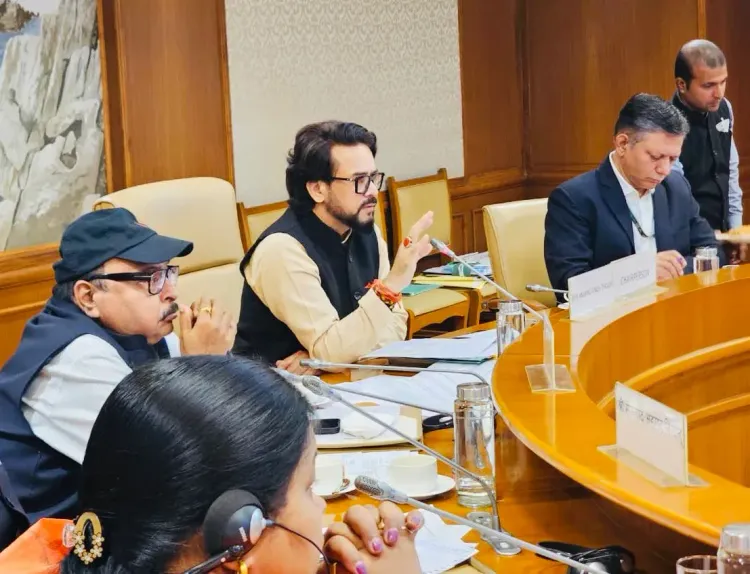
BJP MP Anurag Thakur chaired a Standing Committee sitting on Bharat Gold Mines Limited and India's gold-mining assets, pressing for private-sector acceleration, modern exploration tools and tailing-dump recovery to cut India's dependence on gold imports.
Key Takeaways
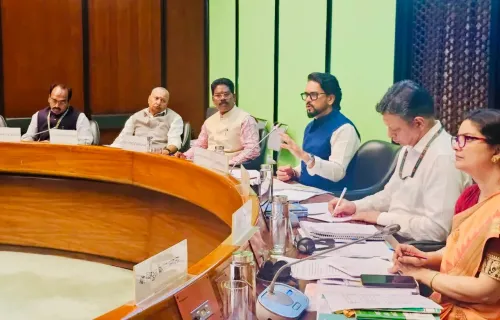
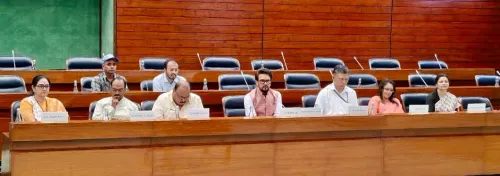
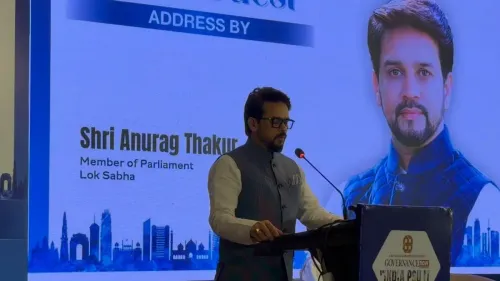
BJP MP Anurag Thakur chaired the Standing Committee on Coal, Mines and Steel on 12 November 2026 , focusing on BGML and domestic gold assets.
India holds over 650 tonnes of gold in primary ore resources but only a small fraction is classified as mineable reserves.
The Ministry of Mines presented AI/ML targeting, drone surveys and aero-geophysical mapping as tools to convert resources into viable reserves.
Since 2015, 27 gold blocks have been auctioned across eight states ; 16 are currently active .
The committee urged greater private participation in gold mining to reduce India's large gold import bill.
BGML's legacy tailing dumps were highlighted as a recoverable source of both gold and strategic minerals using modern technology.
India sits atop over 650 tonnes of gold metal in primary ore resources — yet mines only a sliver of it, writing cheques to foreign suppliers for the rest. BJP MP Anurag Thakur convened the Standing Committee on Coal, Mines and Steel on Thursday, 12 November 2026, to ask a pointed question: why is the country still importing what it already has underground?
BGML's legacy assets and the tailing-dump opportunity
Bharat Gold Mines Limited (BGML), once India's flagship public-sector gold producer, sits at the centre of the committee's scrutiny. The Ministry of Mines briefed members on the reserves still held at BGML's legacy sites — and on something less obvious: the strategic minerals locked inside decades-old tailing dumps. Modern recovery technology, the Ministry told the committee, can now extract gold and critical minerals from waste that an earlier generation simply walked away from.
That framing matters. Tailing dumps are not idle real estate — they are unmined capital. Converting them requires neither new land acquisition nor fresh environmental clearances for virgin territory, lowering two of the biggest friction points in Indian mining.
AI targeting, drone surveys, and the resource-to-reserve gap
The Ministry laid out a toolkit that reads like a technology briefing: AI/ML-based geological targeting, drone surveys, and aero-geophysical mapping. The goal is specific — to close the yawning gap between India's gold 'resources' (what is geologically known to exist) and its 'reserves' (what is economically viable to mine under current conditions). That gap is where most of India's gold effectively disappears on paper.
The distinction is not semantic. A resource becomes a reserve only when exploration data is tight enough and economics are favourable enough to justify a mining plan. Advanced targeting tools compress both the time and the capital needed to clear that bar.
27 blocks auctioned, 16 active — and the private-sector push
Since the Mines and Minerals (Development and Regulation) Amendment Act of 2015 opened mineral blocks to competitive auction, 27 gold blocks across eight states have gone under the hammer. Of those, 16 are currently active. The committee's message to the government was direct: accelerate private participation to push that number higher and chip away at India's dependence on imported gold.
Thakur anchored the session explicitly in Prime Minister Narendra Modi's Aatmanirbhar Bharat framework — the self-reliance doctrine launched in 2020 that elevated critical-mineral security to a national priority. Gold, in this reading, is not just a jewellery commodity; it is a strategic asset whose domestic production directly shrinks a structurally large import bill.
What the committee wants the Ministry to deliver
The committee's stress on private-sector acceleration signals a likely follow-up: more gold-block auctions and possibly regulatory tweaks to make mining licences faster to convert from exploration to production. The Ministry of Mines, tagged in Thakur's post, now has a parliamentary committee formally on record expecting results.
India's gold import bill runs into tens of billions of dollars annually. Even a modest uplift in domestic output — particularly from BGML's sitting reserves and the tailing dumps — would move that needle. The committee has set the question; the Ministry now owns the answer.
Point of View
The committee is essentially telling the executive that the low-hanging fruit has not been picked. The push for expanded private-sector auctions also continues the post-2015 trajectory of reducing state dominance in mineral allocation, a structural shift that has bipartisan legislative backing. The real test will be whether the Ministry of Mines follows up with faster block operationalisation and streamlined clearances — without which even the best geological data stays inert.
NationPress
12 Nov 2026
Frequently Asked Questions
What is Bharat Gold Mines Limited (BGML)?
BGML is a former public-sector gold mining company in India whose reserves, tailing dumps and future utilisation are currently under parliamentary review for modernisation and enhanced recovery.
How much gold does India have in its domestic reserves?
According to the Ministry of Mines briefing cited by the committee, India holds over 650 tonnes of gold metal in primary ore resources, though only a small share is currently classified as economically mineable reserves.
How many gold blocks has India auctioned since 2015?
Since the Mines and Minerals Amendment Act of 2015, India has auctioned 27 gold blocks across eight states, of which 16 are currently active.
What technology is India using to explore gold deposits?
The Ministry of Mines has highlighted AI/ML-based geological targeting, drone surveys and aero-geophysical mapping as advanced tools to convert known gold resources into economically viable, mineable reserves.
What is the Aatmanirbhar Bharat connection to gold mining?
The Aatmanirbhar Bharat initiative, launched in 2020 by PM Narendra Modi, prioritises domestic production of critical minerals including gold to reduce India's heavy dependence on gold imports and strengthen strategic resource security.