Dr. Jitendra Singh writes on bureaucratic reforms in Outlook Independence Day issue
Synopsis
Union Minister Dr. Jitendra Singh has authored a column in Outlook's Independence Day special issue arguing that bureaucratic reforms since 2014 — from scrapping Group B and C interview rounds to launching Mission Karmayogi — have structurally changed how India's government functions.
Key Takeaways
Jitendra Singh published a column on bureaucratic reforms in Outlook 's Independence Day special issue on 14 August 2026 .
The government scrapped interviews for Group B and C central government posts in 2014 to reduce bias and promote transparency in recruitment.
Mission Karmayogi , launched in September 2020 , is the government's flagship programme to modernise civil servant training and shift focus to outcome-oriented performance.
The Department of Personnel and Training , under Dr.
Singh's charge, is the institutional driver of these civil services reforms.
Broader digitisation through Digital India and Aadhaar-linked service delivery has underpinned the administrative reform push.
Analysts note reforms have focused on internal efficiency rather than structural overhaul of the All India Services .
On the eve of Independence Day, Union Minister of State Dr. Jitendra Singh — who holds independent charge of Science and Technology and Earth Sciences and also serves in the Prime Minister's Office — stepped beyond the ceremonial to make an argument: that the bureaucratic reforms pursued since 2014 have fundamentally altered how the Indian state operates, not just at the margins but in its daily mechanics.
The minister shared his column, published in the Independence Day special issue of Outlook magazine, titled 'Bureaucratic Reforms Undertaken By The Government Have Changed The Way India Functions'. The piece, appearing in one of India's most-read annual policy forums, places the government's administrative overhaul on record at a symbolically charged moment — the country's Independence Day.
From interview rooms to algorithm: what the reforms actually changed
The reform story Dr. Singh anchors his argument in begins with a deliberate dismantling of subjectivity. In 2014, the government scrapped interviews for recruitment to Group B and C posts — a move that affected hundreds of thousands of aspirants and removed a layer of discretion that critics had long argued was prone to bias and patronage. The signal was clear: entry into the civil services, at least at these levels, would be merit-driven and paper-based.
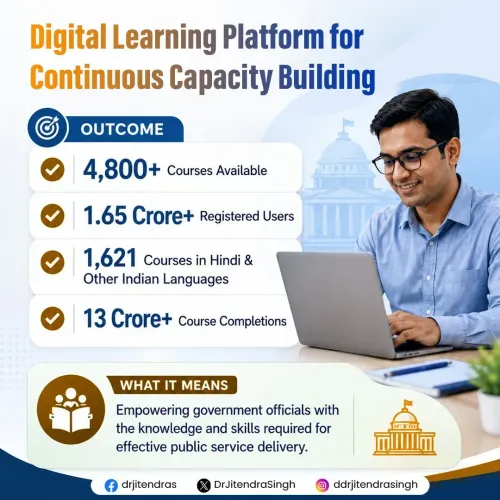
That logic of transparency was then extended inward — to how civil servants are trained and assessed once they are in. Mission Karmayogi, launched in September 2020 as the National Programme for Civil Services Capacity Building, represents the most ambitious attempt yet to modernise the bureaucracy from within. It shifts the emphasis from rule-following to role-competency, building an online learning ecosystem for government employees and tying capacity building to outcome-oriented performance frameworks.
Digitisation as the connective tissue
Underpinning both recruitment reform and training modernisation is a broader digitisation push — the Digital India programme and Aadhaar-linked service delivery — that has rewired how citizens interact with the state. Reduced procedural delays, fewer physical touchpoints, and grievance redressal systems that generate timestamped records have made the bureaucracy more legible, if not yet fully accountable, to the public it serves.
The Department of Personnel and Training, the nodal body under the Ministry of Personnel that Dr. Singh also oversees, has been the institutional engine behind these changes. Its mandate — civil services reform and capacity building — sits at the precise intersection of the administrative and the political, which is why a minister's bylined column on the subject carries weight beyond the ceremonial.
The argument India's administrative reformers must still answer is whether incremental efficiency gains inside existing structures can substitute for deeper structural change to the All India Services themselves. That debate, conspicuously absent from most ministerial columns, is precisely what makes the next Independence Day address — and the next Mission Karmayogi implementation report tabled in Parliament — worth watching.
Point of View
Often discussed in bureaucratic circles but rarely in public discourse, is being positioned as a flagship governance achievement. The harder question the government has yet to answer publicly is whether efficiency-layer reforms can substitute for structural overhaul of the All India Services — and whether the next Parliament session will bring any Mission Karmayogi implementation data to test the claim.
NationPress
14 Aug 2026
Frequently Asked Questions
What did Dr. Jitendra Singh write in Outlook magazine?
Dr. Jitendra Singh authored a column titled 'Bureaucratic Reforms Undertaken By The Government Have Changed The Way India Functions' in Outlook's Independence Day special issue, arguing that reforms since 2014 have structurally altered how the Indian government operates.
What is Mission Karmayogi?
Mission Karmayogi, launched in September 2020, is the National Programme for Civil Services Capacity Building. It modernises training and performance assessment for civil servants through an online learning ecosystem focused on role-competency rather than rule-following.
What was the 2014 interview reform for government jobs?
In 2014, the government scrapped interviews for recruitment to Group B and C central government posts to reduce subjectivity, promote transparency, and make entry-level civil service hiring purely merit and examination-based.
What ministry does Dr. Jitendra Singh head?
Dr. Jitendra Singh is Union Minister of State with Independent Charge of Science and Technology and Earth Sciences. He also serves as Minister of State in the Prime Minister's Office and holds the Personnel, Public Grievances and Pensions portfolio.
What is the Department of Personnel and Training's role in civil service reform?
The Department of Personnel and Training is the nodal body under the Ministry of Personnel responsible for civil services reforms and capacity building. It oversees recruitment policy, training frameworks, and implementation of programmes like Mission Karmayogi.