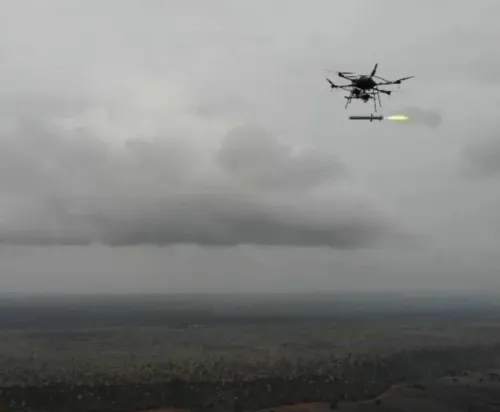
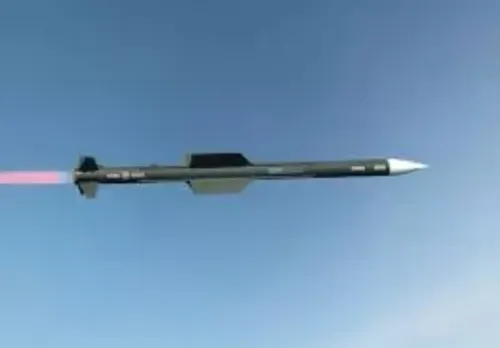
DRDO completes ULPGM-V3 missile trials from UAV in Air-to-Ground and Air-to-Air modes
Synopsis
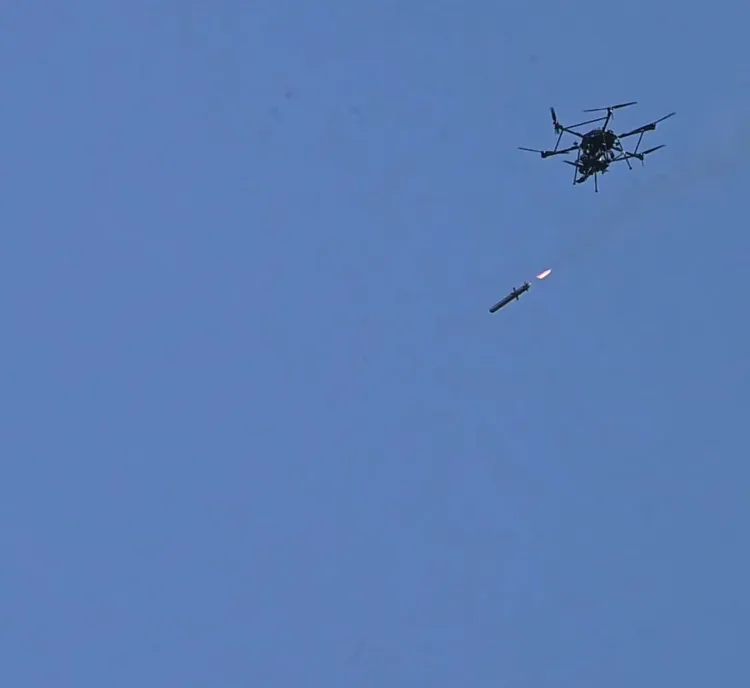
DRDO has cleared the final development hurdle for ULPGM-V3 — a UAV-launched precision missile tested against both ground armour and aerial targets. With a fully domestic supply chain and serial production readiness confirmed, India now has an indigenous guided munition for its drone fleet, arriving at a moment when UAV warfare is reshaping modern battlefields.
Key Takeaways
DRDO completed final development trials of ULPGM-V3 at the DRDO test range near Kurnool, Andhra Pradesh on 19 May .
The missile was tested in Air-to-Ground (anti-tank) and Air-to-Air (drone, helicopter) modes from a UAV platform.
Production partners include Bharat Dynamics Limited and Adani Defence Systems & Technologies Limited , both based in Hyderabad .
The nodal laboratory is Research Centre Imarat, Hyderabad , supported by DRDL, TBRL, and HEMRL.
Trials confirmed a fully mature domestic supply chain involving MSMEs, with the system ready for serial mass production .
Defence Minister Rajnath Singh called it a 'strategic milestone' for Aatmanirbharta in defence.
India's Defence Research and Development Organisation (DRDO) has successfully completed the final deliverable configuration development trials of the Unmanned Aerial Vehicle Launched Precision Guided Missile (ULPGM)-V3 in both Air-to-Ground and Air-to-Air modes at the DRDO test range near Kurnool, Andhra Pradesh. The Defence Ministry confirmed the milestone on Tuesday, 19 May, calling it a significant step toward self-reliance in defence manufacturing.
What the Trials Demonstrated
The ULPGM-V3 was tested in Air-to-Ground mode for anti-tank roles and in Air-to-Air mode for engaging drones, helicopters, and other airborne targets. The trials were conducted using an integrated Ground Control System (GCS) that commands and controls the entire ULPGM weapon system. The GCS incorporates state-of-the-art technologies to automate readiness checks and launch operations, according to the ministry statement.
Industry Partners Behind the System
DRDO partnered with two production agencies for the development and manufacture of the missiles: Bharat Dynamics Limited (BDL), Hyderabad, and Adani Defence Systems & Technologies Limited, Hyderabad. The missile system was integrated on UAVs developed by Newspace Research and Technologies, Bengaluru for the current trials.
The nodal laboratory for the ULPGM missile is Research Centre Imarat (RCI), Hyderabad, which coordinated with Defence Research & Development Laboratory (DRDL), Hyderabad; Terminal Ballistics Research Laboratory (TBRL), Chandigarh; and High Energy Materials Research Laboratory (HEMRL), Pune.
A Fully Domestic Supply Chain
The missile has been produced entirely within the Indian defence ecosystem, involving a large number of MSMEs and other domestic industries. The successful trials, according to the ministry, confirmed a fully mature domestic supply chain capable of immediate serial mass production — a critical benchmark for operationalising the system at scale.
Notably, this trial marks the culmination of the development phase, positioning ULPGM-V3 for induction into frontline UAV platforms.
Government Response
Defence Minister Rajnath Singh congratulated DRDO, public sector undertakings, defence-cum-production partners, and private industry on the achievement. He described the successful trials as a 'strategic milestone' toward 'Aatmanirbharta' — the government's self-reliance in defence initiative.
Dr Samir V. Kamat, Secretary of the Department of Defence R&D and Chairman of DRDO, also extended congratulations to all teams involved, calling it a commendable achievement.
What This Means for India's Defence Posture
The ULPGM-V3 fills a critical operational gap: a UAV-launched precision missile capable of both anti-armour and counter-drone roles. This comes amid heightened focus on drone warfare following its decisive role in recent global conflicts. India's push to develop indigenous UAV-launched munitions reduces dependence on imported guided weapons and strengthens the domestic defence industrial base. With serial production readiness confirmed, induction timelines are expected to be announced in the coming months.
Point of View
Which matters for resilience. The real question now is induction speed: confirmed production readiness and actual frontline deployment are two different milestones, and India's track record on bridging that gap is mixed. With drone warfare proving decisive in contemporary conflicts, the urgency of closing that gap cannot be overstated.
NationPress
2 Oct 2026
Frequently Asked Questions
What is the ULPGM-V3 missile developed by DRDO?
The ULPGM-V3, or Unmanned Aerial Vehicle Launched Precision Guided Missile Version 3, is an indigenously developed Indian missile designed to be fired from UAVs. It can engage ground targets such as tanks in Air-to-Ground mode and aerial targets including drones and helicopters in Air-to-Air mode.
Where were the ULPGM-V3 trials conducted?
The trials were conducted at the DRDO test range near Kurnool in Andhra Pradesh. The missile was integrated on UAVs developed by Newspace Research and Technologies, Bengaluru.
Which companies are involved in producing the ULPGM-V3?
Bharat Dynamics Limited (BDL) and Adani Defence Systems & Technologies Limited, both based in Hyderabad, are the two designated production agencies. A large number of MSMEs and other domestic industries are also part of the supply chain.
What is the significance of these trials for India's defence sector?
The trials confirm that the ULPGM-V3 has completed its development phase and that the domestic supply chain is mature enough for immediate serial mass production. This reduces India's dependence on imported guided munitions for its UAV fleet and advances the government's Aatmanirbharta defence initiative.
Which DRDO laboratories developed the ULPGM-V3?
Research Centre Imarat (RCI), Hyderabad, served as the nodal laboratory. It was supported by the Defence Research & Development Laboratory (DRDL) Hyderabad, Terminal Ballistics Research Laboratory (TBRL) Chandigarh, and High Energy Materials Research Laboratory (HEMRL) Pune.