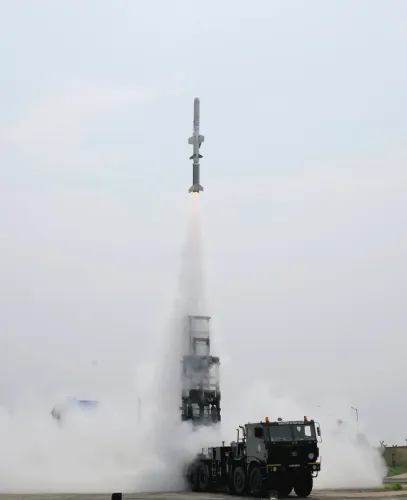
Rajnath Singh hails DRDO's multi-layer BMD, anti-ship missile tests
Synopsis
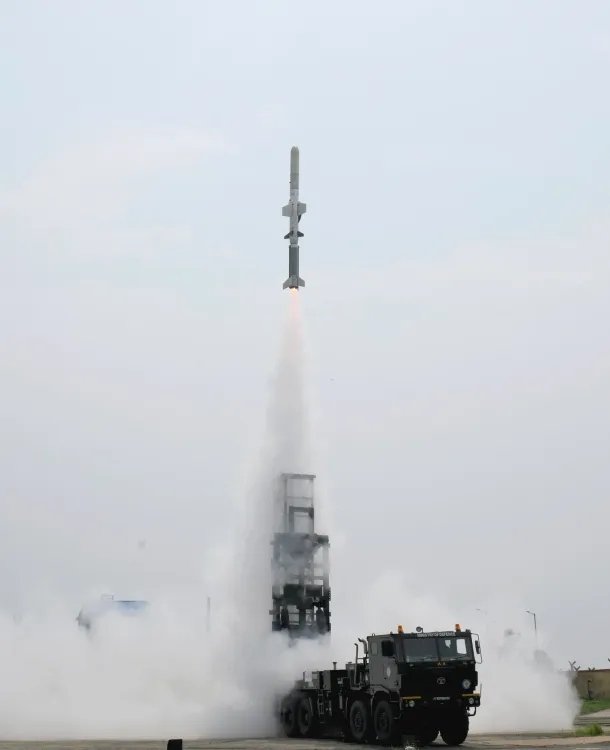
Defence Minister Rajnath Singh on 13 June 2026 hailed DRDO after three consecutive flight-tests demonstrated India's multi-layered Ballistic Missile Defence capability — including interception up to ICBM class — and the maiden flight of the Naval Anti-Ship Missile-Medium Range, placing India in a select global group.
Key Takeaways
Three consecutive flight-tests were successfully conducted by DRDO to demonstrate multi-layered BMD and anti-ship capabilities.
India has joined an elite group of nations with demonstrated ability to intercept ballistic missiles up to the ICBM class .
The Naval Anti-Ship Missile-Medium Range (NASM-MR) completed its maiden flight test , validating medium-range anti-ship strike capability.
All interceptors successfully engaged their respective targets during the tests.
The tests advance India's Atmanirbhar Bharat defence indigenisation agenda by reducing reliance on imported missile systems.
India's BMD programme has been under development since at least 2006 , when the first successful interceptor test was conducted.
Union Defence Minister Rajnath Singh on Saturday, 13 June 2026 congratulated DRDO after the agency successfully demonstrated multiple critical defence technologies, including a multi-layered Ballistic Missile Defence capability and the maiden flight test of the Naval Anti-Ship Missile-Medium Range (NASM-MR), placing India among an elite group of nations capable of intercepting threats up to the ICBM class.
Context
In a post on X, Rajnath Singh said three consecutive flight-tests were successfully conducted to demonstrate 'multi-layered defence against long range Ballistic Missiles and Anti-ship capability at medium range.' He noted that 'the interceptors successfully engaged their respective targets' and that the systems are 'designed and developed with latest technologies to address the emerging missile threats.' The Minister specifically highlighted that the tests have 'put India in elite group of nations having Ballistics Missile Defence Capabilities to engage Ballistic Missiles up to ICBMs.'
The announcement also marked the maiden flight test of the Naval Anti-Ship Missile-Medium Range, which demonstrated anti-ship strike capability at medium ranges for naval platforms — a significant first for the indigenous naval missile programme.
Policy Backdrop
India's Ballistic Missile Defence programme has been under development for over two decades. The first successful interceptor test was conducted in 2006 using the Prithvi Air Defence system. Subsequent integrated BMD trials in 2011 and 2017 validated a two-tier interception architecture covering both endo-atmospheric and exo-atmospheric altitudes.
The current tests build on that lineage and represent a continuation of DRDO's long-running missile development effort, which traces its origins to the Integrated Guided Missile Development Programme (IGMDP) of the 1980s. They also align with the government's Atmanirbhar Bharat push to reduce dependence on imported defence platforms and develop sovereign strike and interception capabilities.
Stakeholders and Impact
The primary beneficiaries of these demonstrations are the Indian Armed Forces, who would eventually induct the validated systems into service. A functional multi-layered BMD shield would provide the military with the ability to intercept ballistic threats across a range of altitudes and distances, strengthening India's strategic deterrence posture in a region with multiple missile-capable adversaries.
For DRDO scientists and engineers, the successful tests validate years of research investment. The maiden flight of the Naval Anti-Ship Missile-Medium Range is particularly significant for the Indian Navy, which has sought indigenous medium-range anti-ship weapons to equip its surface combatants and potentially other platforms.
What's Next
Following successful technology demonstrations, the focus typically shifts to user trials conducted by the respective services before formal induction. Integration of the BMD system with existing long-range tracking infrastructure, including the Swordfish radar network, will be a key technical milestone to watch. Defence budget allocations and parliamentary standing committee deliberations are expected to reflect the programme's progress in the months ahead.
The back-to-back nature of these three flight-tests signals an accelerating tempo in DRDO's missile validation calendar, suggesting that induction timelines for at least some of these systems could be firmed up in the near term.
Point of View
Even at the demonstration stage, carries significant strategic signalling value in South Asia's volatile security environment. For the BJP-led government, the timing reinforces a broader narrative of defence self-reliance that has been central to its political identity since the launch of Atmanirbhar Bharat. The back-to-back nature of three flight-tests in a single sequence, covering both strategic BMD and tactical naval strike, suggests DRDO is moving from isolated technology proofs to integrated, system-level validation — a maturation that brings induction timelines closer to reality. The maiden flight of the Naval Anti-Ship Missile-Medium Range is particularly noteworthy, as it addresses a long-standing gap in India's indigenous naval arsenal.
NationPress
13 Sept 2026
Frequently Asked Questions
What did DRDO test in June 2026?
DRDO successfully conducted three consecutive flight-tests in June 2026, demonstrating a multi-layered Ballistic Missile Defence capability capable of intercepting threats up to the ICBM class, and completing the maiden flight test of the Naval Anti-Ship Missile-Medium Range.
Can India now intercept ICBMs?
India has demonstrated the technology to engage ballistic missiles up to the ICBM class during these flight-tests, placing it in a select group of nations with such capability. Operational induction and further user trials would be required before the system enters active service.
What is the Naval Anti-Ship Missile-Medium Range (NASM-MR)?
The Naval Anti-Ship Missile-Medium Range is an indigenously developed DRDO missile designed to strike enemy ships at medium ranges. Its maiden flight test was successfully conducted as part of the June 2026 test series.
What is India's Ballistic Missile Defence programme?
India's Ballistic Missile Defence programme is a multi-layered indigenous effort developed by DRDO to intercept incoming ballistic missiles at both endo-atmospheric and exo-atmospheric altitudes. It began with the first successful interceptor test in 2006 using the Prithvi Air Defence system.
Why did Rajnath Singh congratulate DRDO?
Union Defence Minister Rajnath Singh congratulated DRDO on 13 June 2026 following the successful demonstration of multi-layered BMD capability and the maiden flight of the Naval Anti-Ship Missile-Medium Range, calling these 'crucial technologies' that bolster India's defence against various enemy threats.