Dryland Congress 2026: Experts call for robust data systems, Delhi Declaration adopted
Synopsis
The Dryland Congress 2026 closed in New Delhi with a landmark outcome: the adoption of the Delhi Declaration on Drylands, a shared Global South agenda to transform dryland agriculture. New agreements with the Global Crop Diversity Trust and a mandate push for ICAR-NIAP to lead foresight work signal that this time, the push is institutional — not just aspirational.
Key Takeaways
The Dryland Congress 2026 concluded in New Delhi on 13 September 2026 , coinciding with the UN Day for South–South Cooperation .
The Delhi Declaration on Drylands (3D) was adopted, outlining a shared Global South agenda for dryland agriculture transformation.
Jat (DARE/ICAR) called for ICAR-NIAP to be formally mandated to lead foresight work on dryland agriculture.
New memoranda of understanding were signed with the Global Crop Diversity Trust to strengthen institutional partnerships.
The ISSCA Global Awards 2026 were presented, recognising proven agricultural innovations from Global South institutions.
Experts stressed the need for 'living laboratories' connecting dryland research directly with policy and practice.
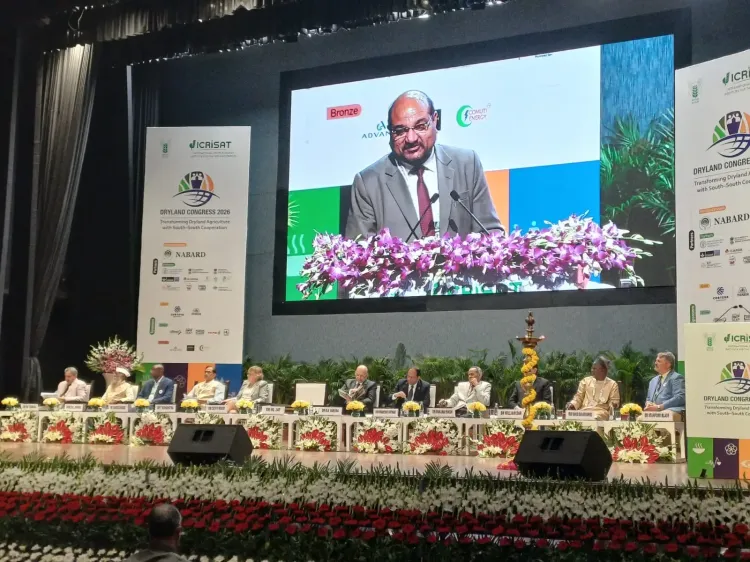
Government officials and leading agricultural scientists at the Dryland Congress 2026 in New Delhi have underscored the urgent need for robust data and information systems to support dryland agri-food systems, alongside the creation of common innovation grounds — or 'living laboratories' — that bridge research, practice, and policy. The three-day congress concluded on 13 September 2026, coinciding with the United Nations Day for South–South Cooperation.
Delhi Declaration on Drylands Adopted
The congress culminated in the adoption of the Delhi Declaration on Drylands (3D), setting out a shared agenda for transforming dryland agriculture through collaboration, knowledge exchange, innovation, and collective action across the Global South. The declaration was welcomed as a landmark outcome, with delegates calling for greater South–South and triangular cooperation to accelerate solutions for the world's dryland farming communities. According to the Ministry of Agriculture and Farmers Welfare, the declaration represents a committed framework for moving from policy dialogue to on-ground implementation.
Key Voices: ICAR and ICRISAT Leadership
Dr M.L. Jat, Secretary of the Department of Agricultural Research and Education (DARE) and Director General of the Indian Council of Agricultural Research (ICAR), called for foresight to be placed at the centre of dryland agriculture efforts. He advocated for a strong institutional mechanism, specifically proposing that the ICAR-National Institute of Agricultural Economics and Policy Research (ICAR-NIAP) be formally mandated to lead foresight work on dryland agriculture.
Dr Himanshu Pathak, Director General of ICRISAT, highlighted the strategic importance of drylands for global food security. He stressed the need to distil the three days of deliberations into prioritised short- and long-term actions — moving, in his words, 'from ideas to concepts and from concepts to concrete action and implementation' by harnessing collective expertise and cross-institutional knowledge.
New Agreements and ISSCA Awards
On the final day, new agreements and memoranda of understanding were announced with the Global Crop Diversity Trust, signalling intent to deepen institutional partnerships on dryland crop genetic resources. The congress also witnessed the presentation of the ISSCA Global Awards 2026, the annual flagship initiative recognising proven agricultural innovations from institutions across the Global South with strong potential for scaling and cross-country adaptation.
The Co-Chairs of the Congress — Dr D.K. Yadava, Deputy Director General (Crop Science) at ICAR, and Dr Stanford Blade, Deputy Director General (Research and Innovation) at ICRISAT — presented a joint summary of the three-day deliberations, outlining the key outcomes and recommendations to emerge from the gathering.
Why Drylands Matter
Drylands cover roughly 40% of the Earth's land surface and support the livelihoods of a significant share of the world's food-insecure populations, particularly across South Asia, Sub-Saharan Africa, and parts of Latin America. Despite their importance, dryland agri-food systems remain chronically underserved by data infrastructure and research investment. This congress, bringing together policymakers, scientists, and development institutions from across the Global South, represents a collective acknowledgement that fragmented, siloed responses are no longer sufficient.
With the Delhi Declaration now adopted and new institutional partnerships in place, attention turns to how quickly signatory nations and research bodies can operationalise commitments on the ground.
Point of View
But declarations have a poor track record of driving dryland investment on their own. The proposal to formally mandate ICAR-NIAP on foresight is the more consequential idea here — institutional ownership beats consensus communiqués every time. What remains unresolved is funding: South–South cooperation frameworks routinely stall when resource commitments are left vague. The real test of Dryland Congress 2026 will be visible within two years, in whether the 'living laboratories' concept moves off the conference slide deck and onto actual farms.
NationPress
13 Sept 2026
Frequently Asked Questions
What is the Delhi Declaration on Drylands (3D)?
The Delhi Declaration on Drylands (3D) is a shared policy framework adopted at the conclusion of the Dryland Congress 2026 in New Delhi on 13 September 2026. It sets out a collective agenda for transforming dryland agriculture across the Global South through collaboration, knowledge exchange, innovation, and coordinated action.
What is the Dryland Congress 2026?
The Dryland Congress 2026 was a three-day international gathering held in New Delhi, bringing together government officials, agricultural scientists, and development institutions to address the challenges facing dryland agri-food systems globally. It was co-chaired by senior leaders from ICAR and ICRISAT.
What role will ICAR-NIAP play in dryland agriculture?
ICAR Secretary Dr M.L. Jat proposed that the ICAR-National Institute of Agricultural Economics and Policy Research (ICAR-NIAP) be formally mandated to lead foresight work on dryland agriculture in India. This would position the institute as the nodal body for long-term strategic planning in the sector.
What agreements were signed at the Dryland Congress 2026?
New agreements and memoranda of understanding were announced with the Global Crop Diversity Trust at the congress. These are aimed at deepening institutional cooperation on dryland crop genetic resources and scaling agricultural innovations across the Global South.
Why is dryland agriculture important for food security?
Drylands cover approximately 40% of the Earth's land surface and support the livelihoods of many of the world's most food-insecure populations, particularly in South Asia, Sub-Saharan Africa, and parts of Latin America. Despite this, dryland farming systems remain underserved by research investment and data infrastructure, making coordinated global action critical.