RBI Governor: India economy resilient, domestic demand steady in Q1 FY27
Synopsis
RBI Governor Sanjay Malhotra struck a cautiously optimistic tone after the August MPC meeting, affirming India’s economic resilience even as he flagged a deficient monsoon, elevated energy prices, and global uncertainty as risks. His signal that policy action awaits greater inflation clarity suggests the rate path remains data-dependent and closely watched.
Key Takeaways
RBI Governor Sanjay Malhotra on 5 August said India’s economy remains resilient despite global headwinds, with steady domestic demand in Q1 FY27 .
Private consumption and investment held firm, supported by construction, capital goods, and bank credit indicators.
Services exports expanded healthily; merchandise exports rebounded, sustaining external demand.
A deficient and uneven south-west monsoon amid El Nino conditions poses risks to agriculture and rural demand.
Malhotra signalled no immediate policy rate action, saying greater clarity on inflation trajectory is needed first.
GST rationalisation, stable employment, and infrastructure spending are expected to support urban demand and investment.
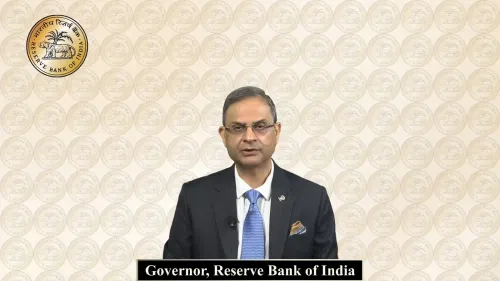
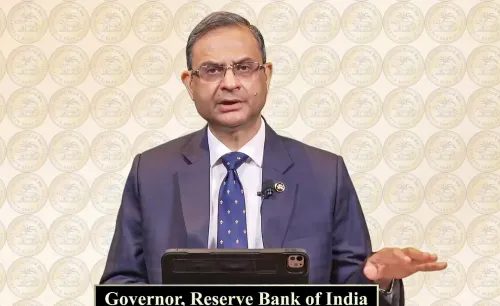
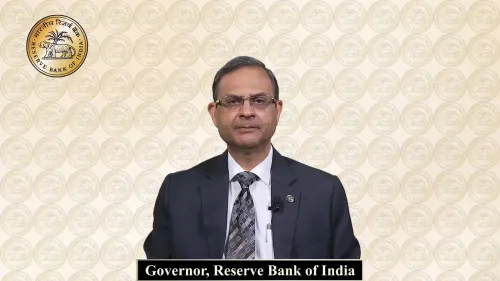
Reserve Bank of India (RBI) Governor Sanjay Malhotra on Wednesday, 5 August said the Indian economy has held firm against persistent global headwinds, with high-frequency indicators pointing to steady domestic demand in the first quarter of 2026-27. His remarks came at the conclusion of the three-day Monetary Policy Committee (MPC) meeting in New Delhi.
Domestic Demand Holds Firm
Governor Malhotra noted that private consumption remained robust and investment continued to show resilience, supported by indicators across construction activity, capital goods, and bank credit. External demand also held up, he said, with healthy expansion in services exports complemented by a rebound in merchandise exports.
“External demand also sustained, as healthy expansion in services exports was complemented by a rebound in merchandise exports,” Malhotra said.
Global Risks and Monsoon Concerns
Despite the broadly positive domestic picture, Malhotra flagged that the turbulent global economic environment is likely to exert some pressure on domestic activity going forward. Energy prices and supply chain disruptions remain elevated and uncertain, he cautioned.
Notably, a deficient and uneven south-west monsoon amid El Nino conditions poses risks to the agriculture sector’s outlook and rural demand. “The adverse impact is being contained with various supply side measures. Even though the situation is still evolving, deficient and uneven south-west monsoon amidst El Nino conditions pose some risks to the agriculture sector’s outlook and rural demand,” Malhotra said.
Government initiatives on crop diversification — including short-duration and climate-resilient varieties — along with water harvesting and conservation measures, are expected to cushion the blow, he added.
Urban Demand and Investment Outlook
Malhotra said sustained momentum in services, the continuing impact of GST rationalisation, and broadly stable employment conditions should support urban demand. On the investment side, strong capacity utilisation, robust credit flow, and the government’s continued infrastructure push are expected to keep investment activity on track.
“Strong capacity utilisation, robust credit flow and the government’s continued thrust on infrastructure is expected to sustain investment activity. While services exports are expected to sustain, merchandise exports will be supported by the recent trade agreements and thrust on diversification,” he noted.
Inflation Path to Guide Policy Action
The Governor underscored that greater clarity on inflation — its trajectory and composition — is needed before any policy action is taken. He indicated that any rate recalibration would need to account for the evolving growth-inflation dynamic, particularly as underlying inflation has remained at relatively benign levels.
“There is a need for greater clarity to emerge, especially regarding inflation, its path and composition before taking any policy action. Any such action would also have to consider the need for recalibration of policy rates in line with the evolving growth-inflation dynamics,” Malhotra explained.
Overall, growth continues to be underpinned by resilient domestic demand, sustained expansion in manufacturing and services, and robust exports — reinforcing India’s standing as the world’s fastest-growing major economy. The RBI’s next policy move will hinge on how the inflation and monsoon situations develop in the weeks ahead.
Point of View
Which has historically forced the RBI’s hand. The governor’s emphasis on supply-side mitigation is reassuring in tone but thin on specifics. Meanwhile, the growth-inflation recalibration language is a signal that the rate-cut window, if it was ever open, is narrowing. India’s fastest-growing-economy tag holds, but the fine print — uneven monsoon, global energy prices, uncertain merchandise demand — deserves more scrutiny than the headline allows.
NationPress
5 Aug 2026
Frequently Asked Questions
What did RBI Governor Sanjay Malhotra say about India’s economy on 5 August?
Governor Malhotra said India’s economy has remained resilient amid global headwinds, with high-frequency indicators pointing to steady domestic demand in Q1 FY27. He made the remarks after the conclusion of the three-day MPC meeting in New Delhi.
What risks did the RBI Governor flag for the Indian economy?
Malhotra flagged a deficient and uneven south-west monsoon amid El Nino conditions as a risk to agriculture and rural demand. He also cited elevated and uncertain energy prices and supply chain pressures stemming from the global environment.
Will the RBI cut interest rates soon?
The Governor did not signal an imminent rate cut, stating that greater clarity on inflation — its path and composition — is needed before any policy action. He indicated any recalibration would depend on evolving growth-inflation dynamics.
How is India’s investment and consumption holding up according to the RBI?
Private consumption remained robust and investment showed resilience, supported by construction activity, capital goods indicators, and bank credit flow. Strong capacity utilisation and the government’s infrastructure push are expected to sustain investment momentum.
What is supporting India’s urban demand according to RBI Governor Malhotra?
Malhotra cited sustained momentum in services, the continuing impact of GST rationalisation, and broadly stable employment conditions as key supports for urban demand going forward.