Police image built on conduct, not PR: Ex-UP DGP Vikram Singh at RRU
Synopsis
At a national policing workshop in Gandhinagar, former UP DGP Vikram Singh delivered a pointed message: police credibility cannot be manufactured through PR — it must be earned through conduct. With officers from seven states in the room and 54 lectures on technology and community policing on the agenda, the session underscored how deeply India's law enforcement establishment is rethinking its relationship with citizens.
Key Takeaways
Former UP DGP Prof. (Dr.) Vikram Singh addressed a one-day workshop at Rashtriya Raksha University, Gandhinagar on 14 July , stressing ethical conduct over publicity as the foundation of police image.
Senior officers including DGPs and IGs from 7 states — UP, Uttarakhand, Delhi, Meghalaya, Gujarat, West Bengal, Rajasthan — and two Union Territories participated.
Singh cited Kolkata Police's 'LISTEN' model and Uttarakhand Police's safe-space reporting as examples of empathetic policing for women.
RRU Pro VC Kalpesh H.
Wandra noted India has ~20,000 police stations and 2.6 million personnel , but emphasised public trust over force size.
RRU's monthly 'Police Image' lecture series has completed 54 sessions , supporting the shift to SMART policing under 'Viksit Bharat 2047' .
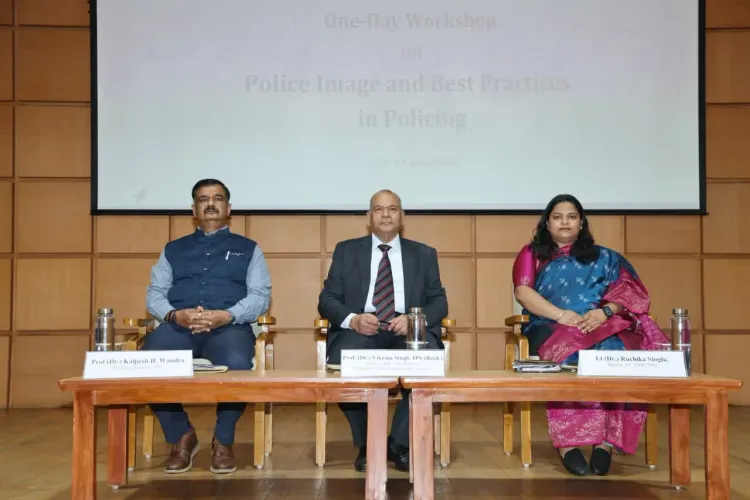
Former Uttar Pradesh Director General of Police Prof. (Dr.) Vikram Singh on Tuesday, 14 July declared that a positive police image is earned through ethical conduct and genuine public service — not through publicity campaigns — while addressing a one-day workshop on Police Image and Best Practices in Policing at Rashtriya Raksha University (RRU)'s School of Internal Security and SMART Policing (SISSP) in Gandhinagar. The workshop brought together senior officers, including Directors General of Police and Inspectors General, from Uttar Pradesh, Uttarakhand, Delhi, Meghalaya, Gujarat, West Bengal, Rajasthan, and the Union Territories of Daman and Diu and Dadra and Nagar Haveli.
Key Remarks by Former DGP
Singh, a retired IPS officer who now serves as Chancellor of Noida International University, urged police personnel to shed what he called the colonial-era 'feudal' mindset rooted in the Police Act of 1861 and embrace a more humane, trust-based approach to law enforcement.
'A positive police image is built not through publicity, but through consistent, ethical conduct and genuine public service, earning the trust and confidence of citizens through action rather than optics,' Singh said.
He cautioned against performative public relations exercises and unauthorised media engagements, arguing that such shortcuts ultimately erode rather than build institutional credibility.
Women's Safety and Empathetic Policing
Highlighting women's safety as a critical benchmark of policing quality, Singh cited Kolkata Police's 'LISTEN' model and Uttarakhand Police's safe-space reporting mechanism as examples of empathetic, citizen-oriented practice. He observed that police stations had historically functioned like a 'boys' club', discouraging many women from reporting offences.
Quoting jurist Justice V.R. Krishna Iyer's observation that 'while murder destroys the body, rape destroys the soul', Singh called on officers to treat crime victims with the highest respect and apply the law impartially, particularly in domestic disputes.
From Danda to Data: The SMART Policing Push
Prof. (Dr.) Kalpesh H. Wandra, Pro Vice Chancellor at RRU, noted that Indian policing was transitioning from a reactive, post-crime investigation model to a predictive, technology-driven system aligned with the Prime Minister's vision of SMART policing. He pointed out that India has nearly 20,000 police stations and around 2.6 million police personnel serving a population of more than 1.4 billion, yet stressed that force size alone cannot substitute for public trust and citizen participation.
Wandra linked the workshop's 54 lectures — spanning technology adoption, women's safety, and community outreach — to a broader national transition towards transparent, accountable policing in keeping with the vision of 'Viksit Bharat 2047'.
RRU's Institutional Initiatives
Lt. (Dr.) Ruchika Singla, Director In-Charge of SISSP, said RRU was working to build a technology-driven, citizen-centric policing ecosystem through skill development and professional training. She highlighted Mission Karmayogi, women-in-policing programmes, and capacity-building efforts across police ranks as part of this mandate.
She noted that RRU's monthly 'Police Image' lecture series, held on the 22nd of every month, had completed 54 lectures to date, bridging the gap between theory and practice under the university's guiding principle: 'National Security is Supreme'.
State Presentations and Best Practices Shared
The workshop featured technical sessions from officers across multiple states. Inspector General (Training) Anant Takwale of Uttarakhand Police spoke on community-oriented policing, while Deputy Inspector General (Training) Dev Ranjan Verma of Uttar Pradesh discussed the Women Power Line 1090 programme and technology-driven approaches to women's safety.
Additional Commissioner of Police Neha Yadav presented Delhi Police best practices; Administrative Officer Lakador Syiem of the Meghalaya Police Academy outlined policing in Meghalaya; Deputy Superintendent of Police Hardik N. Prajapati shared Gujarat Police practices; Inspector Sujit Bhattacharjee of the Swami Vivekananda State Police Academy addressed public trust in West Bengal; and Company Commander Toniya Sharma of the 4th RAC Battalion covered Rajasthan's policing model.
The convergence of senior officers from across India signals a growing institutional consensus that policing reform must be anchored in conduct, community engagement, and technology — with the next phase of SMART policing initiatives expected to take shape through RRU's ongoing training frameworks.
Point of View
Suggesting reform energy is bubbling from within the force rather than being imposed from above. Yet the gap between workshop rhetoric and station-level reality remains vast. India's police-to-population ratio, complaint redressal rates, and custodial conduct data rarely match the language of 'empathetic policing' on display at such events. The real test will be whether models like Women Power Line 1090 or Kolkata's LISTEN initiative are scaled with accountability metrics — or remain showcase examples trotted out at conferences.
NationPress
13 Oct 2026
Frequently Asked Questions
What was the Police Image workshop at Rashtriya Raksha University about?
The one-day workshop, held on 14 July at RRU's Gandhinagar campus, focused on police image and best practices in policing. It brought together senior officers from seven states and two Union Territories to share models on technology adoption, women's safety, and community policing.
What did former UP DGP Vikram Singh say about police image?
Singh said a positive police image is built through consistent, ethical conduct and genuine public service — not through publicity or performative PR exercises. He also urged officers to shed the colonial-era 'feudal' mindset rooted in the Police Act of 1861.
Which policing models were highlighted as examples of empathetic policing?
Kolkata Police's 'LISTEN' model and Uttarakhand Police's safe-space reporting mechanism for women were cited as examples of empathetic, citizen-oriented policing that make it easier for women to report offences.
What is SMART policing and how does RRU support it?
SMART policing refers to a technology-driven, predictive approach to law enforcement aligned with the Prime Minister's vision. RRU supports it through skill development, professional training, and a monthly 'Police Image' lecture series that has completed 54 sessions to date.
Who are the key figures at Rashtriya Raksha University involved in this initiative?
Prof. (Dr.) Kalpesh H. Wandra, Pro Vice Chancellor of RRU, and Lt. (Dr.) Ruchika Singla, Director In-Charge of SISSP, lead the university's policing education initiatives, including Mission Karmayogi and women-in-policing capacity-building programmes.