CM Fadnavis: Ethanol push to benefit Maharashtra farmers
Synopsis
Maharashtra Chief Minister Devendra Fadnavis declared on 7 June 2026 that the central government's push for ethanol-powered vehicles will greatly benefit the state's farmers, citing Maharashtra's position as India's largest ethanol producer and linking the national biofuel drive to direct agricultural gains.
Key Takeaways
CM Devendra Fadnavis stated on 7 June 2026 from Nagpur that the Centre's ethanol-vehicle promotion will benefit Maharashtra farmers.
Maharashtra is described as India's largest ethanol-producing state, giving its farmers a direct stake in biofuel demand growth.
The Ethanol Blending Programme targets 20 percent ethanol blending (E20) , a deadline advanced from 2030 to 2025 after early progress.
India imports more than 80 percent of its crude oil; ethanol blending is a key strategy to reduce that dependence.
Sugarcane farmers and ethanol distilleries in Maharashtra's sugar belt are the primary beneficiaries of higher ethanol procurement mandates.
Future state-level distillery capacity additions and new central procurement orders will determine the scale of farmer gains.
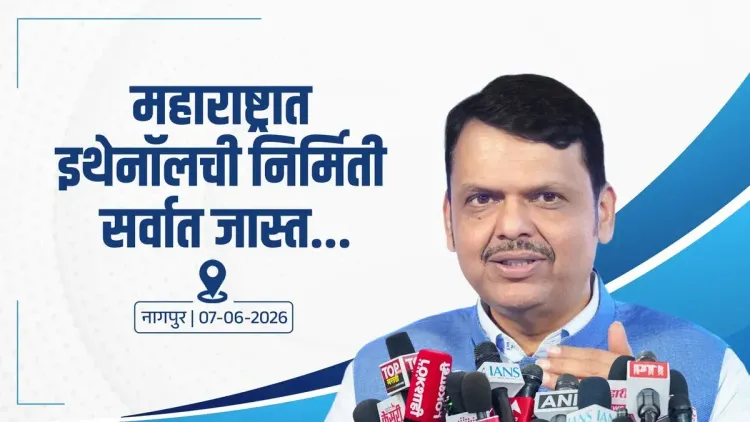
Maharashtra Chief Minister Devendra Fadnavis on Sunday, 7 June 2026, said the central government's drive to promote ethanol-powered vehicles will deliver significant gains to farmers in Maharashtra, which he described as India's top ethanol-producing state. The remarks, made from Nagpur, underline the state's strategic position in the national biofuel economy.
Context
Posting in both Marathi and Hindi, Fadnavis stated: 'केंद्र सरकार इथेनॉलवर चालणाऱ्या वाहनांना प्राधान्य देत असून, महाराष्ट्रात इथेनॉलची निर्मिती सर्वात जास्त होत असल्याने, याचा महाराष्ट्रातील शेतकऱ्यांना मोठा फायदा होईल.' [The central government is prioritising ethanol-powered vehicles; since Maharashtra produces the most ethanol, its farmers will benefit greatly.] The bilingual post signals an effort to reach both urban and rural audiences across the state's diverse linguistic landscape.
The statement comes as the Union government accelerates its push for higher ethanol blends in petrol, a policy that directly links agricultural output — particularly sugarcane — to the transport fuel supply chain. For Maharashtra's large sugarcane farming community, stronger ethanol demand translates into more stable mill revenues and better cane prices.
Policy Backdrop
India's Ethanol Blending Programme has been a cornerstone of the country's energy and farm policy for over a decade. The National Policy on Biofuels, notified in 2018, originally set a 20 percent ethanol blending (E20) target for 2030. After achieving 10 percent blending ahead of schedule, the central government advanced the E20 deadline to 2025, reflecting rapid capacity expansion across producing states.
The programme serves a dual purpose: reducing India's more than 80 percent dependence on imported crude oil and providing an alternative revenue stream for sugar mills during surplus seasons. Vehicle manufacturers have correspondingly been directed to ensure E20 compatibility in new models, creating a structural, long-term pull for domestically produced ethanol.
This initiative also sits within the broader Atmanirbhar Bharat framework, which seeks to develop domestic biofuel capacity as a strategic energy asset. Maharashtra and Uttar Pradesh together supply the bulk of India's ethanol, given their large sugarcane bases and established distillery networks.
Stakeholders and Impact
Sugarcane farmers are the primary beneficiaries of expanded ethanol procurement, as higher offtake by distilleries supports cane prices and reduces the risk of delayed payments — a chronic grievance in Maharashtra's sugar belt districts such as Kolhapur, Sangli, Solapur, and Ahmednagar. Ethanol distilleries also stand to gain from increased central procurement orders tied to blending mandates.
For the state government, positioning Maharashtra as the leading ethanol producer strengthens its bargaining position in national biofuel policy discussions and offers a politically salient narrative ahead of ongoing farm-sector consultations. The Chief Minister's post effectively frames a central policy as a Maharashtra-specific dividend.
What's Next
Attention will now turn to whether the state government announces fresh support for ethanol distillery capacity additions or facilitates new central procurement agreements. Equally significant will be any updated vehicle homologation rules from the Union government permitting higher ethanol blends beyond E20, which would further expand demand for Maharashtra's output.
As India's transport sector gradually integrates biofuels, the alignment between central procurement policy and state-level agricultural output will determine how equitably the gains reach individual farmers — making the next round of cane price and ethanol procurement announcements a key indicator to watch.
Point of View
The Chief Minister simultaneously claims credit for the Centre's biofuel ambitions and positions the state government as the bridge between Union policy and rural benefit. The statement fits a broader BJP pattern of aligning Atmanirbhar Bharat's energy goals with agrarian messaging, particularly in states with large sugar-sector footprints. Whether the rhetoric translates into measurable farm income gains will depend on the pace of distillery expansion and the Centre's procurement pricing in the coming procurement season.
NationPress
24 Oct 2026
Frequently Asked Questions
How will the central government's ethanol policy benefit Maharashtra farmers?
The central government's push to promote ethanol-powered vehicles increases demand for ethanol, which is largely produced from sugarcane molasses. Since Maharashtra is India's largest ethanol-producing state, higher procurement by distilleries supports cane prices and revenues for sugarcane farmers.
What is India's Ethanol Blending Programme?
India's Ethanol Blending Programme aims to mix ethanol with petrol to reduce crude oil imports and support domestic agriculture. The government set a 20 percent blending (E20) target, which was advanced from 2030 to 2025 after achieving 10 percent blending ahead of schedule.
Why is Maharashtra important for ethanol production in India?
Maharashtra has one of India's largest sugarcane cultivation areas and an established network of sugar mills and distilleries, making it a leading source of ethanol produced from molasses and other feedstocks, alongside Uttar Pradesh.
What did CM Devendra Fadnavis say about ethanol on 7 June 2026?
CM Fadnavis posted from Nagpur stating that since the central government is prioritising ethanol-powered vehicles and Maharashtra produces the most ethanol in the country, the state's farmers stand to gain significantly from the policy.
What should Maharashtra farmers watch for next on ethanol policy?
Farmers and industry stakeholders should watch for new central ethanol procurement orders, updates to blending mandates beyond E20, and state-level announcements on distillery capacity expansion, all of which will shape the actual income benefit reaching sugarcane growers.