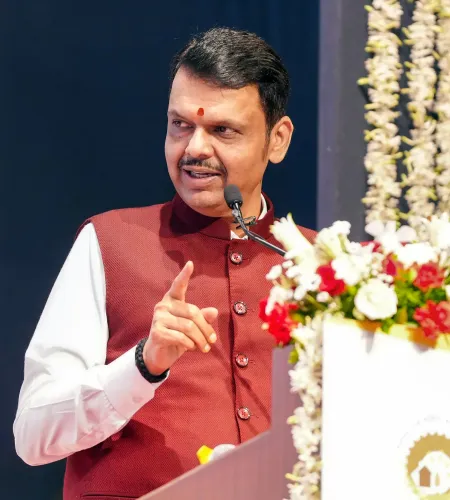
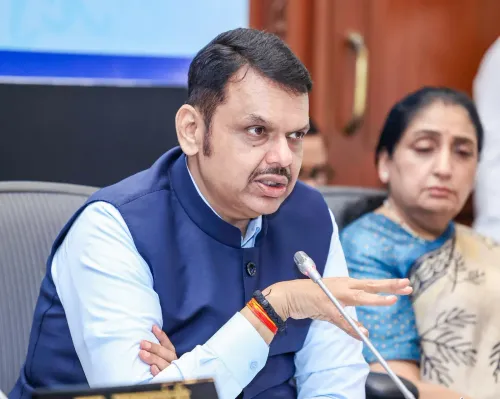
CM Fadnavis Aims to Make Maharashtra India's Quantum Tech Leader
Synopsis
Chief Minister Devendra Fadnavis has declared Maharashtra's ambition to lead India in quantum technology. The announcement aligns with the Centre's Rs 6,003 crore National Quantum Mission and leverages the state's existing scientific assets at IIT Bombay and TIFR in Mumbai and Pune's IT clusters.
Key Takeaways
Chief Minister Devendra Fadnavis announced on 18 July 2026 that Maharashtra aims to be India's top state in quantum technology.
The goal aligns with the National Quantum Mission , approved by the Union Cabinet in 2023 with an outlay of Rs 6,003 crore .
Maharashtra hosts key scientific institutions including IIT Bombay and TIFR that underpin its quantum ambitions.
The state's established IT clusters in Mumbai and Pune provide a commercial foundation for quantum technology applications.
Formal budget allocations and institutional tie-ups with NQM hubs are the key developments to watch next.
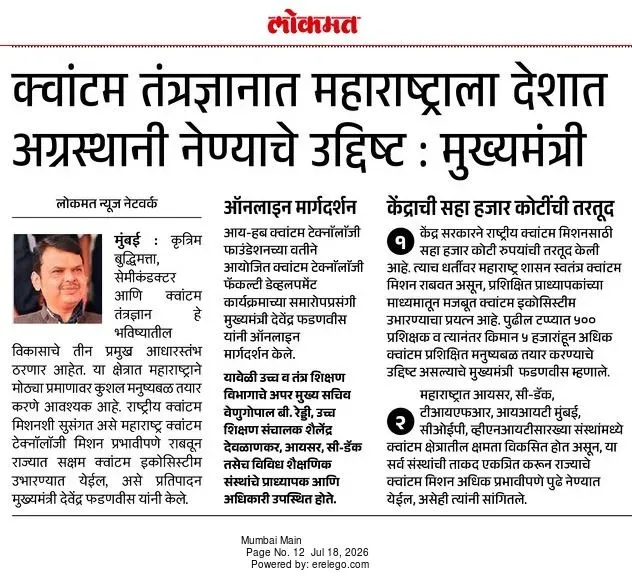
The Chief Minister's Office of Maharashtra, in a post attributed to Chief Minister Devendra Fadnavis, announced on Saturday, 18 July 2026, that the state government has set an ambitious goal of positioning Maharashtra as the country's foremost destination for quantum technology development.
The post, shared from the official CMO Maharashtra handle, quoted Chief Minister Fadnavis stating — 'क्वांटम तंत्रज्ञानात महाराष्ट्राला देशात अग्रस्थानी नेण्याचे उद्दिष्ट' — which translates as: 'The objective is to lead Maharashtra to the foremost position in the country in quantum technology.'
Context
Quantum technology encompasses computing, communication, sensing and cryptography systems that exploit quantum mechanical phenomena to deliver capabilities far beyond classical systems. For a state such as Maharashtra — home to IIT Bombay in Mumbai and the Tata Institute of Fundamental Research (TIFR) — the ambition is grounded in existing scientific infrastructure. The state also hosts major IT clusters in Mumbai and Pune that could serve as commercial anchors for quantum applications.
Policy Backdrop
Chief Minister Fadnavis's stated objective aligns closely with the National Quantum Mission (NQM), approved by the Union Cabinet in 2023 with a total outlay of Rs 6,003 crore. The central mission aims to establish quantum hubs, develop quantum satellites and build research facilities to place India among the top nations in this field. States with strong scientific infrastructure have been encouraged to develop complementary programmes, and Maharashtra's announcement fits squarely within that national framework.
This pattern mirrors earlier state-level responses to central missions in semiconductors and artificial intelligence, where states competed to attract investment, talent and institutional mandates. Maharashtra's move signals an intent to assert early leadership before the quantum ecosystem matures.
Stakeholders and Impact
The primary beneficiaries of such an initiative would be academic research institutions, deep-tech startups, and established IT and defence companies operating in Maharashtra. Institutions such as IIT Bombay and TIFR stand to gain enhanced funding pipelines and collaborative mandates if the state formalises its quantum push with dedicated budget allocations or policy instruments. The broader technology workforce in Pune and Mumbai could also see new employment pathways as quantum-adjacent roles expand.
For India's overall competitiveness, a strong Maharashtra programme would add state-level momentum to the National Quantum Mission, potentially accelerating the timeline for domestic quantum capabilities in secure communications and advanced computing.
What's Next
Analysts and industry observers will watch for concrete follow-through: state budget allocations earmarked for quantum laboratories, formal memoranda of understanding between Maharashtra institutions and NQM-designated hubs, and any dedicated talent or startup incentive schemes. Chief Minister Fadnavis has a track record of pairing policy announcements with structured implementation frameworks in infrastructure and digital governance, making the specifics of this quantum push the critical next step to monitor.
Point of View
003 crore National Quantum Mission. States with scientific infrastructure — Maharashtra, Karnataka, Tamil Nadu — are signalling early intent to host mission hubs and attract deep-tech investment before allocations are finalised. For Fadnavis, who has consistently used technology and infrastructure narratives to project Maharashtra as India's economic frontrunner, this announcement reinforces a broader brand of governance. The real test, however, will be whether the rhetoric is matched by specific budget lines and institutional mandates in the months ahead.
NationPress
16 Oct 2026
Frequently Asked Questions
What is Maharashtra's quantum technology goal announced by CM Fadnavis?
Chief Minister Devendra Fadnavis announced that Maharashtra aims to become the leading state in India in quantum technology, aligning the state's resources and institutions with the national quantum push.
What is the National Quantum Mission and how does it relate to Maharashtra?
The National Quantum Mission is a central government programme approved in 2023 with an outlay of Rs 6,003 crore to build quantum computing, communication and sensing capabilities in India. Maharashtra's announcement is positioned as a state-level complement to this mission.
Which institutions in Maharashtra are relevant to quantum technology?
IIT Bombay in Mumbai and the Tata Institute of Fundamental Research (TIFR) are among the key scientific institutions in Maharashtra engaged in advanced research that could anchor a state quantum programme.
What should I watch for after Fadnavis's quantum technology announcement?
Key developments to track include state budget allocations for quantum laboratories, formal tie-ups between Maharashtra institutions and National Quantum Mission hubs, and any startup or talent incentive schemes announced by the state government.
How does Maharashtra's quantum push fit into India's broader technology policy?
It mirrors a pattern seen in semiconductors and artificial intelligence, where states with existing scientific and industrial infrastructure align with central missions to attract investment, talent and institutional mandates before the ecosystem matures.