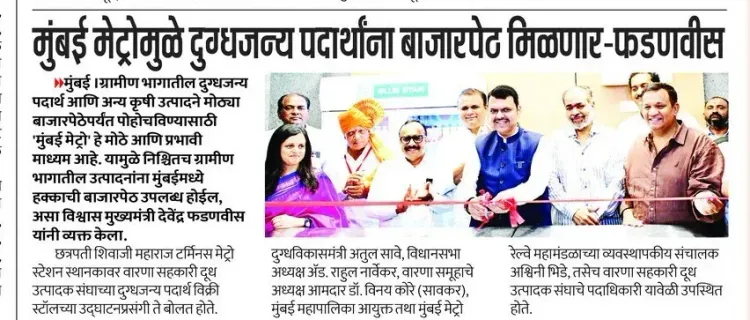
CM Fadnavis: Mumbai Metro to open markets for dairy products
Synopsis
Chief Minister Devendra Fadnavis has said the Mumbai Metro expansion will open new markets for dairy products, with western Maharashtra cooperatives like Warana set to benefit from improved connectivity to Mumbai's consumer base.
Key Takeaways
Chief Minister Devendra Fadnavis stated on 17 June 2026 that the Mumbai Metro will provide market access for dairy products.
The Warana dairy cooperative of Kolhapur district was specifically referenced in the announcement.
The Mumbai Metro is being framed not just as an urban commuter project but as a logistics corridor for perishable goods from western Maharashtra.
Dairy farmers and cooperative members are identified as primary beneficiaries of improved transit connectivity to Mumbai markets.
Maharashtra has previously used similar connectivity arguments for metro extensions around Pune and Nashik .
Cold-chain integration with metro stations and follow-up state schemes remain the key developments to watch.
The Chief Minister's Office of Maharashtra, in a post attributed to Chief Minister Devendra Fadnavis, announced on Wednesday, 17 June 2026 that the Mumbai Metro expansion will open up new market access for dairy products, with specific mention of the Warana cooperative cluster in western Maharashtra.
Context
The post, shared from the official CMO Maharashtra handle, quotes Chief Minister Fadnavis as saying — 'मुंबई मेट्रोमुळे दुग्धजन्य पदार्थांना बाजारपेठ मिळणार' — translated: 'Mumbai Metro will provide a market for dairy products.' The statement links an urban infrastructure project directly to the economic interests of dairy farmers and cooperatives in the state's western belt.
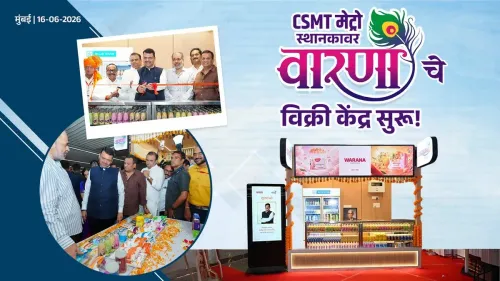
Warana, a prominent dairy cooperative headquartered in Kolhapur district, is among Maharashtra's most established milk-processing institutions and serves as a key livelihood anchor for thousands of farmers across the region.
Policy Backdrop
Maharashtra's metro expansion plans, developed through the Mumbai Metropolitan Region Development Authority (MMRDA), have progressively widened their scope beyond urban commuter relief. State planners have argued that metro corridors can function as logistics arteries, cutting transit time for perishable goods — including milk and dairy — from producing districts to Mumbai's vast consumer base.
Similar connectivity arguments have previously been advanced for agricultural and dairy clusters around Pune and Nashik in the context of their respective metro extensions. Chief Minister Fadnavis has been closely associated with accelerating metro infrastructure across the state since his earlier tenure and into the current administration.
Stakeholders and Impact
The primary beneficiaries identified in this announcement are dairy farmers and members of cooperatives such as Warana, who have historically faced challenges in reaching Mumbai's premium retail and institutional markets quickly and cost-effectively. Faster metro-linked logistics could reduce spoilage and improve price realisation for producers.
Urban consumers in Mumbai stand to gain as well, through potentially fresher and more competitively priced dairy products. The cooperative sector, which aggregates supply from small and marginal farmers, could see strengthened bargaining power if reliable transit corridors are established.
What's Next
Attention will now turn to which specific Mumbai Metro corridors are being positioned to physically connect western Maharashtra's dairy belts to Mumbai terminals, and whether the state government will announce complementary cold-chain infrastructure at metro stations or freight interchange points. Any follow-up scheme detailing integration of perishable goods logistics with metro operations will be closely watched by the cooperative sector and agricultural policy observers.
If realised, the model could set a template for using urban rail networks as economic multipliers for rural producers — a significant shift in how metro infrastructure is justified and designed in Maharashtra.
Point of View
Bridging urban infrastructure narratives with rural agrarian interests ahead of any upcoming electoral cycles in Maharashtra. By invoking Warana — a cooperative with deep roots in western Maharashtra's sugar and dairy belt — the announcement signals an attempt to extend the political dividend of urban metro spending into rural and semi-urban constituencies. This fits a broader pattern in Indian infrastructure politics where large-ticket urban projects are increasingly justified through their downstream benefits for agricultural supply chains. Whether the logistics case translates into concrete cold-chain policy or remains rhetorical will determine its real-world credibility.
NationPress
16 Sept 2026
Frequently Asked Questions
How will Mumbai Metro help dairy farmers in Maharashtra?
Chief Minister Devendra Fadnavis has stated that the Mumbai Metro expansion will provide better market access for dairy products, allowing cooperatives like Warana to reach Mumbai consumers more quickly and cost-effectively, potentially reducing spoilage and improving prices for farmers.
What is the Warana cooperative and why is it significant?
Warana is a well-established dairy cooperative based in Kolhapur district, western Maharashtra. It aggregates milk from thousands of small and marginal farmers and processes it for retail and institutional markets, making it a key livelihood institution in the region.
Which Mumbai Metro corridors will connect western Maharashtra dairy regions?
Specific metro corridors linking western Maharashtra's dairy belts to Mumbai terminals have not yet been detailed in the announcement. This remains a key development to watch as the state government follows up on the Chief Minister's statement.
Has Maharashtra linked metro projects to agricultural benefits before?
Yes. Maharashtra has previously made similar connectivity arguments for metro extensions around Pune and Nashik, positioning metro corridors as logistics arteries that can benefit perishable goods producers in nearby agricultural districts.
What is the Mumbai Metropolitan Region Development Authority?
The Mumbai Metropolitan Region Development Authority, or MMRDA, is the nodal state agency overseeing metro rail planning and execution across the Mumbai metropolitan region, including the expansion corridors referenced in the Chief Minister's announcement.