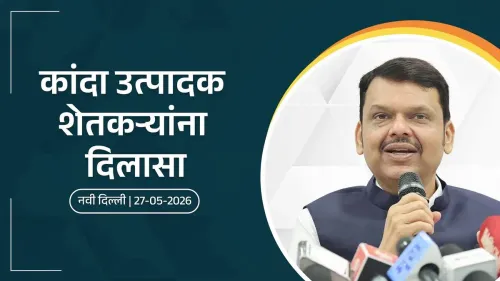
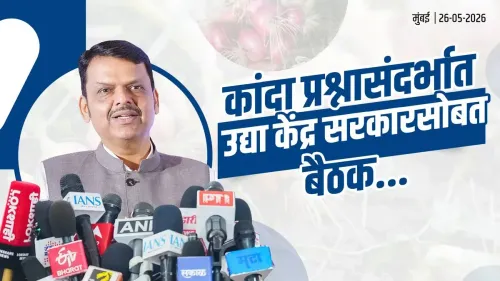
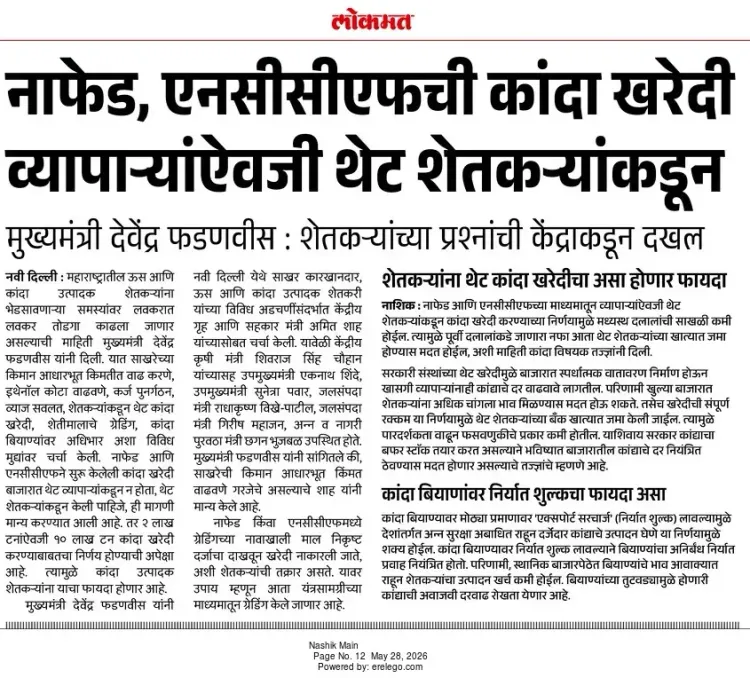
CM Fadnavis: NAFED, NCCF to Buy Onions Directly From Farmers
Synopsis
Maharashtra CM Devendra Fadnavis has directed NAFED and NCCF to procure onions directly from farmers instead of traders, aiming to improve farm-gate prices in India's largest onion-producing state and reduce intermediary margins during the 2026 harvest season.
Key Takeaways
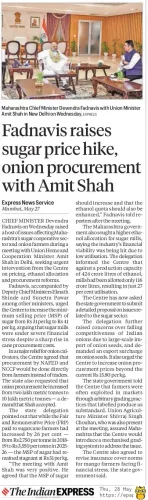
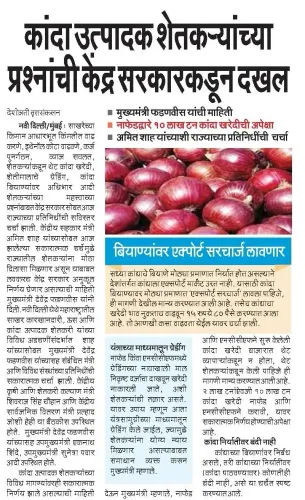
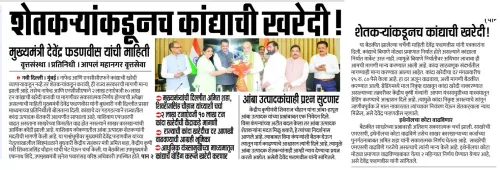
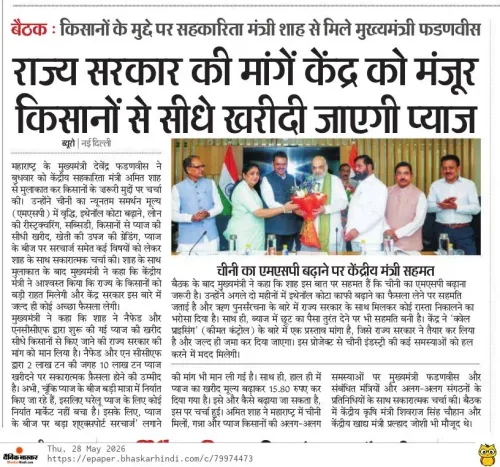
The Chief Minister's Office of Maharashtra announced on 28 May 2026 that onion procurement by NAFED and NCCF will bypass traders and go directly to farmers.
NAFED (National Agricultural Cooperative Marketing Federation) and NCCF (National Cooperative Consumers' Federation) are the two central cooperative agencies tasked with the direct purchase.
Maharashtra is India's largest onion-producing state, with key growing districts including Nashik and Ahmednagar .
The move follows a recurring policy pattern of using central cooperative agencies under the Market Intervention Scheme to stabilise farm-gate prices during surplus seasons.
Specific procurement volumes, floor prices, and district-level centre details have not yet been officially disclosed.
Chief Minister Devendra Fadnavis is associated with the directive, which builds on the Operation Greens policy lineage dating to 2018 .
The Chief Minister's Office of Maharashtra announced on Thursday, 28 May 2026 that NAFED and NCCF will procure onions directly from farmers, bypassing traders — a move attributed to Chief Minister Devendra Fadnavis.
Context
The CMO's post, shared in Marathi, states: 'नाफेड, एनसीसीएफची कांदा खरेदी व्यापाऱ्यांऐवजी थेट शेतकऱ्यांकडून' — ('NAFED and NCCF's onion procurement directly from farmers, instead of traders'). The announcement signals a direct market intervention in Maharashtra's onion sector, where farmer distress during surplus seasons has been a recurring concern.
NAFED (National Agricultural Cooperative Marketing Federation of India) and NCCF (National Cooperative Consumers' Federation of India) are central cooperative bodies that have historically been deployed for price-support procurement of perishable commodities. By routing purchases through these agencies rather than through the trader network, the government aims to ensure that farm-gate prices reach cultivators directly.
Policy Backdrop
Maharashtra is India's largest onion-producing state, with major growing belts concentrated in Nashik, Ahmednagar, and surrounding districts. The state has witnessed repeated cycles of price crashes during bumper harvest seasons, leaving farmers unable to recover input costs even as consumer prices remain elevated due to intermediary margins.
Central cooperative procurement under mechanisms such as the Market Intervention Scheme (MIS) has been used periodically to stabilise farm-gate rates. The Operation Greens initiative, launched in 2018, similarly sought to address price volatility in onions, tomatoes, and potatoes through supply-chain interventions. The current directive appears to extend this policy lineage into the 2026 procurement season.
Direct procurement by NAFED and NCCF effectively removes the trader layer from the price chain, reducing the spread between what farmers receive and what the agencies pay — a model that has drawn both support from farmer groups and scrutiny over implementation capacity at the village level.
Stakeholders and Impact
The primary beneficiaries of this arrangement are onion farmers across Maharashtra's producing districts, who have long complained that commission agents and traders capture a disproportionate share of the final sale price. Direct procurement is intended to transfer a larger portion of the purchase price to the cultivator.
Traders and commission agents operating at Agricultural Produce Market Committees (APMCs) stand to see reduced volume flowing through their channels if the scheme is implemented at scale. The degree of impact will depend on the procurement volumes that NAFED and NCCF are authorised to absorb in the current season — details that have not yet been officially disclosed.
Consumers may also be affected: when central agencies procure and release stocks into the market in a calibrated manner, it can moderate retail price spikes during lean supply periods, a pattern observed in previous NAFED interventions.
What's Next
Attention will now turn to district-level rollout — specifically, which procurement centres will be activated, what floor price will be offered, and the total volume NAFED and NCCF are mandated to purchase in Maharashtra this season. Any parallel decisions on onion export policy or additional state-level price-support allocations will shape how much relief ultimately reaches farmers. Chief Minister Devendra Fadnavis is expected to face questions on implementation timelines as the kharif onion harvest approaches.
Point of View
Signalling responsiveness to agrarian distress in a state where onion-belt constituencies carry significant electoral weight. It fits a broader pattern of using central cooperative infrastructure as a rapid-response tool when market prices threaten to collapse — a mechanism that sidesteps the slower legislative route. The measure's credibility, however, will rest entirely on implementation: previous NAFED interventions have been criticised for limited reach and delayed payments at the farm level. If procurement volumes and disbursement timelines are not disclosed promptly, the announcement risks being read as optics rather than substantive relief.
NationPress
11 Oct 2026
Frequently Asked Questions
What did Maharashtra CM Fadnavis announce about onion procurement?
CM Devendra Fadnavis directed that NAFED and NCCF will purchase onions directly from farmers in Maharashtra, removing traders from the procurement chain, as announced on 28 May 2026.
What is NAFED and why is it involved in onion buying?
NAFED, the National Agricultural Cooperative Marketing Federation of India, is a central cooperative body mandated to conduct price-support procurement for agricultural commodities including onions when market prices fall below remunerative levels.
How does direct procurement help onion farmers in Maharashtra?
Direct procurement by government agencies eliminates trader and commission-agent margins, ensuring a larger share of the purchase price reaches the farmer rather than intermediaries in the APMC chain.
Which districts in Maharashtra produce the most onions?
Nashik and Ahmednagar are the leading onion-producing districts in Maharashtra, which is India's largest onion-producing state overall.
What is the Market Intervention Scheme for onions?
The Market Intervention Scheme is a central government mechanism that authorises agencies like NAFED to procure perishable commodities at a support price when market rates crash, helping stabilise farm-gate earnings during surplus seasons.