Gadkari flags Bengaluru-Mysuru Expressway as Karnataka growth engine

Synopsis
Union Minister Nitin Gadkari spotlighted the Bengaluru-Mysuru Expressway on 27 October 2026 as a significant contributor to Karnataka's development, tying the corridor to the Gati Shakti and Bharatmala frameworks that anchor India's national highway expansion drive.
Key Takeaways
Union Minister Nitin Gadkari promoted the Bengaluru-Mysuru Expressway on 27 October 2026 as a major development enabler for Karnataka .
The project falls under Bharatmala Pariyojana , the national highways programme launched in 2015 .
Gadkari linked the expressway to the Gati Shakti National Master Plan for multi-modal connectivity, launched in 2021 .
The corridor connects Bengaluru — India's tech hub — with Mysuru , targeting reduced logistics costs and commute times.
The ministry has deployed similar messaging for expressway projects in Maharashtra , Uttar Pradesh , and Tamil Nadu , reflecting a nationwide economic-grid strategy.
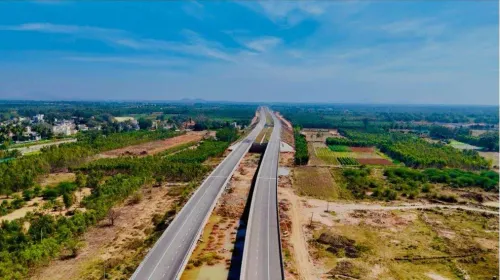
Two of Karnataka's most important cities are about to get a lot closer — economically and in travel time. Union Road Transport and Highways Minister Nitin Gadkari on Tuesday, 27 October 2026 highlighted the Bengaluru-Mysuru Expressway as a transformative project set to make a significant contribution to Karnataka's development.
Posting on X with the hashtags #PragatiKaHighway, #GatiShakti, and #BengaluruMysuruExpressway, Gadkari framed the corridor in his own words as one that will make 'an important contribution to Karnataka's development' — a line that doubles as the central government's consistent pitch for its southern infrastructure push.
What the Bengaluru-Mysuru Expressway means for Karnataka
The expressway links Bengaluru, India's technology capital, with Mysuru, one of the state's most significant cultural and commercial hubs. The project sits under the broader Bharatmala Pariyojana umbrella — the national highway and expressway programme launched in 2015 to build economic corridors across India. Faster, smoother connectivity between the two cities is expected to reduce logistics costs, compress commute times for daily travellers, and open up investment corridors along the route.
The Ministry has repeatedly pointed to such expressways as force multipliers: they don't just move vehicles, they move goods, jobs, and capital. For Karnataka residents and the millions who travel the Bengaluru-Mysuru route, the stakes are immediate and practical.
Gati Shakti's fingerprint on the project
Gadkari's deliberate use of the #GatiShakti hashtag places this expressway squarely within the National Master Plan for Multi-modal Connectivity, launched in 2021. Gati Shakti was designed to end the siloed planning that historically slowed infrastructure delivery — each ministry would now coordinate on a single digital platform, ensuring roads, rail, ports, and logistics nodes are built in sync rather than in sequence. The Bengaluru-Mysuru corridor, with its proximity to industrial zones and Karnataka's export belts, is a textbook fit for that integrated approach.
Gadkari has deployed nearly identical messaging for expressway projects in Maharashtra, Uttar Pradesh, and Tamil Nadu — a deliberate, national drumbeat that the highway ministry under his watch is not building roads state by state, but stitching together an economic grid.
Southern India in the expressway frame
The ministry's southward focus is sharpening. Karnataka joins a list of southern states where high-speed corridor investments are being positioned as answers to urbanisation pressure and logistics bottlenecks. For Bengaluru — a city already straining under its own growth — a dedicated expressway to Mysuru offers a relief valve and a growth corridor rolled into one. Commuters who currently battle congested national highway stretches stand to gain the most directly.
The full operational timeline and traffic data for the expressway are awaited, but Gadkari's public framing on 27 October signals the project is very much live in the ministry's communication — and on the ground.
When a highway minister calls a road a development engine, the real test is the travel time it shaves off and the investment it draws in. Karnataka is watching — and so is the rest of southern India.
Point of View
State-by-state communications strategy the Ministry of Road Transport and Highways has pursued across southern and western India — using expressway launches and updates to reinforce the Centre's infrastructure credentials ahead of electoral cycles. The consistent pairing of project-specific hashtags with Gati Shakti and Pragati Ka Highway branding signals that individual corridors are being packaged as proof points of a larger national plan, not isolated infrastructure works. For Karnataka — a state where the ruling coalition at the state level differs from the BJP at the Centre — the federal government's investment messaging carries an added political dimension. The real measure of the project's impact will come when operational traffic and logistics data are public, allowing analysts to test whether the development narrative matches the numbers on the ground.
NationPress
27 Oct 2026
Frequently Asked Questions
What is the Bengaluru-Mysuru Expressway?
The Bengaluru-Mysuru Expressway is a high-speed road corridor in Karnataka linking the state capital Bengaluru with Mysuru, designed to cut travel times and boost economic connectivity between the two cities.
What is the Gati Shakti initiative mentioned by Gadkari?
Gati Shakti is India's National Master Plan for Multi-modal Connectivity, launched in 2021 to integrate infrastructure planning across roads, rail, ports, and logistics on a single digital platform to speed up project delivery.
How does the Bengaluru-Mysuru Expressway relate to Bharatmala Pariyojana?
The expressway is part of the broader Bharatmala Pariyojana, a national programme launched in 2015 to develop highways and economic corridors across India.
How will the expressway benefit Karnataka commuters and businesses?
The corridor aims to reduce travel time between Bengaluru and Mysuru, lower logistics costs, ease urban congestion, and attract investment along the route — directly benefiting daily commuters and businesses operating between the two cities.
When will the Bengaluru-Mysuru Expressway be fully operational?
An exact completion or full operational timeline has not been officially confirmed in the ministry's latest communication. Traffic and operational data are awaited once the project reaches full operational status.