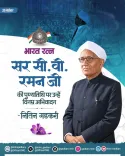
Gadkari pays tribute to C.V. Raman on death anniversary
Synopsis
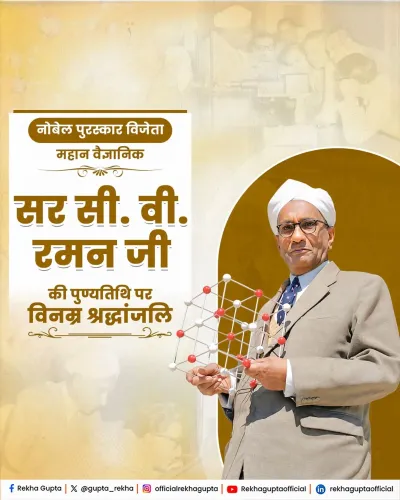
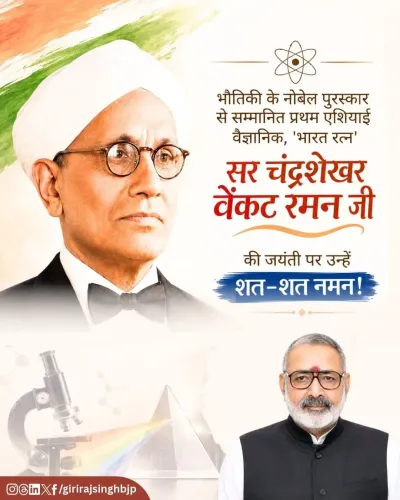
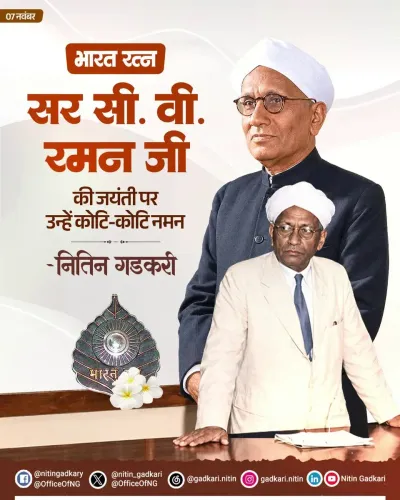
Union Minister Nitin Gadkari paid a humble tribute to Nobel Prize-winning physicist and Bharat Ratna Sir C.V. Raman on his death anniversary, honouring the scientist whose 1930 Nobel-winning discovery of the Raman Effect transformed global science.
Key Takeaways
Nitin Gadkari posted a tribute to Sir C.V.
Raman on his death anniversary, 21 November 2026 , on X.
Raman won the Nobel Prize in Physics in 1930 for discovering the Raman Effect — the inelastic scattering of light through matter.
He was awarded the Bharat Ratna in 1954 , the first year the honour was instituted.
Raman was the first Asian and first non-white scientist to win a Nobel Prize in the sciences.
India observes 28 February as National Science Day to mark the anniversary of the Raman Effect's announcement.
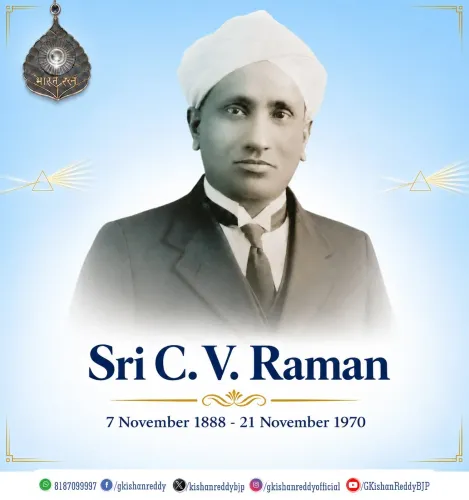
Raman passed away on 21 November 1970 in Bengaluru , at the Raman Research Institute he founded.
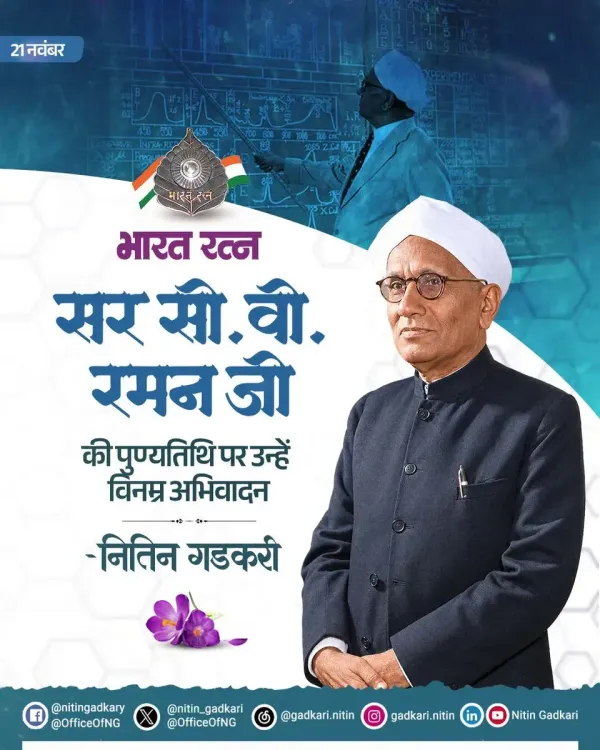
Fifty-six years after his passing, the man who made light itself a scientific instrument is remembered again — this time by Union Road Transport and Highways Minister Nitin Gadkari, who on Saturday, 21 November 2026, offered a humble salute to Nobel laureate and Bharat Ratna Sir C.V. Raman on his death anniversary.
Posting on X in Hindi, Gadkari wrote: 'Nobel Puraskar se sanmanit mahan vaigyanik Bharat Ratna Sir C.V. Raman ji ki punyatithi par unhe vinamra abhivadan' — 'A humble salute to the great Nobel Prize-honoured scientist Bharat Ratna Sir C.V. Raman on his death anniversary.'
The physicist who trapped light's secret
Chandrasekhara Venkata Raman was born in 1888 in Tiruchirapalli, Tamil Nadu, and went on to transform the world's understanding of how light behaves. In 1928, working at the Indian Association for the Cultivation of Science in Kolkata, he discovered what the world now calls the Raman Effect — the phenomenon by which light scattering through a material reveals the material's molecular fingerprint. It was a discovery made with modest equipment but towering intellect, and it earned him the Nobel Prize in Physics in 1930, making him the first Asian and first non-white scientist to win a Nobel in the sciences.
India recognised the scale of that achievement early: Raman received the Bharat Ratna in 1954, the country's highest civilian honour, in the very first year the award was instituted. He passed away on 21 November 1970 in Bengaluru, at the Raman Research Institute he had founded himself.
A legacy written in every spectroscope
The Raman Effect is not a relic of history — it is a living tool. Modern Raman spectroscopy underpins pharmaceutical quality control, forensic analysis, materials science, and even space-exploration instruments. India marks 28 February each year as National Science Day to commemorate the discovery's announcement in 1928, ensuring that schoolchildren across the country grow up knowing the name.
Gadkari's post is part of a wider, consistent tradition among Indian political leaders of publicly honouring scientists, reformers, and national icons on their birth and death anniversaries — a practice that keeps institutional memory alive in the public square.
Raman did not just win a prize. He proved that world-class science could be done in India, by an Indian, with Indian resources. That demonstration — made nearly a century ago — still echoes.
Point of View
Honoring pre-independence Indian scientists fits a broader cultural-nationalist narrative of indigenous genius. What makes Raman's case distinct is that his legacy is empirically unassailable — the Raman Effect is taught in every physics curriculum on earth — so the tribute transcends politics entirely. The ritual, however routine, still carries real signal: science, not just statecraft, belongs in the nation's hall of honour.
NationPress
21 Nov 2026
Frequently Asked Questions
When did C.V. Raman die and why is 21 November significant?
Sir C.V. Raman passed away on 21 November 1970 in Bengaluru , at the Raman Research Institute he had founded. The date is observed each year as his death anniversary, drawing tributes from political leaders and the scientific community.
What did C.V. Raman win the Nobel Prize for?
C.V. Raman was awarded the Nobel Prize in Physics in 1930 for discovering the Raman Effect — the phenomenon whereby light passing through a transparent material scatters at wavelengths that reveal the molecular composition of the material.
Was C.V. Raman awarded the Bharat Ratna?
Yes. Sir C.V. Raman received the Bharat Ratna in 1954 , making him one of the very first recipients of India's highest civilian honour in the award's inaugural year.
What is National Science Day in India and how is it connected to C.V. Raman?
National Science Day is observed on 28 February every year to commemorate the date in 1928 when C.V. Raman publicly announced his discovery of the Raman Effect.
Why did Nitin Gadkari post about C.V. Raman?
Union Minister Nitin Gadkari posted a tribute on X on 21 November 2026 — Raman's death anniversary — offering what he called a 'humble salute' to the Nobel laureate and Bharat Ratna, in keeping with a wider practice among Indian public figures of marking such anniversaries on social media.