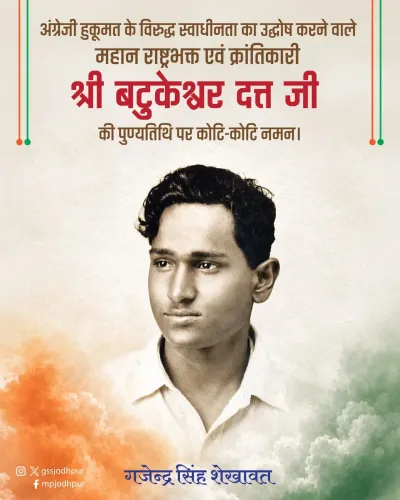
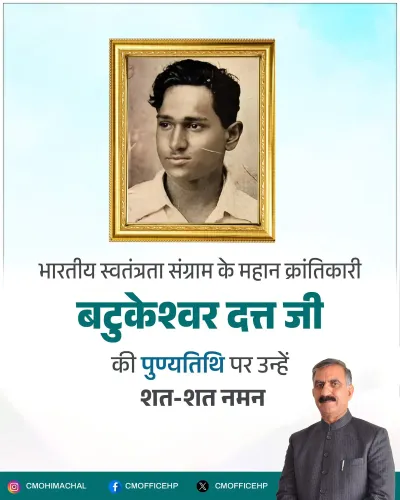
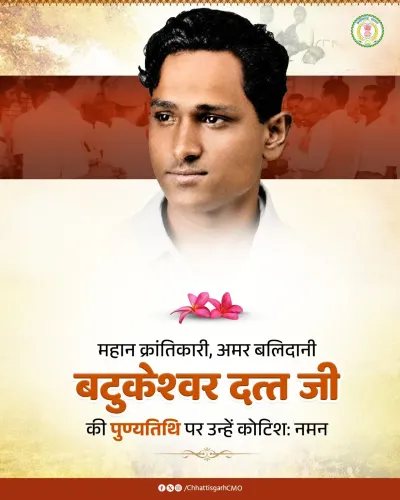
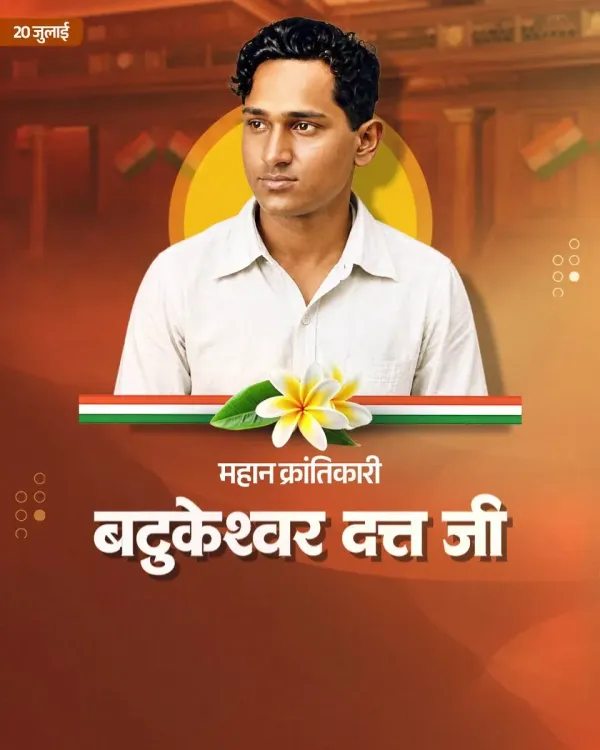
Gadkari pays tribute to revolutionary Batukeshwar Dutt on death anniversary
Synopsis
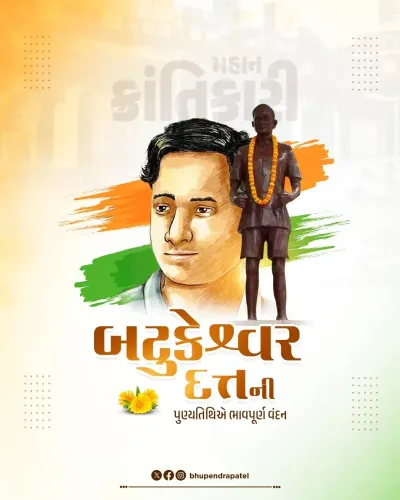
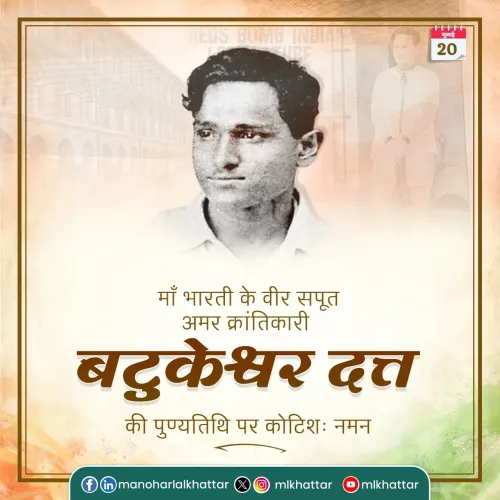
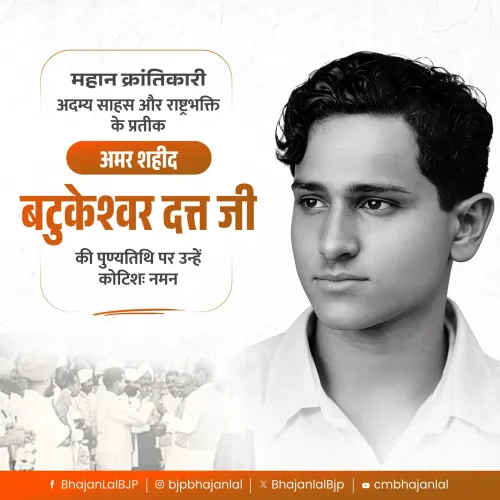
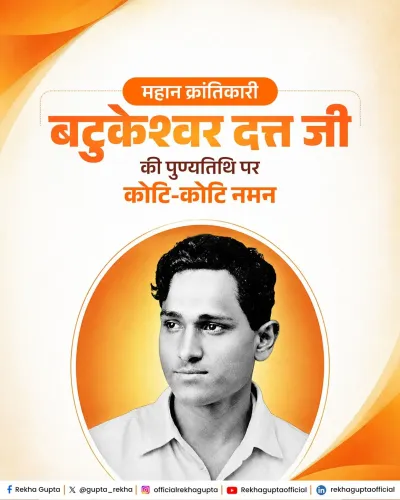
Union Minister Nitin Gadkari on 20 July 2026 paid homage to revolutionary Batukeshwar Dutt on his death anniversary, remembering him as a great patriot who, alongside Bhagat Singh, threw bombs in the Central Legislative Assembly in 1929 to protest British colonial legislation.
Key Takeaways
Nitin Gadkari posted a tribute to Batukeshwar Dutt on 20 July 2026 , the anniversary of Dutt's death in 1965 .
Batukeshwar Dutt and Bhagat Singh threw smoke bombs in the Central Legislative Assembly on 8 April 1929 to protest the Public Safety Bill and Trade Disputes Bill .
Dutt was a member of the Hindustan Socialist Republican Association (HSRA) and was sentenced to life transportation, serving time in the Cellular Jail , Andaman Islands.
Unlike Bhagat Singh, Dutt survived to see independence but died in relative obscurity on 20 July 1965 in New Delhi .
The tribute is part of a broader BJP pattern of commemorating armed revolutionary figures as part of its nationalist political narrative.
Union Road Transport and Highways Minister Nitin Gadkari on Monday, 20 July 2026, paid tribute to freedom fighter Batukeshwar Dutt on his death anniversary, hailing him as a great patriot and revolutionary. Gadkari posted his homage on X, using the Hindi phrase vinarm abhivadan — a humble salutation — to honour Dutt's memory.
Context
Batukeshwar Dutt was a prominent member of the Hindustan Socialist Republican Association (HSRA), the underground revolutionary organisation that sought to overthrow British colonial rule through direct action. On 8 April 1929, Dutt and Bhagat Singh threw smoke bombs inside the Central Legislative Assembly in Delhi to protest the passage of the Public Safety Bill and the Trade Disputes Bill — legislation the revolutionaries argued was designed to suppress labour and political dissent. The act was deliberate and theatrical: the two men did not flee, choosing arrest and a public trial as a platform to voice their ideology.
Dutt was subsequently tried, convicted, and sentenced to transportation for life. He spent years in the Cellular Jail in the Andaman Islands, enduring harsh conditions alongside other political prisoners. Unlike Bhagat Singh, who was hanged in 1931, Dutt survived to see Indian independence but spent much of his post-independence life in relative obscurity and poor health. He passed away on 20 July 1965 in New Delhi.
Policy Backdrop
Gadkari's post is part of a consistent pattern among senior BJP leaders of publicly commemorating pre-independence revolutionaries — particularly those associated with the armed resistance tradition, such as Bhagat Singh, Chandrashekhar Azad, and Batukeshwar Dutt. The party has long sought to foreground these figures as part of a broader nationalist narrative that extends the freedom movement's legacy beyond the Congress-led mainstream. Social media tributes on death and birth anniversaries have become a routine instrument for this political signalling.
Dutt's anniversary falls just weeks before Independence Day on 15 August, a period when references to lesser-known revolutionaries tend to intensify across government communications and state-level events.
Stakeholders and Impact
The tribute is directed at the general public and carries symbolic weight for communities and historians who feel that figures like Dutt have been insufficiently recognised in mainstream national memory. Batukeshwar Dutt spent his final years in poverty and relative anonymity, a fact that advocacy groups and historians have repeatedly highlighted as a failure of post-independence India to honour its revolutionary heroes adequately.
For Gadkari, who is among the BJP's most senior and widely respected leaders, the post reinforces the party's claim to the revolutionary nationalist tradition — a tradition it distinguishes from what it characterises as the more elite, negotiation-oriented strand of the freedom movement.
What's Next
With Independence Day 2026 approaching on 15 August, state governments and central ministries are likely to organise events honouring a range of freedom fighters, including lesser-celebrated figures such as Batukeshwar Dutt. The government has in recent years made efforts to document and publicise the contributions of revolutionaries who fall outside the canonical textbook narrative, and tributes like Gadkari's signal continued political will to keep such figures in public discourse.
Point of View
The party positions itself as the natural custodian of a more muscular nationalism, distinct from the Gandhian and Congress-centric narrative that dominates school curricula. The timing — weeks before Independence Day — amplifies the signal. What is notable is that Dutt remains genuinely under-celebrated relative to his role, meaning the tribute carries both political utility and a degree of legitimate historical corrective.
NationPress
21 Jul 2026
Frequently Asked Questions
Who was Batukeshwar Dutt?
Batukeshwar Dutt was an Indian revolutionary and member of the Hindustan Socialist Republican Association (HSRA) who, alongside Bhagat Singh, threw smoke bombs inside the Central Legislative Assembly on 8 April 1929 to protest British colonial legislation. He was convicted and sentenced to life transportation, serving years in the Cellular Jail in the Andaman Islands. He died on 20 July 1965 in New Delhi.
Why did Batukeshwar Dutt and Bhagat Singh bomb the Central Legislative Assembly?
The two revolutionaries threw smoke bombs — not lethal explosives — in the Central Legislative Assembly on 8 April 1929 to protest the Public Safety Bill and the Trade Disputes Bill, which they argued were designed to suppress political and labour dissent under British colonial rule. They deliberately chose arrest over escape to use their trial as a public platform.
When did Batukeshwar Dutt die?
Batukeshwar Dutt died on 20 July 1965 in New Delhi, after spending much of his post-independence life in poor health and relative obscurity despite his significant role in the freedom struggle.
Why does Nitin Gadkari pay tribute to freedom fighters on social media?
Senior BJP leaders, including Nitin Gadkari, regularly mark the birth and death anniversaries of pre-independence revolutionaries on social media as part of the party's broader effort to highlight nationalist icons, particularly those from the armed resistance tradition who are considered under-represented in mainstream historical narratives.
What is the Hindustan Socialist Republican Association?
The Hindustan Socialist Republican Association (HSRA) was an underground revolutionary organisation active in the late 1920s and early 1930s that sought to end British colonial rule through direct action. Its members included Bhagat Singh, Batukeshwar Dutt, and Chandrashekhar Azad, among others.