Giriraj Singh backs kamikaze drones, CoBRA push for CRPF
Synopsis
Union Textiles Minister Giriraj Singh on November 11, 2026 publicly backed kamikaze drone induction for the CRPF and reinforced CoBRA battalion deployments, calling advanced technology essential for strengthening India's internal security against terrorism and extremism.
Key Takeaways
Giriraj Singh , Union Textiles Minister and BJP MP from Begusarai , endorsed on November 11, 2026 the procurement of kamikaze drones for the CRPF .
He also backed fresh deployment of the CoBRA Battalion , the CRPF's elite counter-Naxal commando unit first raised in 2008–2009 .
The CRPF is India's largest Central Armed Police Force, operating under the Ministry of Home Affairs .
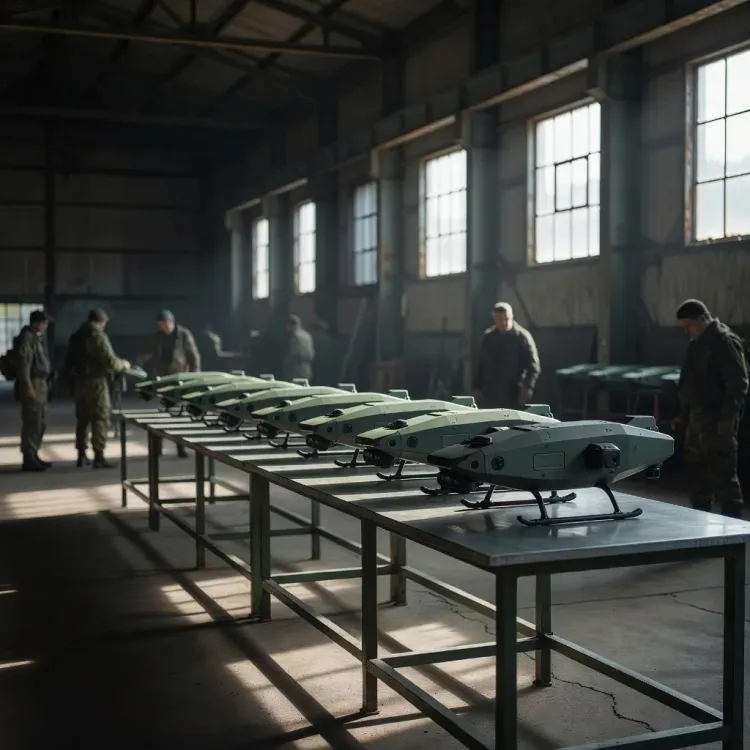
Kamikaze (loitering munition) drones can circle a target zone and strike on command — a significant escalation in internal security technology.
CoBRA deployments are closely watched in Naxal-affected states including Chhattisgarh and Jharkhand .
Singh's cross-portfolio advocacy signals broad political ownership within the NDA coalition for technology-led counter-insurgency modernisation.
Modernising India's internal security architecture just got a vocal champion in an unexpected corner of the cabinet. Union Textiles Minister Giriraj Singh, a senior BJP leader and Lok Sabha MP from Begusarai, Bihar, on Wednesday, November 11, 2026, threw his weight behind equipping the Central Reserve Police Force (CRPF) with kamikaze drones and reinforcing the elite CoBRA Battalion — signalling broad political consensus within the ruling alliance for a sharper, technology-led counter-insurgency posture.
Singh wrote: 'Aantarik suraksha ko aur adhik sudridh banane ke liye aadhunik takneek aur unnat sansadhanon se suraksha balon ko lait karna mahatvapurna hai' — 'Equipping security forces with modern technology and advanced resources is crucial to further strengthening internal security.' He specifically cited the procurement of new kamikaze drones for the CRPF and fresh deployments of the CoBRA (Commando Battalion for Resolute Action) as measures that will give 'new strength' to operations against terrorism and extremism.
What CoBRA brings to the jungle
CoBRA is not an ordinary paramilitary unit. First raised in 2008–2009 under a dedicated counter-Naxal mandate, it was purpose-built for jungle warfare in the dense, difficult terrain of central and eastern India — think Chhattisgarh's Bastar forests and Jharkhand's Saranda. These battalions combine the CRPF's mass mobilisation capability with the precision tactics of a commando outfit. Their operational reviews in states like Chhattisgarh and Jharkhand remain closely watched metrics of the government's anti-left-wing-extremism campaign.
The force they serve is itself a colossus: the CRPF is India's largest Central Armed Police Force, operating under the Ministry of Home Affairs, with a mandate spanning internal security, counter-insurgency, and emergency law-and-order duties across the country.
Kamikaze drones: the new edge in internal security
The reference to kamikaze — or loitering munition — drones marks a significant conceptual shift. Where surveillance drones observe and report, loitering munitions circle a target zone autonomously and strike on command. Their induction into internal security operations, if confirmed through formal procurement, would represent one of the most consequential technology upgrades the CRPF has seen in years. Procurement tenders and field trials for such drone systems are among the key developments to watch as this policy direction firms up.
Successive governments have pursued phased modernisation of Central Armed Police Forces — inducting surveillance tech, armoured vehicles, and specialised training to meet evolving threats. The current push, as articulated by Singh, extends that logic into lethal autonomous systems territory. Whether this signals an already-cleared Cabinet Security Committee decision or an advocacy position by a senior coalition voice, the direction of travel is unmistakable.
A minister beyond his portfolio — and why that matters
Giriraj Singh holds the Textiles portfolio, not Home Affairs. His public endorsement of a specific CRPF procurement and deployment strategy is therefore a political signal as much as a policy comment — illustrating how internal security modernisation commands cross-portfolio political ownership within the NDA government. For constituencies like Begusarai in Bihar — a state with its own complex security history — projecting a strong anti-extremism posture carries significant electoral resonance as well.
The fight against left-wing extremism has narrowed geographically over the past decade but remains ferocious in its remaining strongholds. Kamikaze drones and reinforced CoBRA deployments would, if operationalised, put formidable new tools in the hands of forces that have already significantly degraded Naxal networks. The question now is speed of procurement and rules of engagement. That is where the real story will unfold.
Point of View
Not merely a bureaucratic procurement exercise. The invocation of kamikaze drones marks a rhetorical and possibly doctrinal step-change: lethal autonomous systems in domestic counter-insurgency carry profound legal and operational implications that will demand transparent rules of engagement. CoBRA's renewed salience also suggests the government sees remaining left-wing extremist pockets as a problem to be decisively closed, not merely managed. How quickly procurement converts political signal into battlefield capability will be the true test of this posture.
NationPress
11 Nov 2026
Frequently Asked Questions
What is a kamikaze drone and why does the CRPF need one?
A kamikaze drone, also called a loitering munition, circles a target area autonomously and strikes on command — unlike surveillance drones that only observe. For the CRPF, induction of such systems would provide a precision strike capability in dense jungle terrain where traditional approaches are difficult, potentially transforming counter-insurgency operations against entrenched extremist groups.
What is the CoBRA Battalion of the CRPF?
CoBRA — Commando Battalion for Resolute Action — is an elite unit within the CRPF, first raised in 2008–2009 specifically for jungle warfare and counter-Naxal operations. It combines commando-level tactics with the CRPF's reach and is primarily deployed in Naxal-affected states like Chhattisgarh and Jharkhand.
Why is Textiles Minister Giriraj Singh commenting on CRPF security?
While Giriraj Singh holds the Textiles portfolio, senior cabinet ministers frequently comment on broad national security matters as part of collective political messaging. His statement reflects cross-portfolio NDA consensus on internal security modernisation and carries significance given his political base in Bihar, a state sensitive to security narratives.
What is the CRPF's role in India's internal security?
The Central Reserve Police Force is India's largest Central Armed Police Force, operating under the Ministry of Home Affairs. Its mandate covers counter-insurgency, anti-Naxal operations, law and order emergencies, and election duties across the country, making it the backbone of India's internal security deployment.
Which states are affected by Naxal violence where CoBRA operates?
CoBRA battalions are primarily deployed in left-wing extremism-affected states, with Chhattisgarh and Jharkhand being the most operationally active theatres. These states contain forested, remote terrain that has historically provided cover for Naxal groups, and CoBRA's jungle warfare specialisation is specifically designed for these environments.