Giriraj Singh backs PM Modi's call for e-Zero FIR in all states
Synopsis
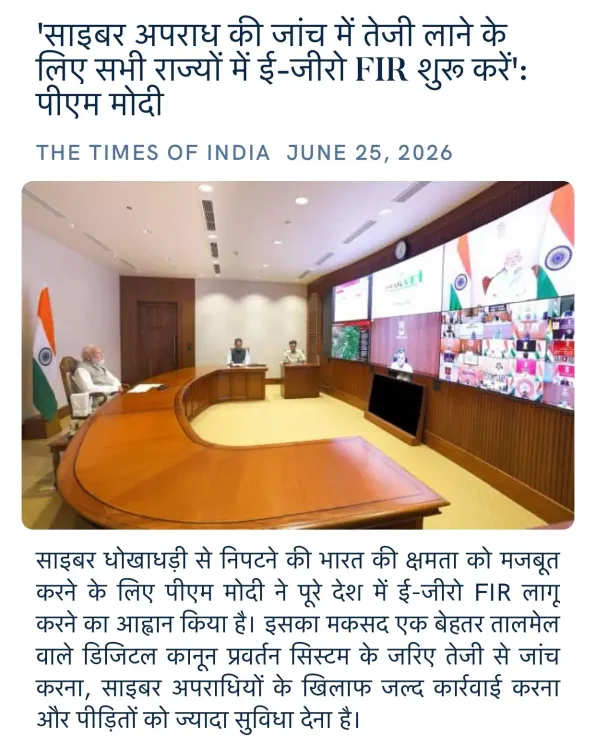
Union Textiles Minister Giriraj Singh on 25 June 2026 amplified PM Modi's directive to roll out e-Zero FIRs across all Indian states, aiming to eliminate jurisdictional delays in cyber fraud investigations and build on the I4C framework established since 2018.
Key Takeaways
Union Textiles Minister Giriraj Singh shared PM Modi's call for e-Zero FIR rollout in all states on 25 June 2026 .
An e-Zero FIR allows online, jurisdiction-free registration of cyber crime complaints at any police station.
The proposal extends earlier reforms: the National Cyber Crime Reporting Portal (2019) and the I4C framework (2018–2020).
State Home Departments must issue enabling orders for the mechanism to be operationalised.
Faster FIR registration is expected to speed up freezing of fraudulent accounts, reducing financial losses for victims.
Uniform adoption hinges on political will at the state level, making DGP and Chief Secretary conferences key forums to watch.
Union Textiles Minister Giriraj Singh on Thursday, 25 June 2026 amplified a directive attributed to Prime Minister Narendra Modi calling for the rollout of e-Zero FIR registration across all Indian states to accelerate investigations into cyber fraud cases.
Context
Giriraj Singh shared a report quoting the Prime Minister as saying, 'साइबर अपराध की जांच में तेजी लाने के लिए सभी राज्यों में ई-जीरो FIR शुरू करें' — translated: 'Roll out e-Zero FIRs in all states to speed up cyber crime investigations.' The post was shared via the NaMo App, a platform used by BJP leaders to amplify centrally curated governance messaging.
An e-Zero FIR is an electronic mechanism that allows a complainant to register a First Information Report at any police station — or online — regardless of jurisdiction, bypassing the procedural delays that typically arise in cross-state cyber crime cases. The proposal builds on Zero FIR provisions that were reinforced through police modernisation guidelines issued between 2014 and 2016.
Policy Backdrop
The push for e-Zero FIRs sits within a broader architecture that the Ministry of Home Affairs has been constructing for nearly a decade. The National Cyber Crime Reporting Portal was launched in 2019, enabling citizens to file cyber complaints online. The Indian Cyber Crime Coordination Centre (I4C), established in 2018, was later tasked with coordinating multi-state investigations and standardising data exchange between state police forces.
The 2020 I4C framework placed particular emphasis on inter-state cooperation for financial fraud cases — a category that has grown sharply alongside the mass adoption of digital payments in India. Introducing an e-Zero FIR mechanism would extend this architecture to the first point of contact between a victim and the justice system.
Stakeholders and Impact
State police forces would bear the primary implementation burden, requiring integration of their station-level software with a centralised filing system. Home Departments in each state would need to issue enabling orders before the mechanism can go live.
For cyber crime victims — particularly those defrauded through UPI, online banking, or social-media scams — the change would remove the current obstacle of approaching the 'correct' jurisdictional police station, which often delays complaint registration by days or weeks. Faster FIR registration also triggers quicker freezing of fraudulent accounts, limiting financial losses.
What's Next
The key indicator to watch is whether state Home Departments issue formal adoption orders and whether the directive features on the agenda of the next conference of Directors General of Police (DGPs) or Chief Secretaries. Central directives on policing carry persuasive but not mandatory force over state governments, making political will at the state level the decisive variable.
If adopted uniformly, e-Zero FIR could mark a significant procedural shift in how India's fragmented, state-administered police system handles the fast-growing category of cyber and financial fraud crimes — a test case for cooperative federalism in digital governance.
Point of View
Including the I4C framework, took years to embed meaningfully in state systems. If the e-Zero FIR gains traction, it could become a template for extending Digital India's reach into the criminal justice pipeline.
NationPress
24 Sept 2026
Frequently Asked Questions
What is an e-Zero FIR in India?
An e-Zero FIR is an electronic First Information Report that can be filed at any police station or online, regardless of which jurisdiction the crime occurred in, removing the procedural barrier of finding the 'correct' station before a complaint is registered.
Why is PM Modi pushing for e-Zero FIR for cyber crimes?
PM Modi has called for e-Zero FIRs to speed up cyber fraud investigations by eliminating jurisdictional delays at the complaint stage, allowing police to freeze fraudulent accounts faster and coordinate across state lines more efficiently.
What is the Indian Cyber Crime Coordination Centre (I4C)?
The Indian Cyber Crime Coordination Centre, or I4C, is a Ministry of Home Affairs body established in 2018 to coordinate multi-state cyber crime investigations, standardise data sharing between state police forces, and support the National Cyber Crime Reporting Portal.
Why did Giriraj Singh share this post about cyber crime?
As a senior BJP leader and Union Minister, Giriraj Singh regularly amplifies central government governance directives on social media via platforms like the NaMo App; his post on e-Zero FIR reflects the party's effort to highlight PM Modi's law-enforcement technology agenda.
Will all states be required to implement e-Zero FIR?
Since policing is a state subject under the Indian Constitution, the Centre cannot mandate adoption; state Home Departments must issue their own orders, making the rollout dependent on political will and administrative capacity in each state.