Giriraj Singh backs rights and dignity for women farmers
Synopsis
Union Textiles Minister Giriraj Singh on 16 July 2026 amplified a Maharashtra policy initiative aimed at giving women farmers formal rights and dignity, framing it as a significant step in India's ongoing effort to empower rural women in agriculture.
Key Takeaways
Giriraj Singh , Union Minister of Textiles and senior BJP leader, posted on 16 July 2026 calling the Maharashtra initiative 'a big step' for women farmers' rights.
The post was shared via the NaMo App and written in Hindi, signalling deliberate party-platform amplification.
The referenced policy relates to recognition and empowerment of women farmers in Maharashtra ; exact provisions are pending official confirmation.
The Mahila Kisan Sashaktikaran Pariyojana , launched in 2011 , remains the foundational central scheme for women in agriculture under the National Rural Livelihoods Mission .
Women farmers remain underrepresented in land records and institutional credit access, making formal recognition frameworks consequential for millions of rural women.
Rollout details and any parallel state-level legislative moves will be key indicators of policy momentum going forward.
Union Textiles Minister Giriraj Singh on Thursday, 16 July 2026, shared what he described as a major step toward securing the rights and dignity of women farmers, amplifying discussion around policy recognition for Maharashtra's women in agriculture through the NaMo App.
Context
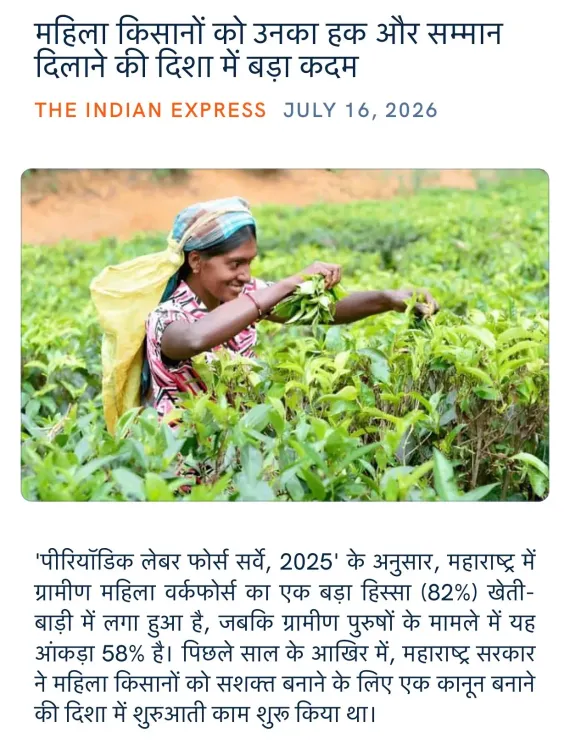
Posting in Hindi, the minister wrote: 'Mahila kisanon ko unka haq aur samman dilane ki disha mein bada kadam' — 'A big step in the direction of giving women farmers their rights and dignity.' The post was accompanied by a link to an opinion piece examining a Maharashtra legislative or policy initiative aimed at formally recognising and empowering women in farming. Singh shared the content via the NaMo App, a platform frequently used by senior BJP leaders to amplify policy messaging.
Policy Backdrop
The welfare of women farmers has been a recurring theme in Indian rural policy for over a decade. The Mahila Kisan Sashaktikaran Pariyojana, launched in 2011 under the National Rural Livelihoods Mission, was among the earliest dedicated central schemes to support and empower women in agriculture through training, resource access and self-help group linkages. Subsequent frameworks have sought to extend land rights, credit access and institutional recognition to women cultivators, who constitute a substantial share of India's agricultural workforce but have historically been undercounted in official land and tenancy records.
Maharashtra has periodically been at the forefront of state-level initiatives on gender and agriculture. The article shared by Singh references what appears to be a recognition and empowerment framework for women farmers in the state, though the precise provisions and legislative status of the measure remain subject to official confirmation.
Stakeholders and Impact
Women farmers and rural women across India stand as the primary stakeholders in any policy that formalises their role in agriculture. Recognition frameworks typically address issues such as inclusion of women's names in land records, access to institutional credit in their own right, eligibility for crop insurance, and representation in farmer producer organisations. Self-help groups, which number in the millions across rural India, are often the delivery channel for such benefits.
Senior BJP leaders at the Union level have periodically spotlighted state-level gender and agriculture initiatives to underscore alignment between central rural development priorities and state executive or legislative action. Singh's post fits this broader pattern of coordination between Union ministers and state-level measures in BJP-ruled or allied states.
What's Next
Attention will now turn to the rollout status of the Maharashtra policy referenced in the shared article, including its implementing rules and timelines for beneficiary coverage. Observers will also watch whether parallel legislative proposals emerge in other state assemblies during upcoming sessions, and whether the Union Ministry of Agriculture or the Ministry of Women and Child Development signals any complementary central measure. Singh's public endorsement adds political weight to the conversation and may prompt other state governments to accelerate similar recognition frameworks for women farmers.
Point of View
Seeking to close the perception gap on gender equity in agriculture. By anchoring the message to Maharashtra, the post also implicitly signals Union-state policy alignment, reinforcing the narrative that BJP-governed or allied states are delivering on women's empowerment. The move builds on a decade-long policy lineage but stops short of announcing any new central scheme, suggesting this is advocacy and agenda-setting rather than a formal policy announcement.
NationPress
15 Oct 2026
Frequently Asked Questions
What did Giriraj Singh post about women farmers on 16 July 2026?
He shared a post in Hindi calling a Maharashtra initiative 'a big step in the direction of giving women farmers their rights and dignity,' amplifying it via the NaMo App.
What is the Maharashtra women farmers recognition policy about?
It refers to a Maharashtra legislative or policy initiative aimed at formally recognising and empowering women in agriculture, though its exact provisions and status are subject to official confirmation.
What is the Mahila Kisan Sashaktikaran Pariyojana?
It is a central scheme launched in 2011 under the National Rural Livelihoods Mission to support and empower women farmers through training, resource access and self-help group linkages.
Why do women farmers need special recognition policies in India?
Women constitute a large share of India's agricultural workforce but are historically undercounted in land records and excluded from institutional credit and crop insurance in their own name.
Will other states follow Maharashtra's lead on women farmer empowerment?
Observers will watch upcoming state assembly sessions for parallel legislative proposals; Singh's high-profile endorsement may encourage other state governments to accelerate similar frameworks.