Giriraj Singh Spotlights Chhattisgarh's Bell Metal Dhokra Artisan
Synopsis
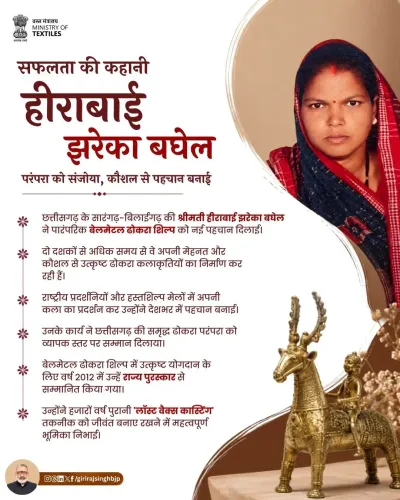
Union Textiles Minister Giriraj Singh spotlighted Chhattisgarh craftswoman Smt. Hirabai Jhareka Baghel on 29 October 2026, praising her role in preserving the ancient Bell Metal-Dhokra lost-wax casting tradition and urging Indians to recognise and encourage such artisans as guardians of cultural heritage.
Key Takeaways
Union Textiles Minister Giriraj Singh publicly recognised Smt.
Hirabai Jhareka Baghel , a Chhattisgarh -based Bell Metal-Dhokra craftswoman, on 29 October 2026 .
Dhokra is an ancient lost-wax metal-casting technique practised by tribal communities in Chhattisgarh , especially in the Bastar region.
The Ministry of Textiles periodically profiles individual artisans as part of its strategy to link cultural heritage with livelihood support and market access.
Singh called on the public to 'recognise, appreciate, and encourage' artisans who safeguard India's cultural heritage.
Potential follow-up actions include GI tag expansions for Chhattisgarh crafts, artisan award nominations, and invitations to national exhibitions like Surajkund Mela .
A centuries-old craft, a single artisan's hands, and a Union Minister's spotlight — Union Textiles Minister Giriraj Singh on Thursday, 29 October 2026 used his official X account to highlight Smt. Hirabai Jhareka Baghel, a craftswoman from Chhattisgarh who is keeping the ancient Bell Metal-Dhokra lost-wax casting tradition alive through sheer skill and dedication.
Posting in Hindi, Singh wrote: 'Chhattisgarh ki shilpkar Shrimati Hirabai Jhareka Baghel ji apne kaushal se Bell Metal-Dhokra kala ki samridh parampara ko aage badha rahi hain.' — 'The craftswoman Smt. Hirabai Jhareka Baghel of Chhattisgarh is advancing the rich tradition of Bell Metal-Dhokra art through her skill.' He called on people to 'recognise, appreciate, and encourage' artisans like her who play a vital role in safeguarding India's cultural heritage.
Dhokra: A Craft That Predates Modern Civilisation
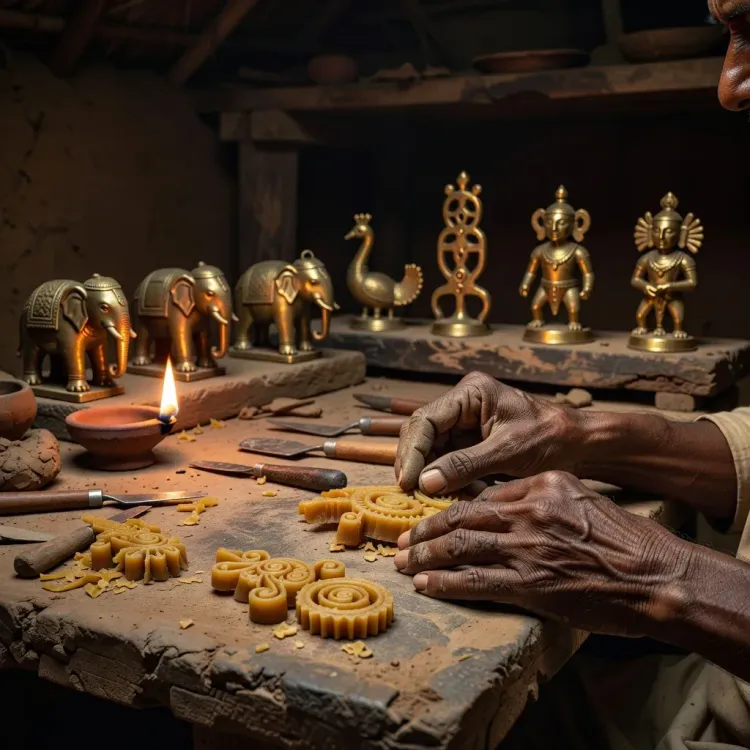
Dhokra, or Bell Metal casting using the lost-wax technique, is one of the oldest known metal-casting methods — examples dating back over 4,000 years have been linked to the Indus Valley. In Chhattisgarh, particularly across the Bastar region, this craft is deeply woven into tribal life and livelihood. Artisans shape beeswax into intricate forms, encase them in clay, pour molten metal alloy, and break open the mould to reveal a one-of-a-kind figure that can never be exactly replicated. Every piece is, by definition, unique.
The craft draws on Bell Metal — an alloy of copper and tin — and the communities practising it have historically passed the knowledge down through generations within families. That chain of transmission is precisely what makes artisans like Smt. Baghel so significant: they are living links to a technique the world cannot afford to lose.
The Textiles Ministry's Artisan Spotlight Strategy
This post is not a standalone gesture. The Ministry of Textiles, which carries a mandate covering both textiles and handicrafts promotion, has periodically used official social media channels to profile individual artisans working in traditional or Geographical Indication (GI)-protected crafts. The practice is part of a broader effort to tie cultural heritage preservation to tangible livelihood support — through artisan cluster programmes, national exhibitions such as the Surajkund Mela, and expanded market-access initiatives.
By naming Smt. Hirabai Jhareka Baghel publicly, Singh elevates a craftsperson who might otherwise remain invisible to urban and global markets — converting a ministerial platform into a visibility engine for tribal artisans.
The real question is whether the spotlight translates into sustained institutional support: a GI-tag expansion for Chhattisgarh's Bell Metal work, an artisan award nomination, or a confirmed berth at a national craft fair. Until then, the minister's words are a beginning — a worthy one, but only that.
Point of View
But critics within artisan communities have long argued that visibility alone does not replace stable procurement, fair pricing, or formal GI protection. The real policy test will come if this spotlight is followed by institutional action — an award, an exhibition slot, or a cluster-development scheme specifically targeting Bell Metal communities in Chhattisgarh. If it is not, the gesture risks becoming the ministerial equivalent of applause without a backstage pass.
NationPress
29 Oct 2026
Frequently Asked Questions
What is Bell Metal Dhokra art?
Bell Metal Dhokra is one of the world's oldest metal-casting techniques, using the lost-wax method in which molten metal alloy is poured into a clay-encased wax form to create unique, non-reproducible sculptures. It is especially prominent among tribal communities in Chhattisgarh's Bastar region.
Who is Smt. Hirabai Jhareka Baghel?
Smt. Hirabai Jhareka Baghel is a Chhattisgarh-based craftswoman recognised for continuing the Bell Metal-Dhokra lost-wax casting tradition. Union Textiles Minister Giriraj Singh highlighted her work on 29 October 2026.
Why did Giriraj Singh post about a Dhokra artisan?
As Union Minister of Textiles — a portfolio covering handicrafts promotion — Singh periodically spotlights individual artisans to raise public awareness and market visibility for traditional and GI-protected crafts, supporting tribal livelihoods in the process.
Does Chhattisgarh's Dhokra craft have a GI tag?
Dhokra craft from regions like Bastar has been the subject of GI-tag discussions in India. The Textiles Ministry's artisan-spotlight activity is linked to broader efforts around GI protection and cluster development, though specific tag status for Chhattisgarh Bell Metal work should be verified with official GI registry records.
How can one buy or support Dhokra craft from Chhattisgarh?
Dhokra artisans in Chhattisgarh sell through government craft emporiums, national exhibitions like Surajkund Mela, and artisan cluster programmes supported by the Ministry of Textiles. The ministry's visibility campaigns are specifically designed to connect such artisans with broader markets.