Giriraj Singh hails 12 years of PM Modi's digital revolution
Synopsis
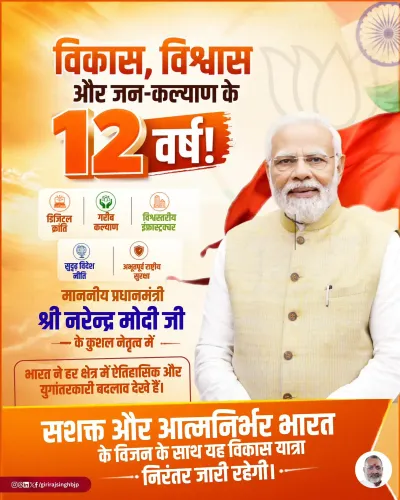
Union Textiles Minister Giriraj Singh on 9 June 2026 celebrated twelve years of PM Modi's digital revolution, saying the vision democratised technology for India's most vulnerable. The post echoes the BJP government's decade-long push through Digital India and the JAM framework to deliver services electronically to rural and low-income citizens.
Key Takeaways
Union Textiles Minister Giriraj Singh marked 12 years of PM Modi's digital governance push on 9 June 2026 .
The minister credited Modi's vision with bringing technology to every Indian , including the country's weakest sections.
The Digital India programme was launched on 1 July 2015 to build digital infrastructure and deliver government services electronically.
The Jan Dhan–Aadhaar–Mobile (JAM) framework, promoted from 2014 , enabled direct benefit transfers and financial inclusion for low-income groups.
Singh shared the post via the NaMo App , reflecting the BJP's use of its own digital platforms for political outreach.
Future focus areas include data protection frameworks , AI-enabled governance and last-mile digital connectivity in underserved states.
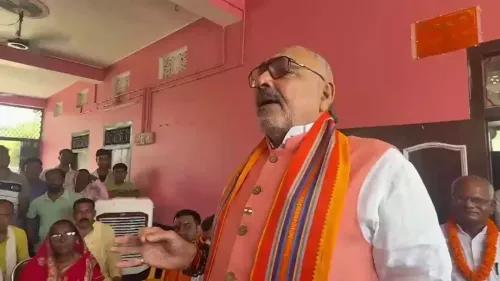
Union Textiles Minister Giriraj Singh on Tuesday, 9 June 2026 marked twelve years of what he called a digital revolution under Prime Minister Narendra Modi, crediting the leadership with democratising technology for India's most vulnerable citizens. Sharing his remarks via the NaMo App, the senior BJP leader said Modi's vision had brought technology to 'every person' — jan-jan tak — across the country.
Context
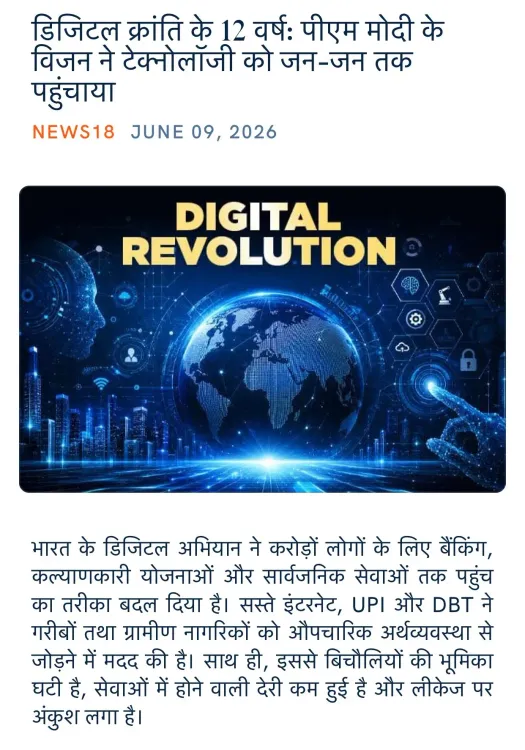
Singh's post, in Hindi, translates as: '12 years of the digital revolution: PM Modi's vision brought technology to every person.' The statement comes as the BJP-led central government completes over a decade of continuous digital governance initiatives, a milestone the ruling party has been marking across platforms and public forums. The minister framed the anniversary as a moment of reflection on how far India has come in bridging its digital divide.
The post was shared through the NaMo App, a platform associated with the BJP's digital outreach ecosystem, underscoring the party's continued use of technology infrastructure to amplify its own governance narrative.
Policy Backdrop
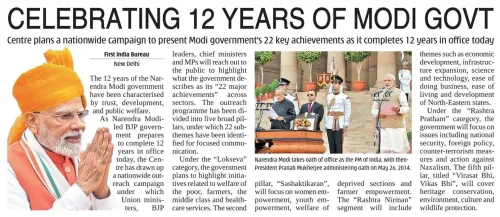
The Digital India programme, launched on 1 July 2015, serves as the backbone of the government's push to create digital infrastructure, deliver services electronically and expand digital literacy. The initiative was conceived as a structural shift — moving welfare delivery, identity verification and financial access onto a unified digital spine.
Central to this effort was the Jan Dhan–Aadhaar–Mobile (JAM) framework, promoted from 2014 onwards to enable direct benefit transfers and cut leakages in subsidy delivery. Together, these programmes aimed to bring low-income and rural citizens into the formal financial and digital ecosystem through biometric authentication and mobile-based payments.
Over the subsequent years, the government expanded the architecture to include UPI-based payments, e-governance portals and digital literacy missions targeting rural and semi-urban populations, particularly women and marginalised communities.
Stakeholders and Impact
The primary beneficiaries of India's digital public infrastructure have been rural citizens, women, small farmers and low-income households — segments historically excluded from formal financial and administrative systems. Direct benefit transfers enabled by the JAM framework have channelled government subsidies more efficiently to these groups.
For India's weaker sections, access to mobile banking, digital identity and e-government services has reduced dependence on intermediaries and expanded economic participation. The government has consistently cited this democratisation of technology as a pillar of its inclusive growth agenda.
Giriraj Singh, as a senior cabinet minister and Lok Sabha MP from Begusarai, Bihar — a state where digital and financial inclusion metrics have historically lagged — lends regional resonance to the broader national narrative.
What's Next
As India's digital public infrastructure matures, attention is turning to the next layer of challenges: data protection frameworks, AI-enabled governance and the deepening of last-mile connectivity in remote areas. Parliamentary discussions and forthcoming budget announcements are expected to address how the government plans to scale digital public goods further.
The government's ability to sustain and deepen these gains — particularly in states like Bihar, Uttar Pradesh and Odisha — will be a key measure of whether the digital revolution's benefits have truly reached jan-jan, every last citizen.
Point of View
Reinforcing the party's brand as the architect of India's digital transformation. Coming at the twelve-year mark, it signals a concerted effort to build a cumulative narrative around Digital India ahead of any electoral or budgetary cycle. For a minister representing Bihar — a state where digital and financial inclusion have been persistent policy challenges — the messaging also carries implicit regional electoral significance. The broader pattern suggests the government is preparing to defend and extend its digital public infrastructure record as a central plank of its development story.
NationPress
16 Sept 2026
Frequently Asked Questions
What did Giriraj Singh say about PM Modi's digital revolution?
Giriraj Singh said that PM Modi's vision had brought technology to every person in India over 12 years, democratising access for the country's weakest sections.
When was the Digital India programme launched?
The Digital India programme was launched on 1 July 2015 by the central government to build digital infrastructure and deliver services electronically across India.
What is the JAM framework in India?
The Jan Dhan–Aadhaar–Mobile (JAM) framework, promoted from 2014, links bank accounts, biometric identity and mobile numbers to enable direct benefit transfers and expand financial inclusion for low-income citizens.
Who is Giriraj Singh and what is his current role?
Giriraj Singh is the Union Minister of Textiles and a senior BJP leader. He is a Lok Sabha MP from Begusarai, Bihar, and frequently uses social media to comment on government initiatives.
How has Digital India benefited rural and poor citizens?
Digital India and the JAM framework have helped rural and low-income citizens access government subsidies directly, reduced dependence on intermediaries, and expanded mobile banking and e-governance services to previously underserved communities.