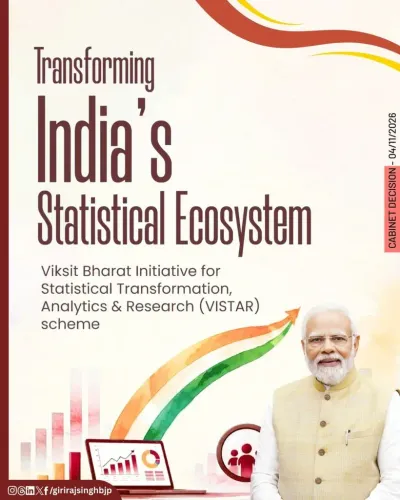
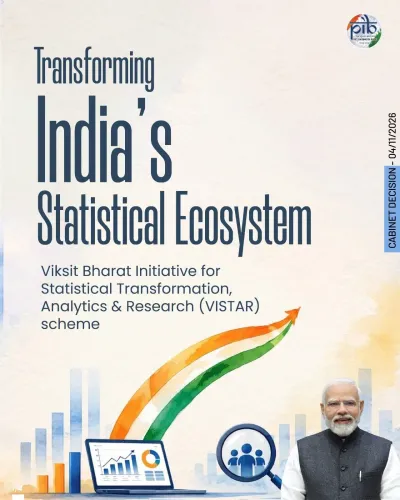
Giriraj Singh: Cabinet clears VISTAR stats scheme
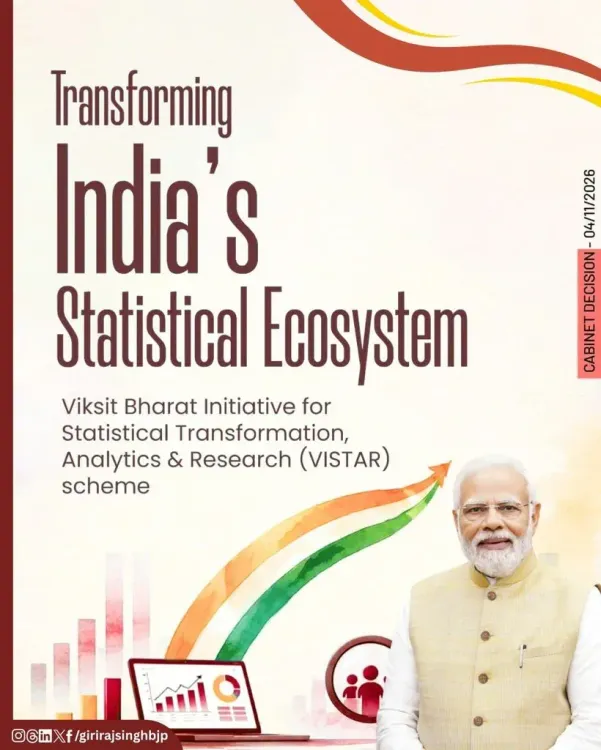
Synopsis
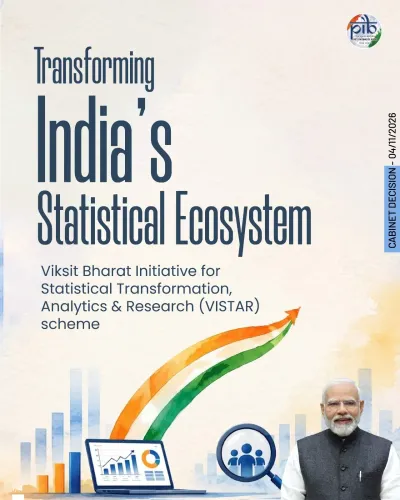
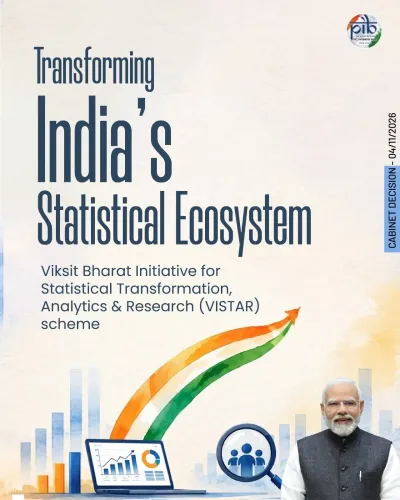
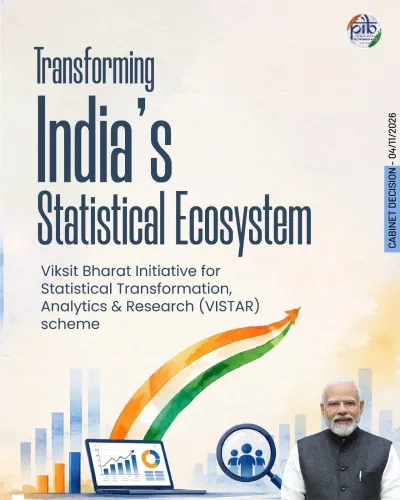
The Union Cabinet has approved the VISTAR scheme to modernise India's official statistical ecosystem, covering FY 2026-27 to 2030-31, in line with the Viksit Bharat 2047 vision. Union Textiles Minister Giriraj Singh shared the announcement on X.
Key Takeaways
The Union Cabinet approved the VISTAR (Viksit Bharat Initiative for Statistical Transformation, Analytics and Research) scheme.
The scheme runs from FY 2026-27 to FY 2030-31 — a five-year implementation window.
Its stated goal is to modernise and strengthen India's official statistical ecosystem.
The scheme is aligned with the Viksit Bharat framework targeting India's development by 2047 .
The nodal ministry is MoSPI (Ministry of Statistics and Programme Implementation).
Detailed funding outlines and guidelines are expected through upcoming Union Budgets from 2026-27 onwards.
India's official data backbone is getting a five-year overhaul. Union Textiles Minister Giriraj Singh announced on Wednesday, 4 November 2026 that the Union Cabinet has approved the Viksit Bharat Initiative for Statistical Transformation, Analytics and Research (VISTAR) scheme — a multi-year programme designed to modernise and strengthen the country's official statistical ecosystem.
What VISTAR sets out to do
The scheme will run from financial year 2026-27 through 2030-31, giving it a five-year runway to reform how India collects, analyses, and disseminates official data. The name itself signals intent: 'VISTAR' — meaning 'expansion' in Hindi — is explicitly anchored to the government's broader Viksit Bharat (Developed India) vision for 2047, which treats data modernisation as foundational to long-term planning across every sector.
The nodal body for the scheme is the Ministry of Statistics and Programme Implementation (MoSPI), which oversees India's core statistical machinery — from GDP estimates and consumer price indices to the Census and large-scale household surveys. Any upgrade to that infrastructure feeds directly into the numbers that drive budget allocations, welfare targeting, and economic policymaking.
A statistical system long overdue for reform
India's statistical architecture has been periodically reviewed since the Rangarajan Commission recommendations led to the creation of the National Statistical Commission in 2005 — itself a landmark step toward institutional independence in data governance. Two decades on, rapid digitalisation, newer economic sectors, and the ambitions of a $5-trillion-and-beyond economy have outpaced the old infrastructure. VISTAR is the Cabinet's answer to that gap.
The pattern is familiar: multi-year Cabinet approvals for statistical upgrades typically follow reviews that expose data lags in economic and social indicators. What is new here is the explicit alignment with the Viksit Bharat framework — signalling that data quality is now treated as a development priority, not a bureaucratic afterthought.
What policymakers and researchers will watch next
The Cabinet approval is the starting pistol, not the finish line. Detailed scheme guidelines, specific programme components, and — critically — budgetary allocations are expected to be formalised through Union Budgets beginning in 2026-27. Parliamentary committee scrutiny of the scheme's targets and spending will be the next meaningful checkpoint. Research institutions and state statistical bureaus, both key stakeholders, will be watching to see how much of the scheme's ambition translates into on-the-ground capacity.
A stronger statistical system does not make headlines the way an infrastructure project does — but it underpins every policy decision that does.
Point of View
Implying that reliable data is now officially a prerequisite for development, not a by-product of it. The long gap since the National Statistical Commission's formation in 2005 gives this approval political salience — it acknowledges that the system has aged. Whether the scheme delivers will ultimately depend on its budgetary muscle and whether state-level statistical capacity is brought into the fold.
NationPress
5 Nov 2026
Frequently Asked Questions
What is the VISTAR scheme approved by the Union Cabinet?
VISTAR stands for Viksit Bharat Initiative for Statistical Transformation, Analytics and Research. It is a government scheme approved by the Union Cabinet to modernise and strengthen India's official statistical ecosystem, covering the period from FY 2026-27 to 2030-31.
Which ministry will implement the VISTAR scheme?
The Ministry of Statistics and Programme Implementation (MoSPI) is the nodal ministry responsible for India's official statistical system and is expected to oversee the VISTAR scheme's implementation.
How long will the VISTAR scheme run?
The VISTAR scheme is approved for five financial years, from 2026-27 to 2030-31.
How is VISTAR connected to Viksit Bharat?
VISTAR is explicitly designed under the Viksit Bharat framework, the government's vision for a fully developed India by 2047. It treats data modernisation as a foundational pillar for achieving long-term development and economic planning targets.
When will the budget and details for VISTAR be known?
Detailed budgetary allocations and scheme guidelines for VISTAR are expected to be announced through Union Budgets beginning in FY 2026-27, and may also be subject to parliamentary committee review.