Giriraj Singh calls Khadi backbone of Atmanirbhar Bharat
Synopsis
Union Textiles Minister Giriraj Singh on 27 July 2026 called Khadi the foundation of Atmanirbhar Bharat and crores of artisan livelihoods, urging every Indian to adopt it while citing PM MITRA parks, the PLI scheme, technical textiles, and skill development as the policy pillars reshaping India's textile sector.
Key Takeaways
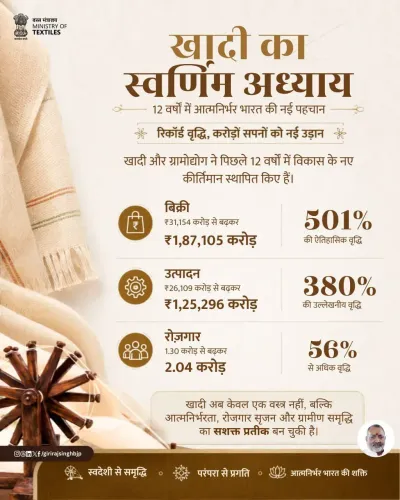
Giriraj Singh described Khadi as the backbone of Atmanirbhar Bharat and the livelihood of crores of weavers and artisans in a post on 27 July 2026 .
The minister called on every Indian to adopt Khadi, saying it could bring positive change to 'innumerable families.' PM MITRA Parks , announced in the Union Budget 2021-22 , aim to create world-class integrated textile infrastructure across multiple states.
The PLI Scheme for Textiles , approved in 2021 , provides financial incentives to scale domestic manufacturing and exports.
Technical textiles and skill development were cited as additional pillars giving the sector 'a new direction.' The appeal aligns with the Vocal for Local and Atmanirbhar Bharat campaigns active since May 2020 .
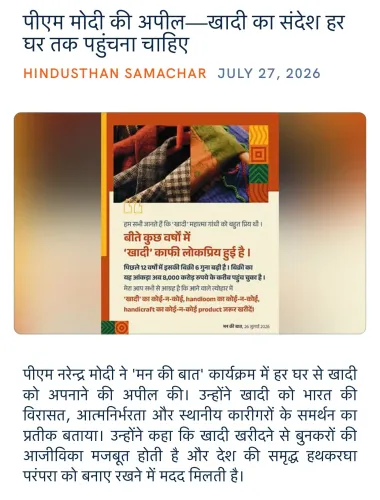
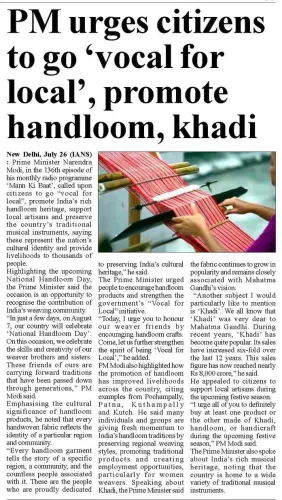
Union Textiles Minister Giriraj Singh on Monday, 27 July 2026 called Khadi far more than a fabric, describing it as the foundation of self-reliant India, indigenous thinking, and the livelihoods of crores of weavers and artisans. The minister used his official X account to urge every Indian to adopt Khadi, arguing that such a shift could bring positive change to countless families.
Context
In his post, Giriraj Singh wrote: 'खादी केवल एक वस्त्र नहीं, बल्कि आत्मनिर्भर भारत, स्वदेशी सोच और करोड़ों बुनकरों-कारीगरों की आजीविका का आधार है' — 'Khadi is not merely a cloth, but the foundation of Atmanirbhar Bharat, the spirit of Swadeshi, and the livelihood of crores of weavers and artisans.' He added that if every Indian embraces Khadi, it can bring a positive transformation to innumerable families. The appeal was accompanied by hashtags #Khadi, #VocalForLocal, and #AtmanirbharBharat, signalling its alignment with the government's broader economic messaging.
The minister also highlighted ongoing efforts to give Khadi and handicrafts 'new markets, modern designs, and global recognition,' naming specific flagship schemes as the vehicles for this ambition. The statement comes as the textiles ministry continues to position India's traditional crafts within a modern industrial and export framework.
Policy Backdrop
The schemes cited by Giriraj Singh form the core of the Centre's post-2020 textiles strategy. The PM MITRA (PM Mega Integrated Textile Region and Apparel) Parks scheme, announced in the Union Budget 2021-22, aims to develop world-class integrated textile infrastructure across multiple states, providing common facilities and complete value chains under one roof.
The Production Linked Incentive (PLI) Scheme for Textiles, approved in 2021, offers financial incentives to domestic manufacturers to scale up output and exports in man-made fibre apparel, fabric, and technical textiles. Alongside these, the government has pushed technical textiles — a high-value segment covering medical, defence, and agricultural applications — and skill development programmes targeting artisan communities. These initiatives collectively seek to raise domestic value addition, create employment, and expand India's share in global textile trade.
The Atmanirbhar Bharat Abhiyan, launched in May 2020, and the Vocal for Local campaign that gained prominence the same year, provided the ideological scaffolding for linking traditional crafts such as Khadi with formal industrial schemes. The Khadi and Village Industries Commission (KVIC), a statutory body under the Ministry of Micro, Small and Medium Enterprises, has been a key institutional vehicle for promoting Khadi production and rural artisan incomes.
Stakeholders and Impact
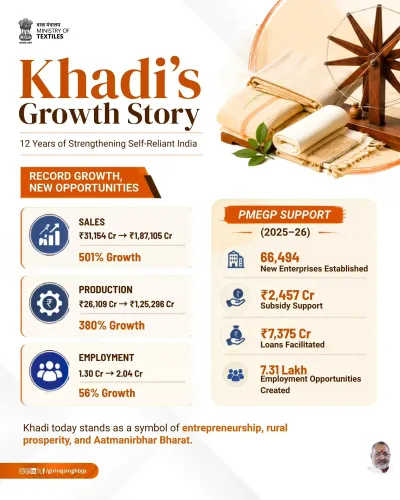
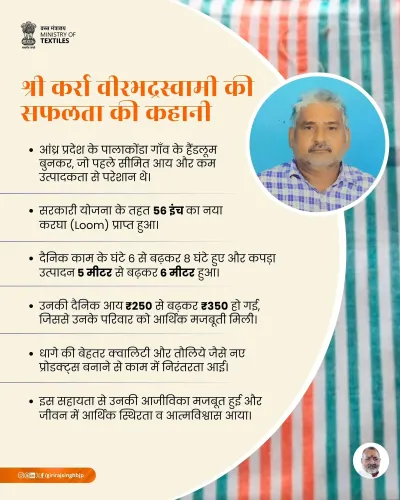
Handloom weavers and textile artisans stand at the centre of the minister's appeal. India has one of the largest handloom and handicraft workforces in the world, and Khadi production remains a significant source of rural income, particularly in states such as Bihar, Uttar Pradesh, Gujarat, and West Bengal. A sustained increase in consumer demand for Khadi products directly translates into higher earnings and more stable livelihoods for these communities.
On the industrial side, the PLI scheme and PM MITRA parks are designed to attract private investment into the organised textile sector, creating a complementary demand for skilled labour. Modern design interventions and access to global markets — both referenced by Giriraj Singh — are seen as critical to making Khadi and handicraft products competitive beyond the domestic market.
What's Next
Observers will watch for concrete progress on PM MITRA park approvals and land acquisition in identified states, which has been a bottleneck in rolling out the scheme at scale. Any mid-term review of PLI disbursements for textiles will also be closely tracked by industry stakeholders. Parliamentary discussions and forthcoming budget deliberations are expected to address additional allocations for skill development and technical textiles, areas the minister specifically flagged as priorities for giving the sector 'a new direction.'
The minister's statement reinforces the government's intent to keep Khadi and traditional crafts at the symbolic and economic heart of India's textiles policy, even as it pursues large-scale industrial modernisation through integrated parks and production incentives.
Point of View
The minister signals that the government wants credit both for grassroots artisan welfare and for large-scale industrial ambition. This dual messaging is particularly significant given that PM MITRA park rollouts have faced land-acquisition delays, making public ministerial advocacy a tool to sustain momentum and investor confidence. The statement also fits a broader pattern of senior cabinet ministers using social media to frame policy continuity ahead of budget and parliamentary cycles.
NationPress
27 Jul 2026
Frequently Asked Questions
What did Giriraj Singh say about Khadi?
Giriraj Singh said Khadi is not merely a fabric but the foundation of Atmanirbhar Bharat, the Swadeshi spirit, and the livelihoods of crores of weavers and artisans, urging every Indian to adopt it.
What is the PM MITRA Park scheme?
PM MITRA (PM Mega Integrated Textile Region and Apparel) Parks is a central government scheme announced in the Union Budget 2021-22 to develop world-class integrated textile infrastructure, common facilities, and complete value chains across multiple states.
How does the PLI scheme help the textiles sector?
The Production Linked Incentive scheme for textiles, approved in 2021, provides financial incentives to domestic manufacturers to scale up output, boost exports, and generate employment in man-made fibre apparel, fabric, and technical textiles.
What is Atmanirbhar Bharat and how does it relate to Khadi?
Atmanirbhar Bharat Abhiyan is a national self-reliance campaign launched in May 2020 that emphasises domestic manufacturing and reduced import dependence; Khadi promotion is positioned as a grassroots expression of this vision, linking traditional craft with formal industrial policy.
Who oversees Khadi production in India?
The Khadi and Village Industries Commission (KVIC), a statutory body under the Ministry of Micro, Small and Medium Enterprises, is the principal institution responsible for promoting Khadi production and supporting rural artisan livelihoods across India.