Giriraj Singh highlights Chhattisgarh's rise under Modi era
Synopsis
Union Textiles Minister Giriraj Singh amplified a BJP narrative on June 14, 2026, framing Chhattisgarh's journey from a Left Wing Extremism conflict zone to a growth engine under Prime Minister Narendra Modi, citing infrastructure and security gains since 2014.
Key Takeaways
Union Textiles Minister Giriraj Singh shared an article on June 14, 2026 via the NaMo App praising Chhattisgarh's transformation under the Modi government.
Chhattisgarh , formed in 2000 , has been one of India's most LWE-affected states, with districts like Bastar and Sukma at the epicentre.
The central government launched the Road Connectivity Project for LWE Affected Areas in 2016 to improve access in conflict-hit districts.
Multiple Chhattisgarh districts were included in the Aspirational Districts Programme from 2018 , directing focused welfare investment.
The BJP's messaging frames improved security as a catalyst for industrial investment in the state's mineral-rich interior.
Upcoming state assembly sessions and budget discussions on industrial policy and LWE road funding will be key indicators of progress.
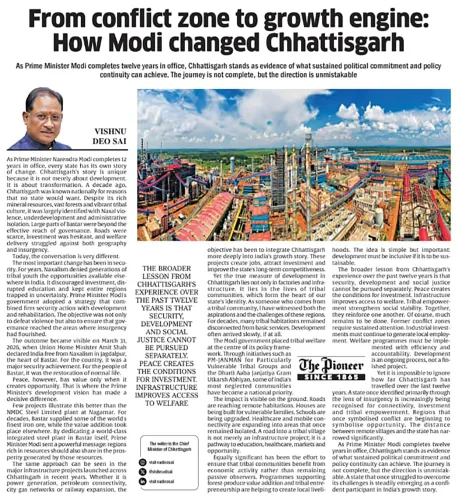
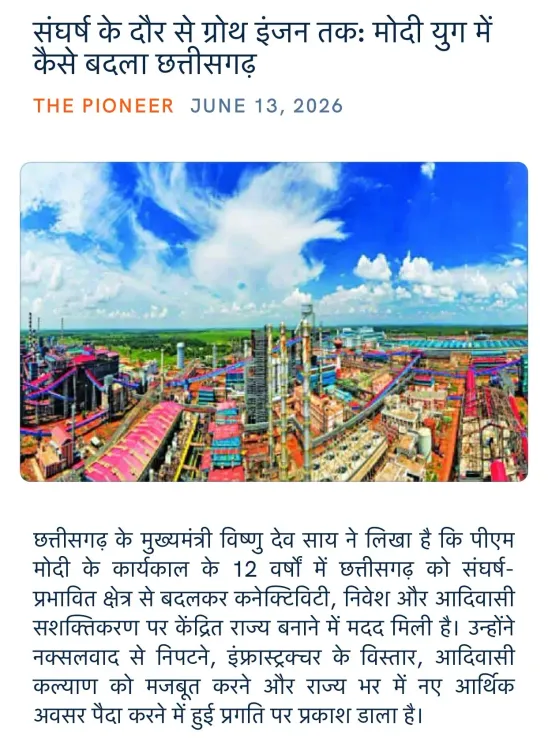
Union Textiles Minister Giriraj Singh on Sunday, June 14, 2026, shared an article praising the transformation of Chhattisgarh under the Narendra Modi government, amplifying a narrative that frames the state's journey as moving from a conflict zone to a growth engine during the Modi era.
The post, shared via the NaMo App, carried the headline 'संघर्ष के दौर से ग्रोथ इंजन तक: मोदी युग में कैसे बदला छत्तीसगढ़' ('From the era of conflict to growth engine: how Chhattisgarh changed in the Modi era'), underscoring a central BJP communication theme ahead of policy and budget discussions.
Context
Chhattisgarh, carved out of Madhya Pradesh in 2000, has for decades been among the states most severely affected by Left Wing Extremism (LWE), with Maoist insurgency disrupting governance, infrastructure development, and investment across large swathes of its mineral-rich interior. The state's tribal heartland — spanning districts such as Bastar, Sukma, and Dantewada — bore the brunt of prolonged violence that hampered both public services and economic activity.
The framing of Chhattisgarh as a 'growth engine' represents a deliberate shift in political messaging, positioning improved security conditions as a gateway to industrial and infrastructure expansion.
Policy Backdrop
Since 2014, the central government has pursued a twin-track approach in LWE-affected regions: intensified coordinated security operations alongside targeted connectivity and welfare investments. In 2016, the Road Connectivity Project for LWE Affected Areas was launched to open remote districts to commerce and administration. From 2018, several Chhattisgarh districts were included in the Aspirational Districts Programme, channelling focused central resources into health, education, and livelihoods.
This policy architecture has been replicated across the LWE belt — including Jharkhand and Odisha — with Chhattisgarh consistently cited as a flagship case where improved ground security has begun to translate into measurable development indicators and fresh industrial interest in the state's substantial mineral reserves.
Stakeholders and Impact
The primary beneficiaries of reduced LWE violence are tribal communities in interior districts who previously had limited access to roads, schools, hospitals, and banking services. Central paramilitary forces and Chhattisgarh Police have been central to the security gains, while mining and industrial investors have watched the improving environment as a signal for fresh capital deployment in the state's coal, iron ore, and bauxite sectors.
Critics and civil society groups have, however, raised concerns about the pace at which security-driven development translates into genuine welfare for forest-dwelling communities, particularly around land rights and displacement linked to mining expansion.
What's Next
Attention will now turn to upcoming state assembly debates on Chhattisgarh's new industrial policy and central funding allocations for LWE roads and mining projects in forthcoming budget sessions. Singh's amplification of the 'growth engine' narrative suggests the BJP intends to make Chhattisgarh's development trajectory a prominent talking point in national political discourse, particularly as the central government seeks to consolidate its record on security and development in India's tribal heartland.
Point of View
And which the party has deployed with increasing frequency ahead of budget and policy cycles. By amplifying the Chhattisgarh story via the NaMo App, the communication is clearly routed through the party's own digital infrastructure, signalling coordinated rather than spontaneous outreach. The framing of a mineral-rich tribal state as a 'growth engine' also quietly sets the stage for justifying expanded mining and industrial activity in regions where land and forest rights remain contested. Analysts will watch whether this narrative is backed by fresh policy announcements or remains primarily an electoral positioning exercise.
NationPress
13 Sept 2026
Frequently Asked Questions
What did Giriraj Singh post about Chhattisgarh?
On June 14, 2026, Union Textiles Minister Giriraj Singh shared an article via the NaMo App framing Chhattisgarh's transformation from a Left Wing Extremism conflict zone to a growth engine under Prime Minister Narendra Modi.
How has Chhattisgarh changed under the Modi government?
The central government has pursued intensified anti-Naxal security operations alongside infrastructure schemes such as the Road Connectivity Project for LWE Affected Areas (2016) and inclusion in the Aspirational Districts Programme (2018), which together aim to convert improved security into development gains.
What is the Aspirational Districts Programme and how does it affect Chhattisgarh?
The Aspirational Districts Programme, launched in 2018, channels focused central government resources into health, education, and livelihoods in underdeveloped districts. Several Chhattisgarh districts, particularly in the LWE-affected interior, were included in the programme.
What is Left Wing Extremism and why is Chhattisgarh significant?
Left Wing Extremism refers to the decades-long Maoist insurgency in central and eastern India. Chhattisgarh has been one of the most severely affected states, with districts such as Bastar, Sukma, and Dantewada experiencing prolonged violence that disrupted governance and development.
What are the concerns about Chhattisgarh's development push?
Civil society groups and critics have raised concerns that security-driven development may not adequately protect the land rights and welfare of forest-dwelling tribal communities, particularly given the expansion of mining activity in the state's mineral-rich interior.