Giriraj Singh eyes $100 bn textile exports by 2030
Synopsis
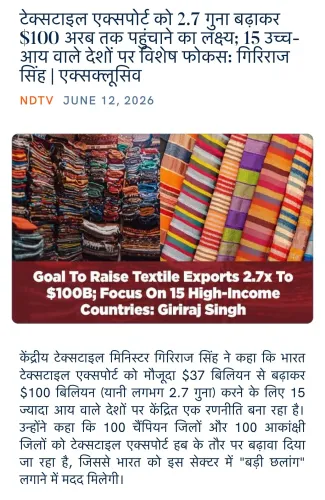
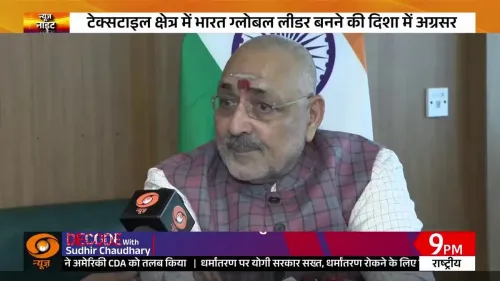
Union Textiles Minister Giriraj Singh has highlighted India's goal of reaching $100 billion in textile exports by 2030, with Free Trade Agreements and sustainability compliance identified as the two key drivers of that ambition.
Key Takeaways
Union Textiles Minister Giriraj Singh shared India's $100 billion textile export target for 2030 on 25 June 2026 .
Sustainability standards and Free Trade Agreements (FTAs) are identified as the twin pillars of India's textile export strategy.
The 2022 Foreign Trade Policy had already set a broader merchandise export goal of $2 trillion by 2030 , with textiles as a priority sector.
The PLI scheme for man-made fibre apparel and technical textiles , notified in 2021 , is a key instrument to scale up production capacity.
Key FTA negotiations with the EU and UK are being closely watched as potential tariff-reduction levers for Indian exporters.
The textile sector directly employs an estimated 4.5 crore people , making the export push a significant employment-policy priority.
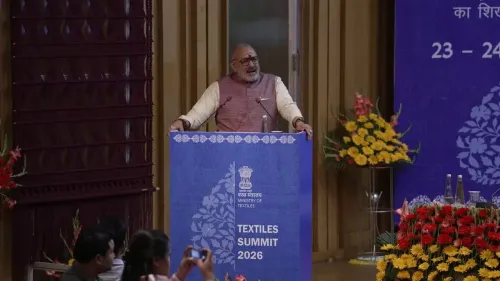
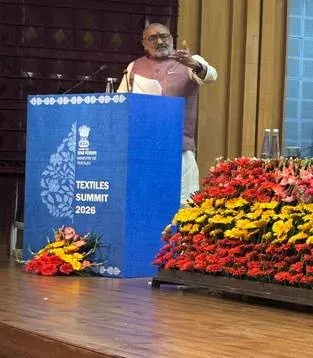
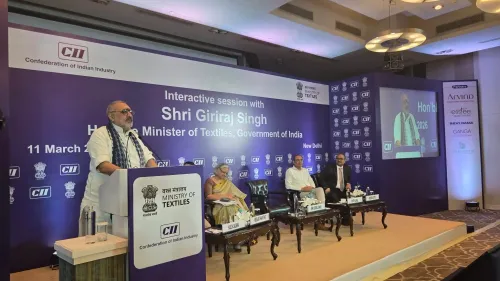
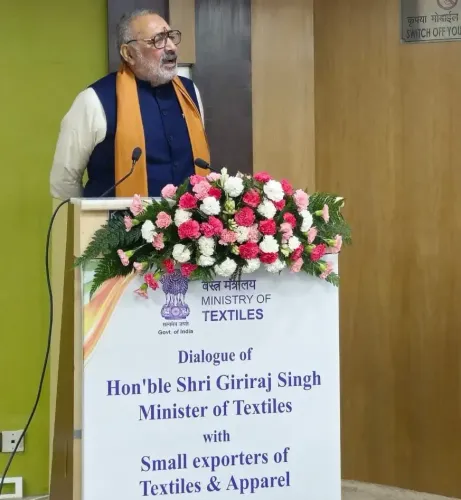
Union Textiles Minister Giriraj Singh on Thursday, 25 June 2026 shared India's ambition to reach $100 billion in textile exports by 2030, flagging sustainability standards and Free Trade Agreements as the twin pillars of the country's strategy to achieve that target.
Context
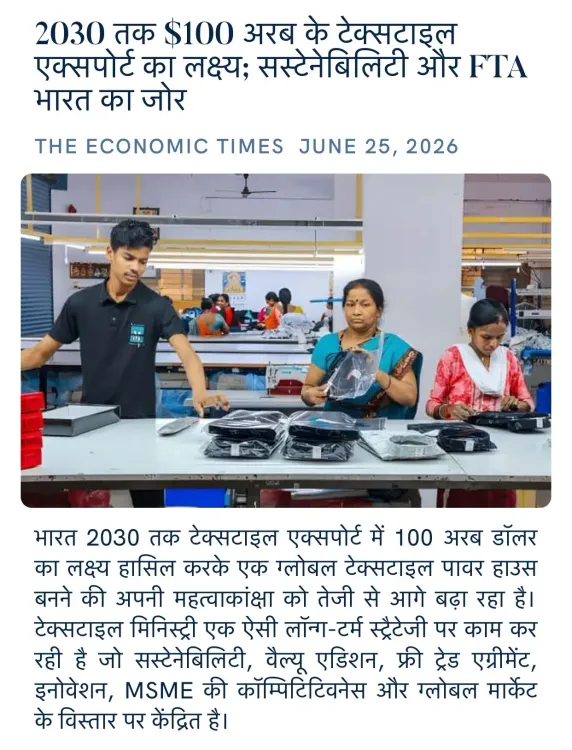
The minister shared a report highlighting India's $100 billion textile export goal for 2030, with the post's Hindi caption reading: '2030 tak $100 arab ke textile export ka lakshya; sustainability aur FTA Bharat ka zor' — ('Target of $100 billion in textile exports by 2030; sustainability and FTAs are India's focus'). The post was shared via the NaMo App, a platform routinely used by BJP leaders to amplify government messaging.
India is currently the world's second-largest textile producer and one of the largest exporters of cotton yarn, fabrics, and readymade garments. The sector employs an estimated 4.5 crore people directly, making it one of the most employment-intensive industries in the country.
Policy Backdrop
The $100 billion target sits within a broader export architecture. The 2022 Foreign Trade Policy set an overall merchandise export goal of $2 trillion by 2030, with textiles identified as a priority sector. To accelerate output, the government in 2021 notified the Production Linked Incentive (PLI) scheme for man-made fibre apparel and technical textiles, offering financial incentives to manufacturers who scaled up capacity and revenues.
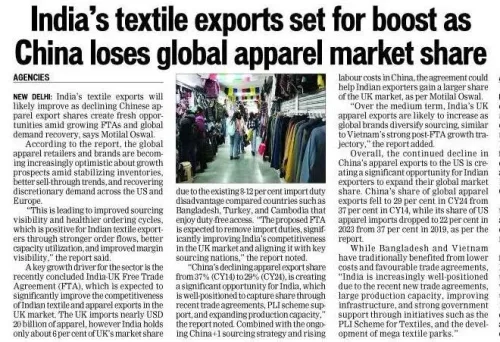
Sustainability has emerged as a non-negotiable condition for market access, particularly in the European Union and the United States, where buyers increasingly demand compliance with environmental and labour standards. Simultaneously, Free Trade Agreements are seen as critical tools to lower tariff barriers and improve the price competitiveness of Indian textiles against rivals such as Bangladesh, Vietnam, and Cambodia.
Stakeholders and Impact
Textile exporters and garment manufacturers stand to gain most directly from a successful FTA strategy. A concluded trade pact with the United Kingdom or the European Union, for instance, could reduce import duties on Indian apparel from as high as 9.6 per cent in the EU to near zero, unlocking significant new order flows for clusters in Tiruppur, Surat, Ludhiana, and Mumbai.
For workers, especially women who constitute a large share of the garment workforce, a sustained export push could translate into millions of additional jobs. However, industry bodies have long stressed that sustainability compliance — including cleaner dyeing processes, reduced water consumption, and certified supply chains — requires upfront capital investment that smaller units may struggle to fund without government support.
What's Next
The immediate watchpoints are the progress of India-EU and India-UK FTA negotiations, both of which have seen multiple rounds of talks. Any fresh budgetary allocation for textile parks or an enhanced Remission of Duties and Taxes on Exported Products (RoDTEP) or RoSCTL rates in the next Union Budget will be a key signal of how seriously the government intends to back the $100 billion ambition with fiscal firepower. Minister Singh's post underscores that the Ministry of Textiles regards the 2030 deadline as a live and active target, not a distant aspiration.
Point of View
The ministry is effectively acknowledging that the old playbook of cost-competitiveness alone is insufficient; Indian textiles must now meet the ESG expectations of Western buyers to stay in the game. The timing also matters: with India-UK and India-EU trade talks at sensitive junctures, a minister-level restatement of the $100 billion goal adds negotiating urgency. If the ambition is to be credible, the next Union Budget's provisions for RoSCTL, textile parks, and green-technology adoption will be the real test.
NationPress
25 Jun 2026
Frequently Asked Questions
What is India's textile export target for 2030?
India has set a target of $100 billion in textile exports by 2030 , as highlighted by Union Textiles Minister Giriraj Singh. The strategy rests on leveraging Free Trade Agreements to reduce tariffs and meeting sustainability standards demanded by major buyers in the EU and US.
What is the PLI scheme for textiles in India?
The Production Linked Incentive (PLI) scheme for man-made fibre apparel and technical textiles was notified by the government in 2021 . It offers financial incentives to manufacturers who achieve defined production and revenue thresholds, aiming to scale up India's textile output and export capacity.
How do FTAs help India's textile sector?
Free Trade Agreements (FTAs) help by reducing or eliminating import duties on Indian textiles in partner countries. For example, a concluded deal with the EU could cut tariffs on Indian apparel from around 9.6 per cent to near zero , making Indian goods more price-competitive against rivals like Bangladesh and Vietnam.
Why is sustainability important for Indian textile exports?
Major buyers in the European Union and United States increasingly require exporters to comply with environmental and labour standards as a condition of doing business. Indian textile manufacturers must invest in cleaner processes, certified supply chains, and reduced resource consumption to retain and grow their market share.
What is Giriraj Singh's role in the textile sector?
Giriraj Singh is India's Union Minister of Textiles , a senior BJP leader and Lok Sabha MP from Begusarai, Bihar . His ministry is responsible for framing policy, supporting exports, and overseeing schemes that govern India's textile and apparel industry.