Giriraj Singh flags India power sector value chain reset
Synopsis
Union Textiles Minister Giriraj Singh flagged a structural 'value chain reset' in India's power sector on 6 July 2026, spotlighting transmission expansion, energy storage, and surging demand as the forces reshaping the country's electricity ecosystem ahead of its 2030 clean energy targets.
Key Takeaways
Union Textiles Minister Giriraj Singh shared a report on 6 July 2026 describing a 'value chain reset' in India's power sector.
The reset is driven by three forces: transmission expansion , energy storage deployment , and rising electricity demand .
India is the world's third-largest electricity consumer and has committed to 500 GW of non-fossil fuel capacity by 2030 , announced at COP26 in 2021 .
The Ministry of Power has deployed storage mandates and viability gap funding to accelerate grid-scale battery storage alongside renewable generation.
New demand drivers — including data centres , electric vehicles , and manufacturing — are intensifying pressure for reliable, storage-backed renewable supply.
Upcoming revisions to the National Electricity Plan and potential transmission tariff reforms are the key policy developments to watch.
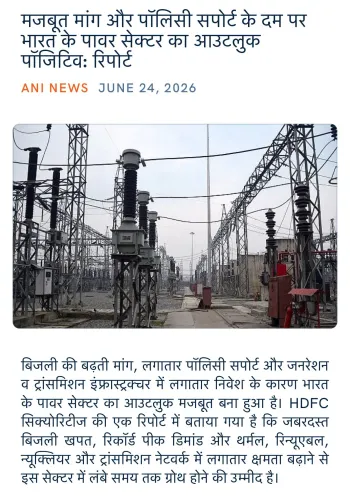
Union Textiles Minister Giriraj Singh on Monday, 6 July 2026, shared a report highlighting a structural shift underway in India's power sector, driven by transmission expansion, energy storage deployment, and rapidly rising electricity demand. The minister amplified the report via the NaMo App, signalling the ruling dispensation's attention to the ongoing transformation in the country's energy infrastructure.
Context
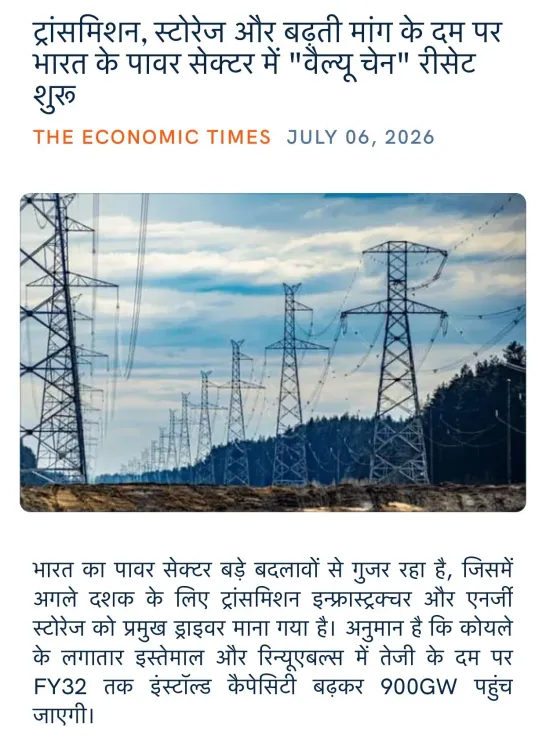
The post, written in Hindi, reads: 'Transmission, storage aur badhti maang ke dam par Bharat ke power sector mein 'value chain' reset shuru' — translated as: 'A 'value chain' reset has begun in India's power sector, driven by transmission, storage, and rising demand.' The framing of a 'value chain reset' points to a systemic realignment — not merely capacity addition — across the full electricity ecosystem, from generation through to end consumption.
India is the world's third-largest electricity consumer and has been pursuing one of the most ambitious renewable energy build-outs globally. The pressure to integrate that capacity into a reliable, affordable grid has made transmission infrastructure and storage the two critical bottlenecks attracting policy and investment attention.
Policy Backdrop
India committed at COP26 in Glasgow in 2021 to achieving 500 GW of non-fossil fuel electricity capacity by 2030 as part of its Panchamrit climate strategy. Meeting that target requires not just renewable generation but a commensurate expansion of high-voltage transmission corridors and grid-scale storage to manage intermittency.
Earlier structural reforms, including the Ujwal DISCOM Assurance Yojana (UDAY) launched in 2015, addressed the financial fragility of state power distribution companies. While UDAY improved balance sheets, the operational challenge of integrating large volumes of solar and wind power has since emerged as the next frontier. Updates to the National Electricity Policy and successive National Electricity Plans through the 2010s and 2020s have progressively emphasised transmission strengthening and renewable integration as co-equal priorities alongside generation.
Storage mandates for renewable energy developers and viability gap funding mechanisms for battery energy storage systems have been among the tools deployed by the Ministry of Power to accelerate this transition. Transmission tariff structures and competitive bidding frameworks for new corridors are also under active review.
Stakeholders and Impact
Power distribution companies stand at the intersection of this reset — they must procure renewable power under long-term contracts while managing grid stability in real time. Renewable energy developers increasingly need transmission access and co-located storage to remain commercially viable as the grid absorbs more variable generation.
Industrial consumers, including the fast-growing data centre and electric vehicle sectors, are emerging as significant new demand drivers. Their requirement for reliable, round-the-clock power is itself pushing utilities and policymakers toward firmer, storage-backed renewable supply arrangements. The manufacturing sector, central to the government's self-reliance agenda, similarly requires stable and competitively priced electricity to remain globally competitive.
What's Next
Analysts and policymakers are watching for revisions to the National Electricity Plan, fresh announcements on viability gap funding for battery storage, and any transmission tariff or bidding reforms expected in forthcoming Union Budgets or parliamentary sessions. The convergence of demand growth from new industries, a maturing renewable energy sector, and a government focused on energy security suggests the value-chain reset described in the report is likely to accelerate rather than plateau. How quickly transmission and storage capacity can scale will determine whether India's clean energy ambitions translate into affordable, reliable power for households and industry alike.
Point of View
Particularly in sectors linked to manufacturing competitiveness and energy security. The real test will come in whether transmission and storage investments keep pace with renewable capacity additions — a gap that, if it widens, could undermine the very narrative being promoted.
NationPress
6 Jul 2026
Frequently Asked Questions
What is the value chain reset in India's power sector?
The 'value chain reset' refers to a structural realignment across India's entire electricity ecosystem — from generation through transmission and storage to end consumption — driven by the need to integrate large volumes of renewable energy reliably and affordably.
Why did Giriraj Singh share a post about the power sector when he is the Textiles Minister?
Senior ministers frequently share reports on major economic and infrastructure themes beyond their direct portfolio, particularly when the topic aligns with the government's broader development narrative. Energy security and manufacturing competitiveness are closely linked policy priorities.
What is India's renewable energy target by 2030?
India committed at COP26 in Glasgow in 2021 to achieving 500 GW of non-fossil fuel electricity capacity by 2030 as part of its Panchamrit climate strategy.
What role does energy storage play in India's power sector?
Grid-scale battery storage is critical for managing the intermittency of solar and wind power. The Ministry of Power has introduced storage mandates for renewable developers and viability gap funding to make battery storage projects commercially viable.
What is the NaMo App?
The NaMo App is a mobile platform associated with Prime Minister Narendra Modi and the BJP, used by party leaders and ministers to share news, government updates, and policy content with supporters and the public.