Giriraj Singh Flags India's Maize Exports at Three-Year High
Synopsis
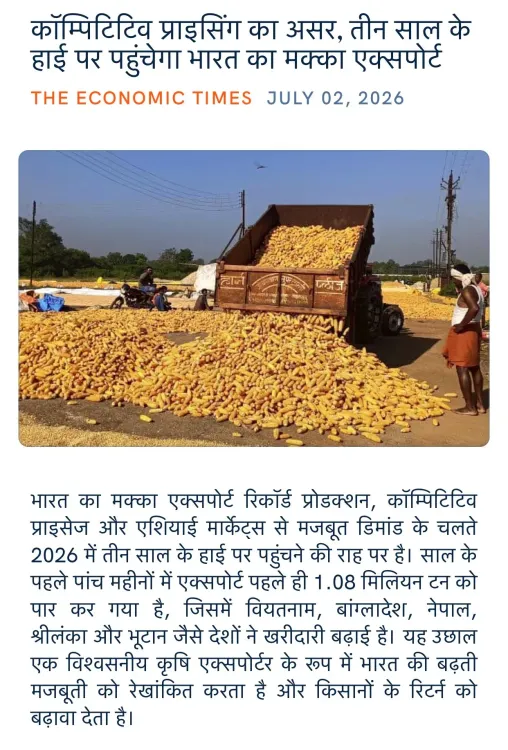
Union Textiles Minister Giriraj Singh flagged a report on 2 July 2026 projecting India's maize exports are set for a three-year high, attributing the rise to competitive pricing. The development benefits maize farmers and agri-exporters, and aligns with India's broader agricultural export ambitions.
Key Takeaways
Union Textiles Minister Giriraj Singh shared on 2 July 2026 that India's maize exports are projected to reach a three-year high .
Competitive pricing is cited as the primary factor driving the surge in Indian corn exports.
India's Agricultural Export Policy 2018 had targeted doubling agri-exports to $60 billion by 2022.
Maize farmers in states like Karnataka, Bihar, and Andhra Pradesh are key beneficiaries of stronger export demand.
The post was shared via the NaMo App , reflecting BJP's cross-sectoral economic communication strategy.
Next quarterly figures from the Ministry of Commerce will confirm the export volume trajectory.
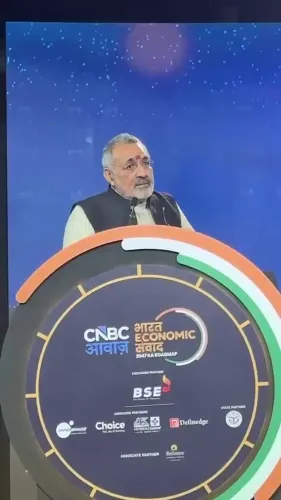
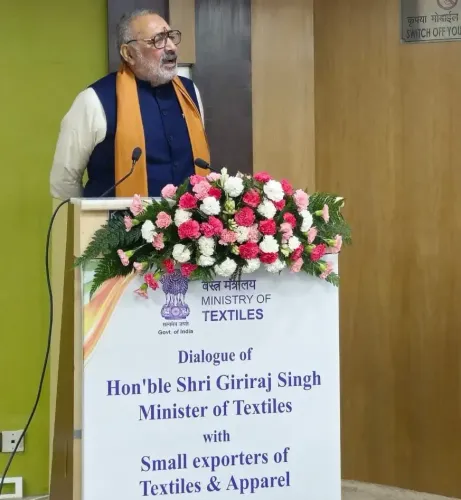
Union Textiles Minister Giriraj Singh on Thursday, 2 July 2026 shared a report projecting that India's maize exports are set to reach a three-year high, crediting competitive pricing as the primary driver behind the surge in outbound corn shipments.
Context
Singh shared the report via the NaMo App, highlighting a development in the agricultural commodities space. The post, in Hindi, reads: 'कॉम्पिटिटिव प्राइसिंग का असर, तीन साल के हाई पर पहुंचेगा भारत का मक्का एक्सपोर्ट' — translated as: 'The impact of competitive pricing: India's maize exports set to reach a three-year high.' Though Singh's ministerial portfolio covers textiles, senior BJP leaders routinely amplify positive economic data across sectors as part of the party's broader governance communication.
Policy Backdrop
India's Agricultural Export Policy 2018 set an ambition to double agricultural exports to $60 billion by 2022, with a focus on infrastructure development and market diversification. Maize, a key coarse grain, has periodically benefited from global demand cycles, particularly when Indian pricing becomes competitive relative to major exporters such as the United States, Brazil, and Ukraine.
Indian agricultural exports have historically tracked global commodity price movements and domestic output levels. When surplus domestic production coincides with elevated international demand, Indian maize tends to gain traction in markets across Southeast Asia and parts of Africa.
Stakeholders and Impact
Maize farmers, concentrated in states such as Karnataka, Andhra Pradesh, Bihar, and Madhya Pradesh, stand to benefit directly from a sustained uptick in export demand, which typically supports farm-gate prices. Agricultural exporters and commodity traders are the other key stakeholders, as higher export volumes translate into improved throughput for ports and logistics chains handling bulk grain.
Competitive pricing — driven by a combination of a productive domestic harvest and currency dynamics — has been the cited catalyst. When Indian maize is priced attractively on global markets, buyers shift procurement away from pricier alternatives, boosting India's market share.
What's Next
The trajectory of India's maize export volumes will be confirmed in the next quarterly agricultural trade figures released by the Ministry of Commerce and Industry. Any new trade facilitation measures for coarse grains — such as port handling upgrades or bilateral trade agreements — could further consolidate the momentum. Analysts and agri-exporters will also watch whether the competitive pricing window remains open through the second half of 2026, or whether a global supply correction narrows India's advantage.
Point of View
If borne out in official trade data, would offer the government a tangible data point to highlight rural income gains ahead of state electoral cycles. It also signals that India's price competitiveness in global grain markets is being actively monitored and publicised at the cabinet level. The broader arc here is India's ongoing effort to position itself as a reliable agricultural exporter, a goal that has seen uneven progress since the 2018 export policy was announced.
NationPress
2 Jul 2026
Frequently Asked Questions
Why are India's maize exports rising in 2026?
India's maize exports are projected to reach a three-year high in 2026 primarily due to competitive pricing, which makes Indian corn attractive to international buyers compared to other major exporters.
What did Giriraj Singh say about maize exports?
Union Textiles Minister Giriraj Singh shared a report on 2 July 2026 stating that the impact of competitive pricing is set to push India's maize exports to a three-year high.
Which states in India produce the most maize?
Karnataka, Andhra Pradesh, Bihar, and Madhya Pradesh are among India's leading maize-producing states, and farmers in these regions stand to benefit from higher export demand.
What is India's Agricultural Export Policy?
India's Agricultural Export Policy 2018 aimed to double the country's agricultural exports to $60 billion by 2022 through infrastructure investment and market diversification for commodities including coarse grains like maize.
Who buys Indian maize exports?
India's maize exports are primarily directed towards markets in Southeast Asia and parts of Africa, where Indian corn competes on price against supplies from the United States, Brazil, and Ukraine.