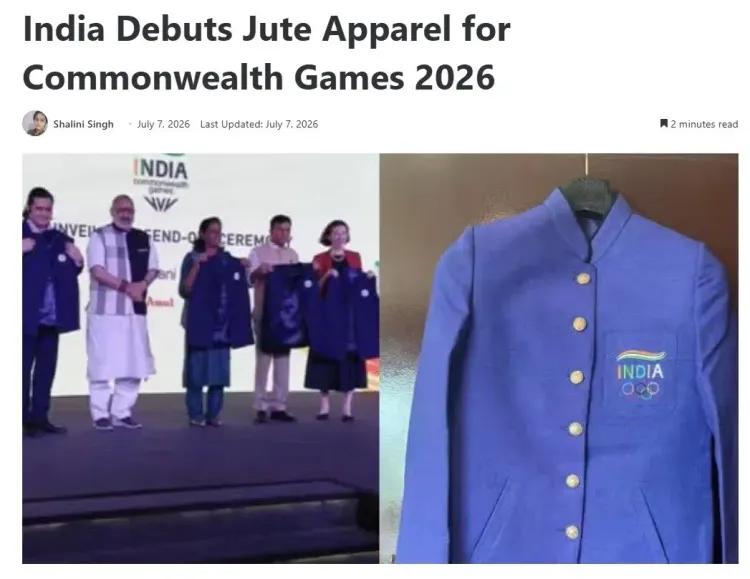
Giriraj Singh flags off Team India in jute-viscose kit for CWG 2026
Synopsis
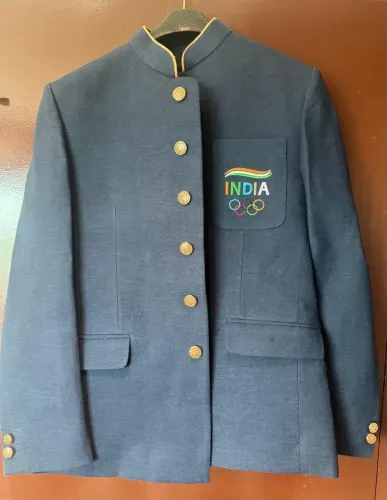
Union Textiles Minister Giriraj Singh on 8 July 2026 celebrated Team India's formal CWG 2026 send-off, spotlighting a ceremonial kit crafted from 100% biodegradable jute-viscose fibre as proof of India's sustainable manufacturing ambition and Vocal for Local commitment.
Key Takeaways
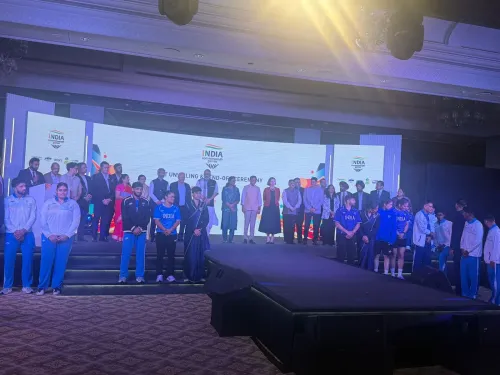
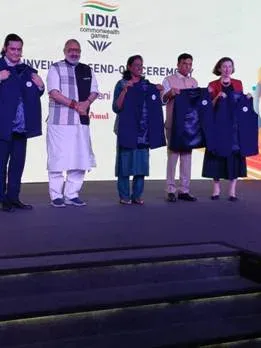
Union Textiles Minister Giriraj Singh posted on 8 July 2026 hailing the formal farewell of Team India for the Commonwealth Games 2026 .
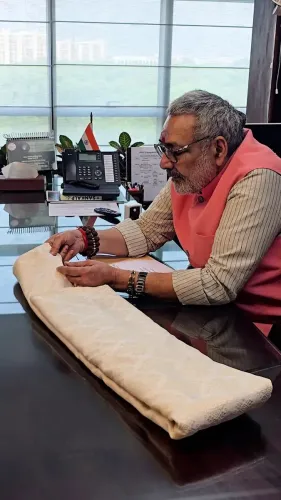
The ceremonial kit is made from 100% biodegradable jute-viscose fibre , produced domestically under the Made Sustainably in India framework.
The kit is framed as a global showcase of India's design, innovation, and manufacturing capability, aligned with the Vocal for Local campaign launched in 2020 .
The National Jute Board , under the Ministry of Textiles, has been a key institutional driver of jute's expansion into technical textiles and value-added applications.
Jute farmers in West Bengal , Bihar , and Assam and domestic textile manufacturers stand to gain visibility and potential export interest from the international exposure.
The Commonwealth Games 2026 are scheduled in Victoria, Australia , continuing India's pattern of using major sporting events to showcase indigenous technical textiles.
Union Textiles Minister Giriraj Singh on Wednesday, 8 July 2026 hailed the formal send-off of Team India for the Commonwealth Games 2026, drawing attention to the athletes' ceremonial kit made entirely from 100% biodegradable jute-viscose fibre — a material produced domestically and designed to project India's credentials in sustainable manufacturing on a global stage.
Context
Posting on X, Giriraj Singh described the kit send-off as 'khiladiyon ki aupcharik vidaai' (the formal farewell of athletes) and called it a powerful symbol of India's sporting spirit, innovation, and commitment to sustainable development. He underlined that the ceremonial kit is not merely an identity marker for the players but also a global statement of 'Made Sustainably in India' — reflecting the Vocal for Local ethos and India's design and manufacturing capability.
The Commonwealth Games 2026 are scheduled to be held in Victoria, Australia, where India is expected to field teams across multiple disciplines. The formal farewell ceremony marks one of the last official engagements for the contingent before departure.
Policy Backdrop
The use of jute-viscose fibre in the ceremonial kit sits squarely within a long-running policy push by the Ministry of Textiles to expand jute into non-traditional, value-added applications. Since 2015, the ministry has run successive iterations of the Jute Integrated Development Scheme, which funds research and market development for jute in technical textiles and eco-friendly consumer goods.
The broader Vocal for Local campaign, launched by Prime Minister Narendra Modi in 2020 under the Atmanirbhar Bharat package, has provided political and policy momentum to link domestic textile manufacturing with high-visibility national occasions — including major sporting events. The National Jute Board, a statutory body under the Ministry of Textiles, has been a key institutional driver of such product development and promotion.
India has previously leveraged international sporting events such as the Olympics and the Asian Games to showcase indigenous technical textiles, and the CWG 2026 kit continues that pattern with an explicit sustainability angle.
Stakeholders and Impact
Indian athletes travelling to Victoria will wear the kit as their official ceremonial uniform, giving the jute-viscose product global television and media visibility across Commonwealth nations. For jute farmers — concentrated primarily in West Bengal, Bihar, and Assam — the move signals continued government demand for raw jute in value-added segments beyond traditional sacking and packaging.
Domestic textile manufacturers involved in producing the kit stand to benefit from the reputational value of an international showcase, potentially opening export inquiries from other Commonwealth countries seeking biodegradable fabric solutions. The kit also reinforces India's positioning in global supply chains as a source of sustainable, design-led textile products.
What's Next
The Indian Olympic Association and the Ministry of Youth Affairs and Sports are expected to finalise the full contingent list and the broader kit rollout timeline ahead of the Commonwealth Games 2026. Observers will watch whether the government follows up with formal procurement mandates requiring biodegradable materials in sports federation uniforms — a step that would institutionalise what is currently a high-profile but one-off showcase.
For the Ministry of Textiles, the CWG 2026 kit represents an opportunity to build an export narrative around sustainable Indian jute goods at a moment when global buyers are under increasing pressure to source environmentally responsible materials.
Point of View
The Ministry of Textiles is effectively auditing its own Vocal for Local and Atmanirbhar Bharat commitments in real time, before an international audience. The move also signals that the government sees biodegradable textiles as an export narrative, not just an environmental aspiration — a distinction that matters as global buyers tighten sustainability sourcing requirements. Whether this translates into binding procurement policy for future sporting events will determine if the gesture is a one-off showcase or the start of a structural shift.
NationPress
8 Jul 2026
Frequently Asked Questions
What is the Team India ceremonial kit for Commonwealth Games 2026 made of?
The ceremonial kit is made from 100% biodegradable jute-viscose fibre , produced domestically in India. Union Textiles Minister Giriraj Singh highlighted this on 8 July 2026 , calling it a symbol of India's sustainable manufacturing capability.
Where are the Commonwealth Games 2026 being held?
The Commonwealth Games 2026 are scheduled to be held in Victoria, Australia , where India is expected to compete across multiple disciplines.
What is the Vocal for Local campaign and how does it relate to the CWG kit?
Vocal for Local is a campaign launched by Prime Minister Narendra Modi in 2020 under the Atmanirbhar Bharat package to promote domestically produced goods. The jute-viscose ceremonial kit is being presented as a direct embodiment of this initiative on an international stage.
What is the National Jute Board's role in India's textile policy?
The National Jute Board is a statutory body under the Ministry of Textiles responsible for the development, promotion, and research of jute products. It has been central to expanding jute into non-traditional applications such as technical textiles and eco-friendly consumer goods.
Which Indian states benefit most from government promotion of jute textiles?
Jute farming is concentrated primarily in West Bengal , Bihar , and Assam . Government initiatives promoting jute in value-added products like the CWG ceremonial kit directly support farmers and manufacturers in these states.