Giriraj Singh Hails Bharat Tex 2026 as Symbol of New India
Synopsis
Union Textiles Minister Giriraj Singh on 24 July 2026 hailed Bharat Tex 2026 as a demonstration of India's innovation and global ambition, linking the event to the Aatmanirbhar Bharat initiative and PM Modi's 5F Vision that connects farm-level fibre production to international fashion markets.
Key Takeaways
Union Textiles Minister Giriraj Singh posted on 24 July 2026 praising Bharat Tex 2026 as a showcase of India's confidence and enterprise in the global textile sector.
Singh invoked the Aatmanirbhar Bharat self-reliance initiative, launched in 2020 , and PM Modi's 5F Vision — Farm to Fibre, Fibre to Factory, Factory to Fashion, Fashion to Foreign — as the policy anchors for India's textile ambition.
The Production Linked Incentive (PLI) scheme for textiles , approved in 2021 , is a key instrument designed to attract investment and boost exports under this broader framework.
The minister explicitly named weavers, artisans, entrepreneurs, and manufacturers as central actors in India's push to integrate traditional craft with modern global supply chains.
Textile export performance data and follow-up policy measures will be the next key indicators of whether Bharat Tex 2026 momentum converts into structural trade gains.
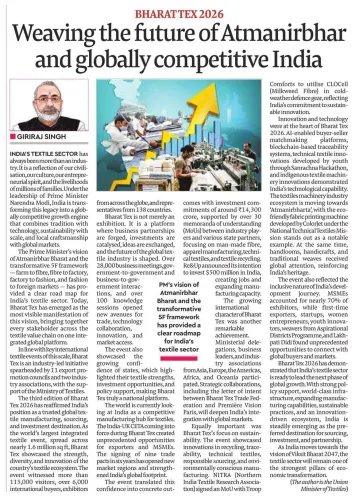
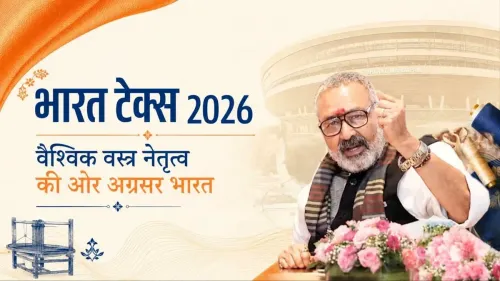
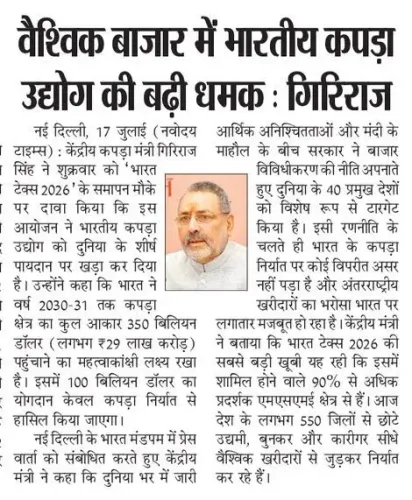
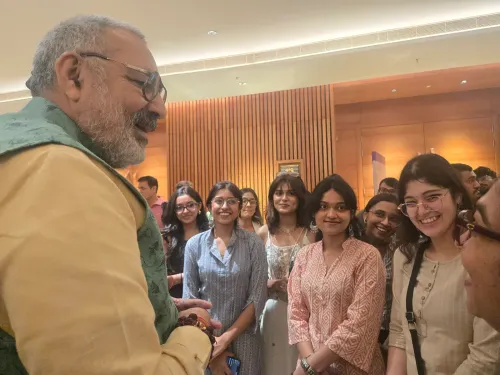
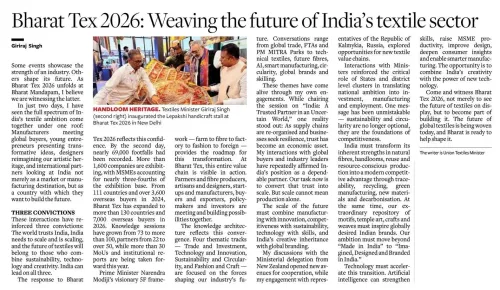
Union Textiles Minister Giriraj Singh on Friday, 24 July 2026, invoked the spirit of Aatmanirbhar Bharat and the government's 5F Vision as he reflected on Bharat Tex 2026, describing the event as a showcase of India's confidence, innovation, and enterprise on the global stage.
Context
Posting on X, Minister Singh wrote that India's textile journey 'beautifully blends centuries-old heritage with the aspirations of a modern, globally competitive future.' He singled out Bharat Tex 2026 as evidence of a transformed sector, stating that 'weavers, artisans, entrepreneurs, and manufacturers' are now connecting with global markets in ways that reinforce the vision of a self-reliant India.
The minister's remarks carry the weight of his portfolio: as the head of the Union Ministry of Textiles, Singh is the principal policy voice for a sector that employs tens of millions of workers across handloom, powerloom, and industrial manufacturing segments.
Policy Backdrop
The post anchors itself in two flagship frameworks. The Aatmanirbhar Bharat initiative, launched in 2020, is the government's overarching drive to promote domestic manufacturing and reduce import dependence. The 5F Vision — articulated by Prime Minister Narendra Modi — traces the value chain from Farm to Fibre, Fibre to Factory, Factory to Fashion, and Fashion to Foreign, positioning textiles as an end-to-end national priority.
Underpinning both frameworks is the Production Linked Incentive (PLI) scheme for textiles, approved in 2021, which was designed to attract large-scale investment, modernise manufacturing infrastructure, and accelerate export growth. Together, these instruments represent a deliberate policy architecture aimed at making India a dominant node in global textile supply chains.
Stakeholders and Impact
The minister's language is notably inclusive, naming weavers, artisans, entrepreneurs, and manufacturers in a single breath — a rhetorical choice that bridges traditional craft communities and industrial exporters. For handloom weavers and artisans, whose livelihoods have historically been vulnerable to competition from power-loom and synthetic alternatives, government-backed platforms that connect them to international buyers represent a meaningful economic opportunity.
For larger manufacturers and exporters, events such as Bharat Tex 2026 serve as high-visibility trade platforms that can translate into order books, partnerships, and long-term supply agreements. The broader ambition — embedding Indian textiles deeper into global value chains — aligns with parallel government efforts in other labour-intensive sectors to generate employment at scale while expanding the trade surplus.
What's Next
Attention will now turn to textile export performance data for the current financial year, which will serve as the most concrete measure of whether the confidence on display at Bharat Tex 2026 is translating into tangible market gains. Any follow-up policy announcements — on trade facilitation, cluster development, or technology upgradation funds — will indicate how the Ministry intends to sustain the momentum generated by the event.
With global supply chains continuing to shift and major buyers diversifying away from single-country dependence, India's window to consolidate its position as a preferred sourcing destination remains open — but competitive. The Ministry's ability to convert showcase moments into structural export growth will define the next chapter of the 5F Vision.
Point of View
The Ministry signals that the 5F Vision is intended to be socially broad, not just export-metric-driven. The Bharat Tex platform functions as a recurring proof-of-concept moment for this narrative, giving the government a visible stage to assert progress. Whether the underlying export and employment numbers validate that confidence is the question that will outlast the event itself.
NationPress
24 Jul 2026
Frequently Asked Questions
What is Bharat Tex 2026?
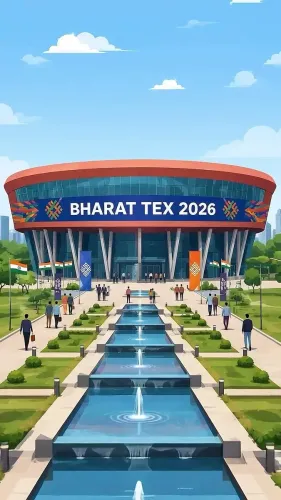
Bharat Tex 2026 is a major Indian textile trade and exhibition event designed to connect Indian weavers, artisans, manufacturers, and exporters with global markets, showcasing the country's textile capabilities under the government's Aatmanirbhar Bharat and 5F Vision frameworks.
What is PM Modi's 5F Vision for textiles?
The 5F Vision is Prime Minister Modi's framework for the textile sector covering the full value chain: Farm to Fibre, Fibre to Factory, Factory to Fashion, and Fashion to Foreign, aiming to make India globally competitive across every stage of textile production and export.
What is the PLI scheme for textiles?
The Production Linked Incentive (PLI) scheme for textiles was approved in 2021 to attract large-scale investment into the sector, modernise manufacturing, and accelerate India's textile exports as part of the broader Aatmanirbhar Bharat initiative.
What did Giriraj Singh say about Bharat Tex 2026?
Union Textiles Minister Giriraj Singh said Bharat Tex 2026 'showcased the confidence, innovation, and enterprise that define a new India,' adding that every thread strengthens the vision of an Aatmanirbhar and globally competitive India.
What is Aatmanirbhar Bharat and how does it relate to textiles?
Aatmanirbhar Bharat is a national self-reliance initiative launched in 2020 to promote domestic manufacturing and reduce import dependence. In textiles, it translates into policies like the PLI scheme and platforms like Bharat Tex that integrate traditional handloom skills with modern technology and global supply chains.