Giriraj Singh hails Tiruppur's ₹46,000 cr knitwear export record
Synopsis
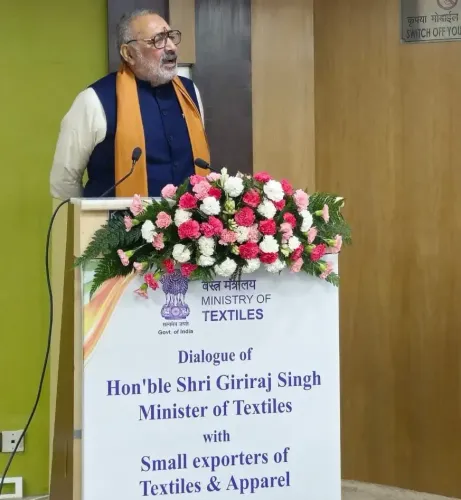
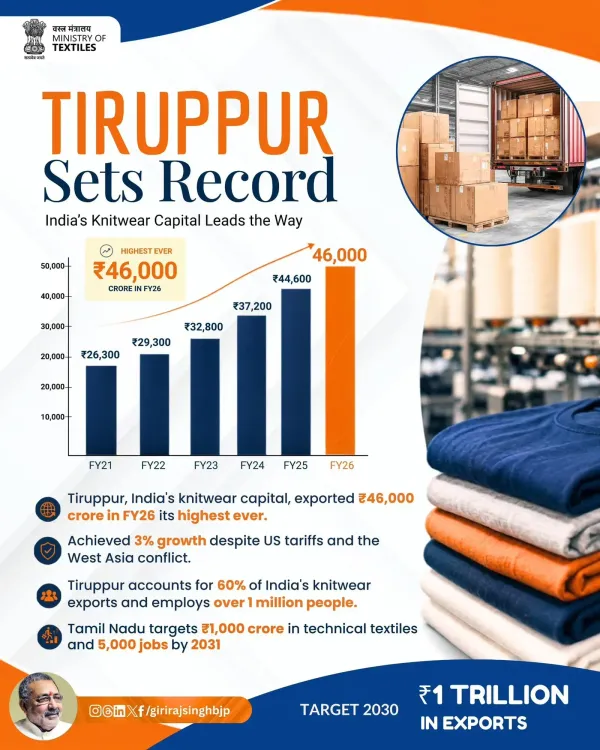
Union Textiles Minister Giriraj Singh on 2 July 2026 highlighted Tiruppur's record ₹46,000 crore knitwear exports in FY 2025-26, calling it evidence of India's growing global textile capacity and reinforcing the government's 2030 textile hub ambition.
Key Takeaways
Tiruppur recorded ₹46,000 crore in knitwear exports in FY 2025-26 , described by the minister as a new historic milestone.
Union Textiles Minister Giriraj Singh attributed the achievement to the policies of PM Narendra Modi 's government.
The milestone is linked to the government's goal of making India a global textile hub by 2030 under the Viksit Bharat 2047 roadmap.
The Make in India initiative (launched September 2014 ) and the PLI scheme for textiles (notified September 2021 ) form the key policy pillars behind the sector's growth.
The Tiruppur cluster supports employment for lakhs of workers and hundreds of MSME garment units across Tamil Nadu .
Union Textiles Minister Giriraj Singh on Thursday, 2 July 2026 credited Prime Minister Narendra Modi's leadership for a record knitwear export milestone achieved by Tiruppur, Tamil Nadu, describing it as proof of India's rising global textile capacity. The minister posted on X that Tiruppur had clocked ₹46,000 crore in knitwear exports in financial year 2025-26, calling it a new chapter in Indian textile history.
Context
In his post, Giriraj Singh wrote — 'तिरुपुर ने वित्त वर्ष 2025-26 में ₹46,000 करोड़ के रिकॉर्ड निटवेयर निर्यात के साथ नया इतिहास रचा है' ['Tiruppur has scripted new history with a record knitwear export of ₹46,000 crore in financial year 2025-26']. He added that the achievement strengthens the resolve to create employment for lakhs of people, grow exports, and make India a global textile hub by 2030. The post was tagged with #Textiles, #Tiruppur, #ViksitBharat2047, and #MakeInIndia.
Policy Backdrop
Tiruppur, located in Tamil Nadu, is India's single largest knitwear and garment export cluster, long regarded as the backbone of the country's apparel trade. The Make in India initiative, launched in September 2014, placed textiles among its priority sectors, aiming to attract investment and deepen India's role in global value chains. A Production Linked Incentive (PLI) scheme for man-made fibres and technical textiles, notified in September 2021, further extended incentives to boost exports and draw fresh capital into the sector.
The Viksit Bharat 2047 vision — the government's blueprint for a developed India by the centenary of Independence — identifies textiles as a key pillar of the manufacturing economy, with the 2030 global textile hub target serving as an intermediate milestone under that broader roadmap.
Stakeholders and Impact
The Tiruppur cluster directly supports hundreds of MSME garment units and employs a large workforce drawn from across Tamil Nadu and neighbouring states. Knitwear exporters in the cluster have benefited from cluster development programmes and trade facilitation measures rolled out over the past decade. Giriraj Singh specifically highlighted employment for 'lakhs of people' as a core outcome of the milestone, underscoring the sector's role as a labour-intensive export engine.
A sustained rise in export values from Tiruppur also signals improving integration into global apparel supply chains at a time when several international buyers are diversifying sourcing away from competing markets.
What's Next
Full FY 2025-26 textile export data from the Ministry of Textiles is expected to provide a comprehensive picture of how other clusters performed alongside Tiruppur. Any mid-term review of the National Textile Policy and parliamentary discussions on PLI disbursements and budget allocations for apparel clusters will be closely watched by industry stakeholders. Achieving the 2030 global textile hub target will require consistent export growth across multiple product categories and geographies beyond knitwear alone.
Point of View
Connecting a single cluster's performance to the sweeping Viksit Bharat 2047 vision. Tiruppur has long served as the BJP's preferred exhibit for labour-intensive export success, and invoking it ahead of any mid-term policy review signals the ministry intends to use the milestone as political capital for continued PLI and cluster-development spending. The 2030 textile hub target, while ambitious, gives the government a concrete benchmark against which opposition and industry can hold it accountable. How quickly the Ministry of Textiles releases verified full-year export data will determine whether this milestone gains broader traction in the policy debate.
NationPress
2 Jul 2026
Frequently Asked Questions
What is Tiruppur's knitwear export figure for FY 2025-26?
According to Union Textiles Minister Giriraj Singh, Tiruppur recorded ₹46,000 crore in knitwear exports in financial year 2025-26, which he described as a new historic record for the cluster.
What is India's textile hub 2030 target?
The Indian government has set a goal to make India a global textile hub by 2030, a target that forms part of the larger Viksit Bharat 2047 development roadmap and is supported by schemes such as Make in India and the PLI for textiles.
What is the PLI scheme for textiles?
The Production Linked Incentive (PLI) scheme for man-made fibres and technical textiles was notified in September 2021 to attract investment, boost domestic manufacturing, and increase India's textile exports.
Why is Tiruppur important for India's textile exports?
Tiruppur in Tamil Nadu is India's largest knitwear and garment export cluster, employing lakhs of workers across hundreds of MSME units and contributing a significant share of the country's total apparel export earnings.
What is Viksit Bharat 2047?
Viksit Bharat 2047 is the Indian government's vision to achieve developed-nation status by 2047, the centenary of Independence, with textiles identified as one of the key manufacturing sectors driving that goal.