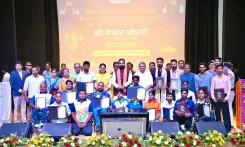
Giriraj Singh Highlights PM SVANidhi Boost for Street Vendors
Synopsis
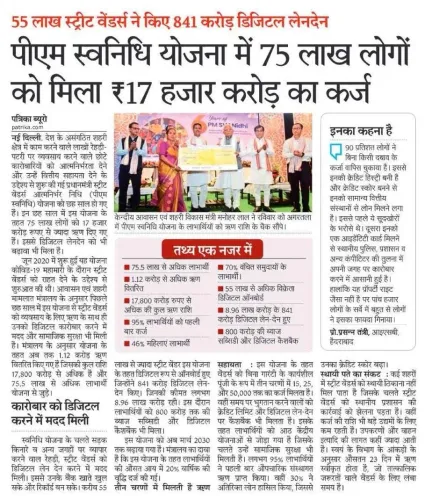
Union Textiles Minister Giriraj Singh on 24 July 2026 shared a report claiming a 20% rise in business profits among street vendors under PM SVANidhi, the government's flagship micro-credit scheme launched in June 2020 to rehabilitate vendors hit by COVID-19 lockdowns.
Key Takeaways
Giriraj Singh shared a report on 24 July 2026 highlighting the impact of PM SVANidhi on street vendor incomes.
The cited report claims a 20% increase in business profits among street vendors enrolled in the scheme.
PM SVANidhi was launched in June 2020 under the Atmanirbhar Bharat package to provide collateral-free working capital loans to street vendors.
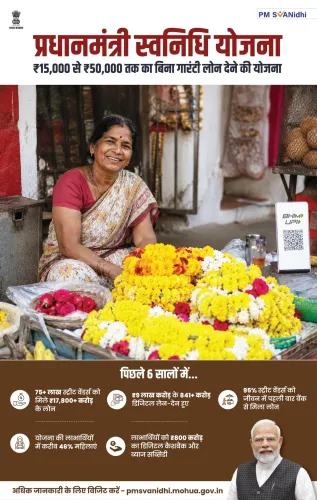
The scheme offers loans from Rs 10,000 up to Rs 50,000 , scalable based on repayment history and credit-building.
The scheme is administered by the Ministry of Housing and Urban Affairs and disburses loans through public-sector banks and microfinance institutions.
The minister shared the post via the NaMo App , reflecting cross-ministry amplification of BJP welfare messaging.
Union Textiles Minister Giriraj Singh on Friday, 24 July 2026 shared a report citing a 20 per cent increase in business profits among street vendors benefiting from the PM SVANidhi scheme, amplifying the central government's messaging on the micro-credit programme's on-ground impact.
Context
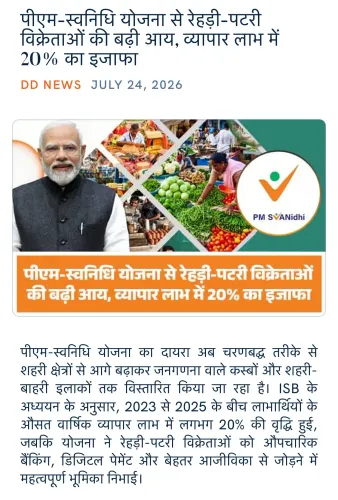
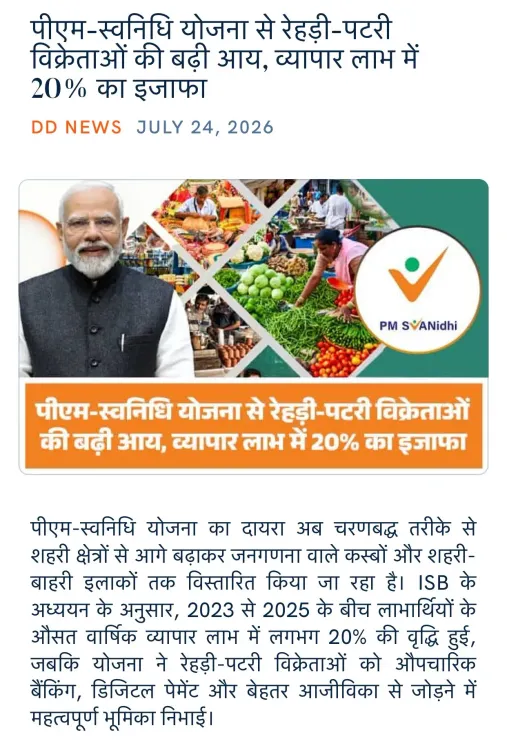
The minister's post, shared via the NaMo App, linked to a report headlined 'PM-Svanidhi yojana se rehdi-patri vikretaon ki badhi aay, vyapar labh mein 20% ka ijafa' ('PM SVANidhi scheme boosts income of street vendors, 20% increase in business profits'). The share underscores the ruling dispensation's effort to publicise welfare scheme outcomes across ministries, even those outside a minister's direct portfolio.
PM SVANidhi falls under the Ministry of Housing and Urban Affairs, not the Textiles Ministry. Senior BJP leaders across government regularly amplify scheme-related coverage to reinforce the party's outreach narrative among the urban informal workforce.
Policy Backdrop
PM SVANidhi — the PM Street Vendor's AtmaNirbhar Nidhi scheme — was launched in June 2020 as part of the Atmanirbhar Bharat economic package, specifically to rehabilitate street vendors whose livelihoods were disrupted by COVID-19 lockdowns. The scheme provides collateral-free working capital loans starting at Rs 10,000, scalable up to Rs 50,000 for vendors who repay on time and build a credit history.
The scheme also incentivises digital transactions through cashback rewards, positioning it as both a credit-access and financial-inclusion tool for the urban informal sector. Successive disbursement rounds have extended formal banking relationships to vendors who were previously outside the organised credit system.
Stakeholders and Impact
Street vendors — a large and historically underserved segment of India's urban informal economy — are the direct beneficiaries. The cited figure of a 20 per cent rise in business profits points to measurable income gains among loan recipients, though the scope and methodology behind that figure originate from the linked report and have not been independently verified by NationPress.
Broader stakeholders include urban local bodies, which are responsible for identifying and certifying eligible vendors, and public-sector banks and microfinance institutions that disburse the loans. Repayment performance and credit-score building among first-time borrowers are key metrics that determine whether vendors qualify for higher loan tranches.
What's Next
The Ministry of Housing and Urban Affairs periodically releases scheme performance dashboards tracking disbursements, repayment rates, and vendor coverage. Parliamentary questions on loan uptake and default rates are expected to provide a fuller picture of the programme's fiscal health and outreach depth.
With the government continuing to frame PM SVANidhi as a flagship financial-inclusion success, any expansion of the loan ceiling or the introduction of new vendor categories could be announced in upcoming urban development policy reviews or the Union Budget cycle.
Point of View
If substantiated by independent audit, would represent a meaningful outcome for a programme that began as an emergency COVID-19 relief measure and has since evolved into a broader financial-inclusion vehicle. The cross-ministry sharing also signals the party's strategic interest in consolidating support among the urban informal workforce, a constituency that cuts across caste and regional lines. Analysts will watch whether such amplification is followed by concrete policy announcements — loan ceiling hikes, new vendor categories, or expanded digital-transaction incentives — or remains primarily communicative.
NationPress
24 Jul 2026
Frequently Asked Questions
What is the PM SVANidhi scheme?
PM SVANidhi — PM Street Vendor's AtmaNirbhar Nidhi — is a central government micro-credit scheme launched in June 2020 that provides collateral-free working capital loans of up to Rs 50,000 to street vendors, administered by the Ministry of Housing and Urban Affairs.
What did Giriraj Singh post about PM SVANidhi?
On 24 July 2026, Union Textiles Minister Giriraj Singh shared a report claiming that PM SVANidhi has boosted street vendor incomes, with business profits rising by 20% among scheme beneficiaries.
Who benefits from the PM SVANidhi scheme?
Street vendors across urban India are the primary beneficiaries. They can access collateral-free loans starting at Rs 10,000, with the loan amount scalable up to Rs 50,000 for vendors who repay on time and build a credit record.
Why is Giriraj Singh, the Textiles Minister, posting about a housing ministry scheme?
Senior BJP leaders regularly share welfare scheme updates across portfolios to amplify the government's outreach narrative. PM SVANidhi is administered by the Ministry of Housing and Urban Affairs, but ministers across departments promote it as part of party communication strategy.
How can street vendors apply for PM SVANidhi loans?
Eligible street vendors can apply through urban local bodies that certify them, after which loans are disbursed via empanelled public-sector banks and microfinance institutions. Digital repayment is incentivised through cashback rewards under the scheme.