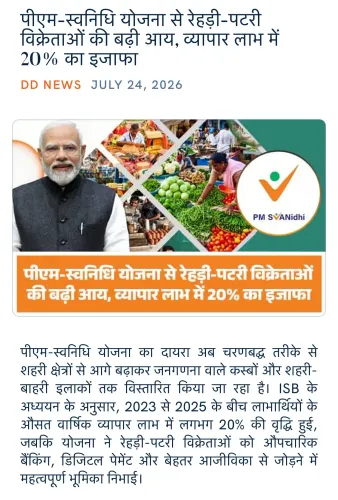
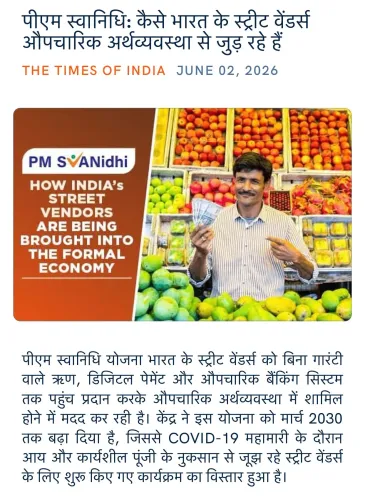
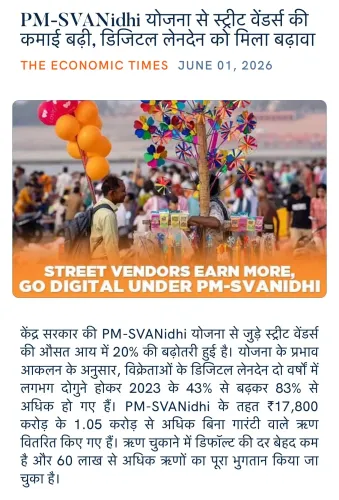
Giriraj Singh highlights PM SVANidhi's reach for street vendors
Synopsis
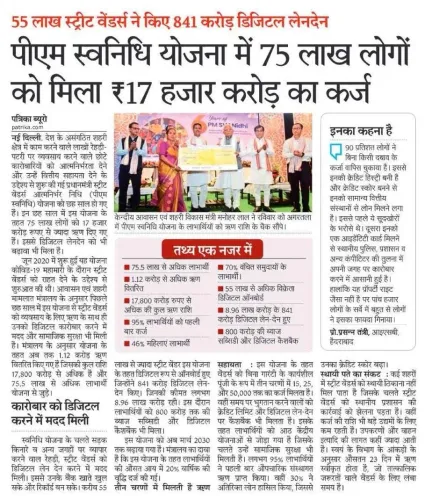
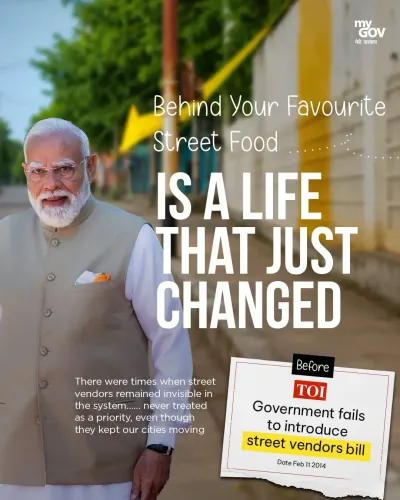
Union Textiles Minister Giriraj Singh on June 1, 2026, shared a report citing that the PM SVANidhi scheme has transformed the lives of over 75 lakh street vendors, underscoring the Modi government's push to extend formal credit to India's urban informal workforce.
Key Takeaways
Giriraj Singh shared a report on June 1, 2026 highlighting the reach of the PM SVANidhi scheme .
The post claims more than 75 lakh street vendors have seen a change in their lives under the scheme.
PM SVANidhi was launched in June 2020 under the Atmanirbhar Bharat package, offering collateral-free loans up to Rs 10,000 .
The scheme is administered by the Ministry of Housing and Urban Affairs through urban local bodies and lending partners.
It is part of a broader push — alongside Jan Dhan and Mudra loans — to integrate India's informal sector into the formal credit system.
Updated beneficiary and repayment data is expected in the next quarterly review by the nodal ministry.
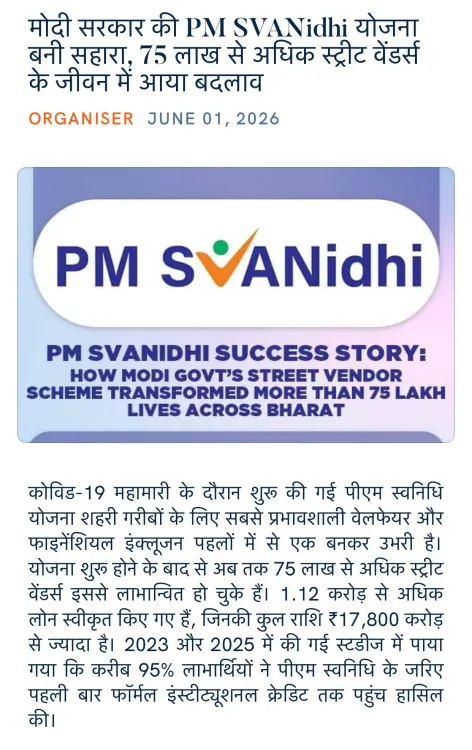
Union Textiles Minister Giriraj Singh on Monday, June 1, 2026, shared a report highlighting the reach of the PM SVANidhi scheme, stating that the Modi government's micro-credit programme has brought about a change in the lives of more than 75 lakh street vendors across the country.
Context
Posting via the NaMo App, Singh shared a link to a report with the caption: 'मोदी सरकार की PM SVANidhi योजना बनी सहारा, 75 लाख से अधिक स्ट्रीट वेंडर्स के जीवन में आया बदलाव' — translated as 'PM SVANidhi scheme of the Modi government becomes a support, change comes in the lives of more than 75 lakh street vendors.' The post amplifies a narrative around the scheme's social impact ahead of what the government has positioned as a landmark in urban poverty alleviation.
The PM Street Vendor's AtmaNirbhar Nidhi (PM SVANidhi) scheme was launched in June 2020 under the Atmanirbhar Bharat stimulus package to provide collateral-free working capital loans of up to Rs 10,000 to urban street vendors who had lost livelihoods during the COVID-19 lockdowns. The scheme is administered by the Ministry of Housing and Urban Affairs through urban local bodies and partner lending institutions.
Policy Backdrop
PM SVANidhi was subsequently integrated with the broader PM Mudra Yojana framework and expanded in 2021-22 to include higher loan tranches and capacity-building modules for beneficiaries. The scheme also incorporated digital on-boarding components, linking vendors to formal banking and payment infrastructure for the first time.
The intervention sits within a wider policy arc — stretching back to the Jan Dhan Yojana and Mudra loans — aimed at bringing India's large informal-sector workforce into the formal credit system. Convergence with state municipal bodies and fintech partners has been central to the scheme's rapid roll-out across urban centres. India's urban street vendor population is estimated at over one crore, making them a significant constituency for last-mile financial inclusion efforts.
Stakeholders and Impact
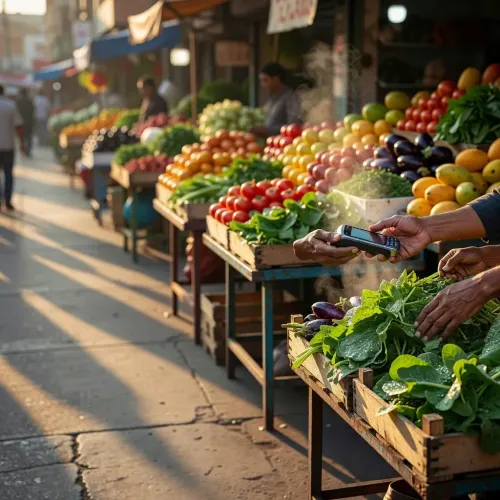
Street vendors — selling vegetables, fruits, prepared food, and daily-use goods from pushcarts and fixed stalls — form the core beneficiary group. Access to collateral-free credit has allowed many to restock inventory, avoid predatory moneylenders, and begin building a formal credit history. Urban local bodies across states have served as the primary on-boarding and certification agencies under the scheme.
The scheme's digital dimension has also drawn attention: vendors who repay on time and adopt digital payments are eligible for enhanced loan tranches in subsequent cycles, creating an incentive structure designed to deepen financial inclusion over multiple years. The figure of 75 lakh-plus beneficiaries, as cited in the post, reflects the scale at which the programme has reportedly been implemented, though updated official data is expected in the next quarterly review by the Ministry of Housing and Urban Affairs.
What's Next
The government's focus on SVANidhi is expected to intensify as the Ministry of Housing and Urban Affairs prepares its next quarterly beneficiary and repayment data review. State-level expansion announcements during upcoming budget sessions could further widen the scheme's footprint.
As a senior BJP leader and Lok Sabha MP from Begusarai, Bihar, Singh's amplification of welfare scheme milestones signals the party's continued emphasis on urban informal-sector outreach as a political and policy priority ahead of future electoral cycles.
Point of View
Using a welfare milestone to reinforce the BJP's 'pro-poor' governance narrative ahead of future electoral cycles. The invocation of '75 lakh lives changed' fits a well-established pattern of quantifying scheme beneficiaries as a measure of political legitimacy. That a Textiles Minister — not the nodal Housing and Urban Affairs Minister — is amplifying the scheme underscores the party-wide mandate to promote flagship welfare programmes across portfolios. The post also reflects the NaMo App's role as a parallel communications channel for BJP leaders to curate a consistent government-achievement narrative directly to a mobilised base.
NationPress
15 Oct 2026
Frequently Asked Questions
What is the PM SVANidhi scheme?
PM SVANidhi is a micro-credit scheme launched by the Modi government in June 2020 under the Atmanirbhar Bharat package. It provides collateral-free working capital loans of up to Rs 10,000 to urban street vendors who lost livelihoods during the COVID-19 lockdowns, with higher tranches available for timely repayers.
How many street vendors have benefited from PM SVANidhi?
According to the report shared by Giriraj Singh on June 1, 2026 , more than 75 lakh street vendors have benefited from the scheme. Official updated figures are expected in the next quarterly review by the Ministry of Housing and Urban Affairs .
Which ministry runs the PM SVANidhi scheme?
The Ministry of Housing and Urban Affairs is the nodal ministry for PM SVANidhi. It implements the scheme through urban local bodies and partner lending institutions across Indian cities and towns.
Why did Giriraj Singh post about PM SVANidhi?
Giriraj Singh , Union Textiles Minister and senior BJP leader, shared the report via the NaMo App to highlight the welfare impact of the Modi government's urban poverty alleviation programmes. It reflects a party-wide practice of amplifying flagship scheme milestones.
What is the connection between PM SVANidhi and PM Mudra Yojana?
PM SVANidhi was subsequently integrated with the PM Mudra Yojana framework and expanded in 2021-22 to include higher loan tranches and capacity-building modules, broadening its scope beyond the initial pandemic-relief mandate.