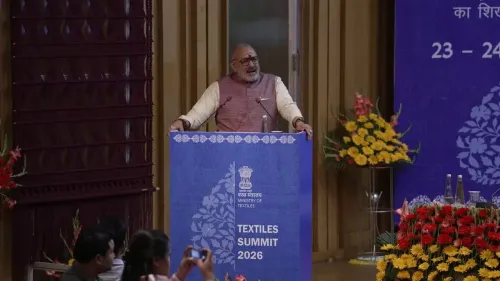
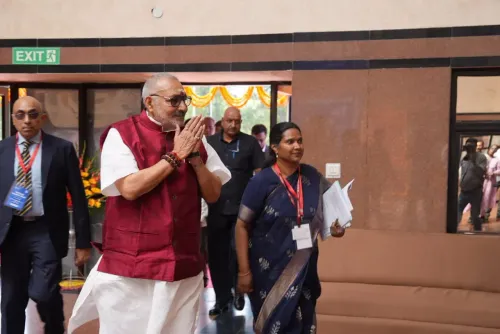
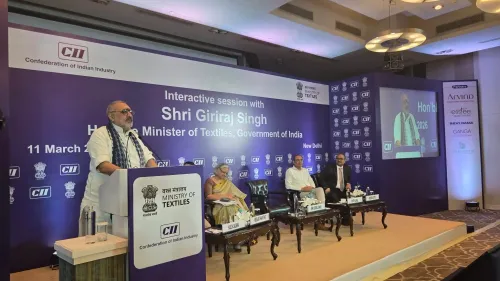
Giriraj Singh launches apparel export strategy book at Bharat Tex 2026
Synopsis
Union Textiles Minister Giriraj Singh met Rural Development Secretary Rohit Kansal at Bharat Tex 2026 on 15 July 2026, launching a book on India's apparel export strategy and discussing rural livelihoods, local product promotion, and farm-to-export value chain integration.
Key Takeaways
Union Textiles Minister Giriraj Singh and Rural Development Secretary Rohit Kansal met on the sidelines of Bharat Tex 2026 on 15 July 2026 .
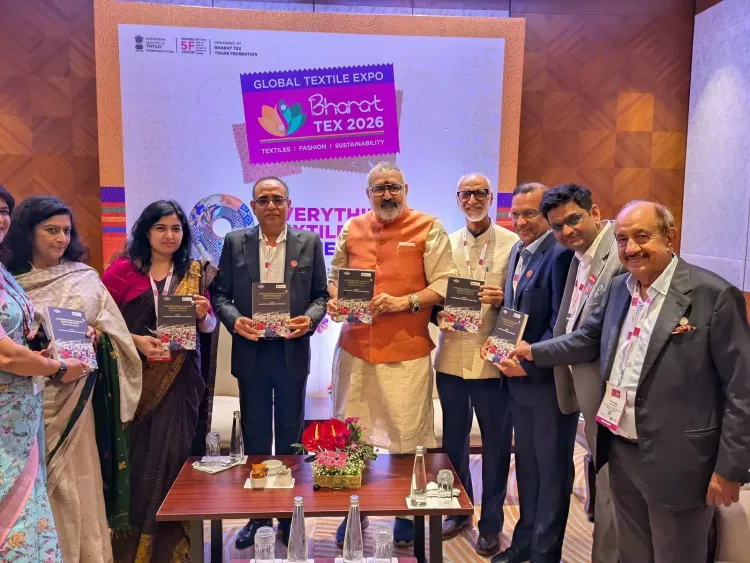
The book 'Stitching India's Apparel Export Strategy: From Farm to Foreign' , edited by Kansal, was launched at the event.
Discussions covered the textiles sector, rural livelihoods , and promotion of local and indigenous products .
The meeting reflects ongoing inter-ministerial coordination between the Ministry of Textiles and the Ministry of Rural Development .
The engagement aligns with existing policy frameworks including the PLI scheme for textiles (2021) and the National Handloom Development Programme .
Follow-up outcomes may be reflected in upcoming Export Promotion Council meetings or the next Union Budget .
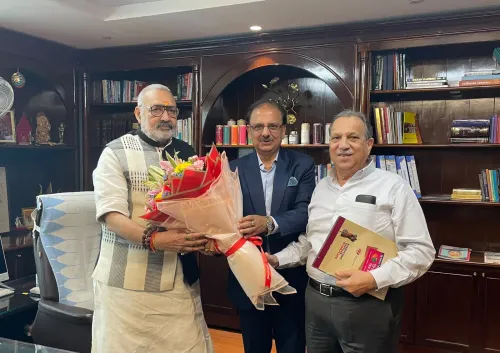
Union Textiles Minister Giriraj Singh met with Ministry of Rural Development Secretary Rohit Kansal on the sidelines of Bharat Tex 2026 on Wednesday, 15 July 2026, where the two officials jointly launched a book on India's apparel export roadmap and exchanged views on strengthening rural livelihoods through the textiles sector.
Singh announced the meeting and the book launch on X, writing that a 'cordial meeting' (सौहार्दपूर्ण भेंट) took place with Kansal, and that a book edited by Kansal — titled 'Stitching India's Apparel Export Strategy: From Farm to Foreign' — was released at the event. The minister added that discussions covered the textiles sector, rural livelihoods, and promotion of local products.
Context
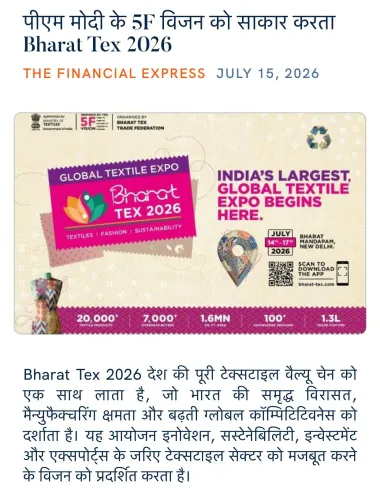
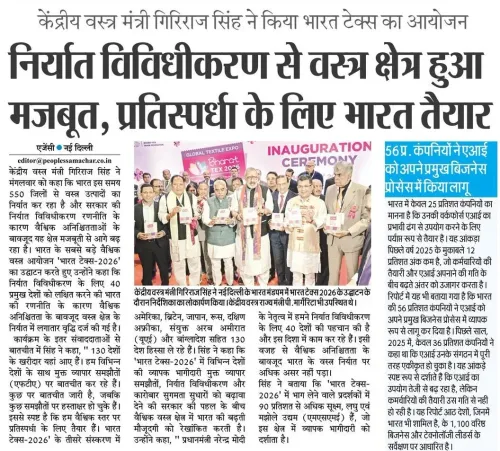
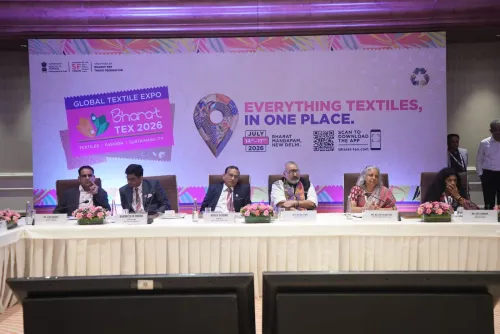
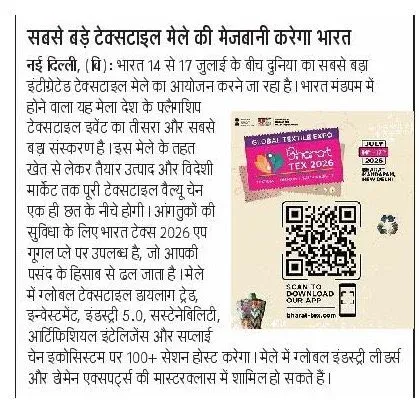
Bharat Tex 2026 is a major textiles-sector event that brings together policymakers, exporters, manufacturers, and artisans to deliberate on India's position in global textile trade. The event serves as a platform for inter-ministerial engagement and industry consultations on export targets and rural production linkages.
The book's title — 'Stitching India's Apparel Export Strategy: From Farm to Foreign' — signals a focus on integrating the entire value chain, from raw fibre grown in rural areas to finished garments shipped to overseas markets, a priority that successive governments have articulated in policy documents.
Policy Backdrop
India's textiles and apparel export ambitions have been backed by several policy instruments. The Production Linked Incentive (PLI) scheme for textiles and apparel, notified in 2021, was designed to attract fresh investment and scale up manufacturing capacity. The National Handloom Development Programme, restructured in 2015-16, supports weavers through cluster development and market access initiatives.
Inter-ministerial coordination between the Ministry of Textiles and the Ministry of Rural Development has featured in policy frameworks aimed at connecting artisans, handloom clusters, and khadi producers with formal export channels. The meeting between Singh and Kansal reflects this ongoing institutional dialogue between the two ministries.
Stakeholders and Impact
The constituencies most directly affected by this policy direction include apparel exporters, rural weavers, and handloom clusters spread across states such as Bihar, Uttar Pradesh, West Bengal, and Tamil Nadu. A tighter farm-to-export linkage could improve income for artisans who currently operate outside formal supply chains.
Promotion of Geographical Indication (GI)-tagged textiles and khadi products in overseas markets has been a recurring theme in export promotion council meetings. The book launch at a high-visibility industry event suggests an attempt to consolidate and communicate a unified strategy to sector stakeholders.
What's Next
Observers will watch for any follow-up action plans or joint ministerial directives emerging from the discussions held at Bharat Tex 2026. Concrete outcomes — such as new inter-ministerial working groups, revised export targets, or budget allocations for rural textile clusters — are likely to be signalled in upcoming Export Promotion Council meetings or the next Union Budget.
The convergence of textiles policy with rural development priorities, underscored by this meeting, points to a broader push to position India's cottage and handloom sectors as competitive contributors to the country's apparel export basket.
Point of View
Potentially signalling a more unified strategic framework. For Giriraj Singh, associating textiles growth with rural livelihoods also carries political resonance in states like Bihar where weaver communities are electorally significant. Whether this convergence translates into measurable export gains will depend on the follow-through in budget allocations and institutional coordination.
NationPress
15 Jul 2026
Frequently Asked Questions
What is Bharat Tex 2026?
Bharat Tex 2026 is a major Indian textiles-sector event that brings together policymakers, exporters, manufacturers, and artisans to discuss India's position in global textile trade and related policy priorities.
What book was launched at Bharat Tex 2026 by Giriraj Singh?
The book launched was 'Stitching India's Apparel Export Strategy: From Farm to Foreign' , edited by Ministry of Rural Development Secretary Rohit Kansal , focusing on integrating India's rural production with its apparel export chain.
What did Giriraj Singh and Rohit Kansal discuss at Bharat Tex 2026?
The two officials exchanged views on the textiles sector, rural livelihoods, and promotion of local and indigenous products, reflecting inter-ministerial coordination between the Ministry of Textiles and the Ministry of Rural Development.
What is India's PLI scheme for textiles?
The Production Linked Incentive (PLI) scheme for textiles and apparel was notified in 2021 to attract investment in man-made fibre and technical textiles segments and boost India's apparel manufacturing and export capacity.
How does rural development connect to India's apparel exports?
India's handloom clusters, khadi producers, and rural weavers form the upstream end of the apparel value chain. Policy frameworks have increasingly sought to link these rural producers with formal export channels to raise incomes and grow India's share in global textile trade.