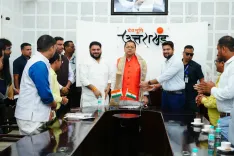
Giriraj Singh marks Surgical Strike anniversary, salutes armed forces
Synopsis
On the 10th anniversary of the 2016 Surgical Strikes, Union Textiles Minister Giriraj Singh paid tribute to India's armed forces and invoked PM Narendra Modi's zero-tolerance counter-terrorism doctrine, calling the strikes a symbol of India's firm national resolve.
Key Takeaways
29 September 2026 marks the 10th anniversary of India's 2016 Surgical Strikes across the Line of Control.
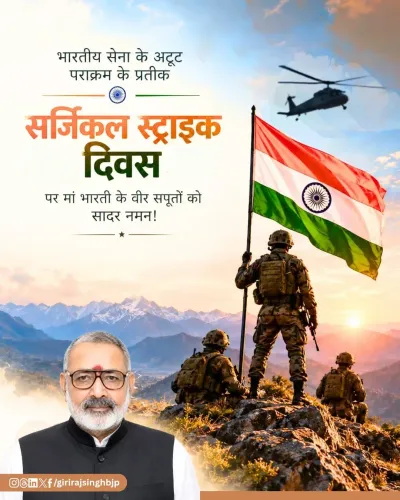
Union Textiles Minister Giriraj Singh posted a tribute on X honouring the soldiers involved.
Singh reaffirmed India's zero-tolerance policy on terrorism under Prime Minister Narendra Modi .
The 2016 strikes were launched in response to the Uri attack of 18 September 2016 , which killed 19 Indian Army soldiers .
India publicly acknowledged the strikes — a historic departure from earlier ambiguity on cross-border operations.
Annual commemorations by BJP leaders have established 29 September as a recurring marker in India's national security calendar.
Ten years to the day India's Special Forces slipped across the Line of Control under cover of darkness, Union Textiles Minister Giriraj Singh marked the anniversary of the 2016 Surgical Strikes on 29 September 2026 with a tribute on X — reaffirming what he called the country's unshakeable zero-tolerance posture against terrorism.
In his post, Singh wrote: 'Surgical Strike aatankwaad ke khilaf Bharat ke dridh sankalp aur zero tolerance ki neeti ka prateek hai' — 'The Surgical Strike is a symbol of India's firm resolve and zero-tolerance policy against terrorism.' He added that under Prime Minister Narendra Modi, no compromise is made on the country's security and every attempt at terror is met with firm resolve. The post closed with a salute to the soldiers dedicated to protecting the motherland.
The night that reset India's counter-terror calculus
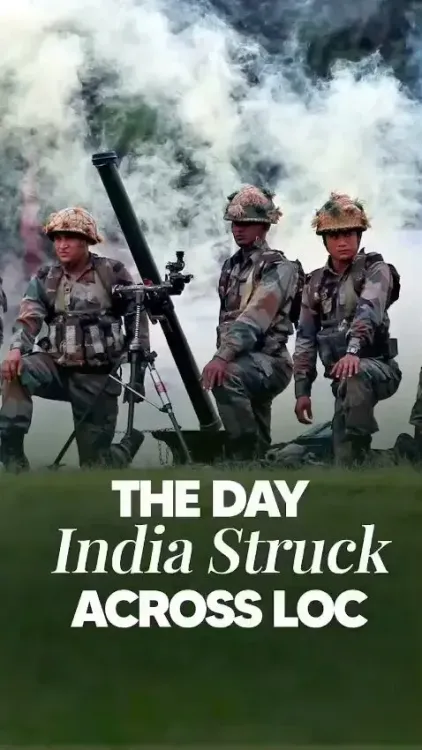
It began with the Uri attack of 18 September 2016, when militants struck an Indian Army brigade headquarters in Jammu and Kashmir, killing 19 soldiers — one of the deadliest strikes on Indian forces in years. Eleven days later, on the night of 28–29 September 2016, Indian Army para-commandos crossed the Line of Control and dismantled terrorist launch pads in Pakistan-administered territory before withdrawing without casualties on the Indian side.
The operation was unprecedented in one specific way: the Indian government publicly acknowledged and detailed the strikes, a departure from the studied ambiguity that had characterised previous cross-border actions. That announcement made the strikes as much a political and psychological statement as a military one — and every anniversary since has been treated as a reminder of that posture shift.
A decade of 'zero tolerance' as doctrine
Singh's commemoration lands on the tenth anniversary of the strikes, a milestone that gives the tribute additional weight. The Modi administration has consistently used the anniversary to underline what it describes as a fundamental change in India's security doctrine — from reactive diplomacy to calibrated, proactive military response.
Senior BJP leaders and defence ministers have marked the date in successive years, a pattern that has cemented 29 September in the national security calendar. The messaging is deliberate: zero tolerance is not a slogan but a standing order. For India's armed forces, the annual tributes from political leadership also serve as a public acknowledgement of operational risks taken in service of national security.
A decade on, the Surgical Strikes remain the clearest shorthand for the argument that deterrence must be visible — and credible — to hold.
Point of View
That messaging carries extra resonance, framing the strikes not merely as a one-time operation but as the founding moment of a doctrine. The pattern of commemoration also suggests the ruling party sees counter-terrorism posture as a durable political asset, likely to intensify ahead of any state or general election cycle.
NationPress
29 Sept 2026
Frequently Asked Questions
What were India's 2016 Surgical Strikes?
India's 2016 Surgical Strikes were a military operation conducted on the night of 28–29 September 2016, in which Indian Army para-commandos crossed the Line of Control and destroyed terrorist launch pads in Pakistan-administered territory in response to the Uri attack.
Why did India carry out the Surgical Strikes?
The strikes were ordered in retaliation for the Uri attack of 18 September 2016, in which militants killed 19 Indian Army soldiers at a brigade headquarters in Jammu and Kashmir.
What did Giriraj Singh say about the Surgical Strikes in 2026?
On 29 September 2026, Union Textiles Minister Giriraj Singh posted on X calling the strikes a symbol of India's firm resolve and zero-tolerance policy against terrorism, and paid tribute to soldiers dedicated to protecting the nation.
What is India's zero-tolerance policy on terrorism?
India's zero-tolerance terrorism policy, emphasised by the Modi government since 2014, holds that every act of terrorism will be met with a firm, calibrated response — militarily, diplomatically, or both — without compromise on national security.
Why is 29 September significant in India's defence calendar?
29 September is the anniversary of the 2016 Surgical Strikes, the first publicly acknowledged cross-LoC military operation by India, making it an annual occasion for tributes to the armed forces and restatements of counter-terrorism doctrine.