Modi Govt Approves ₹62,370 Cr P&K Fertilizer Subsidy for Rabi 2026-27
Synopsis
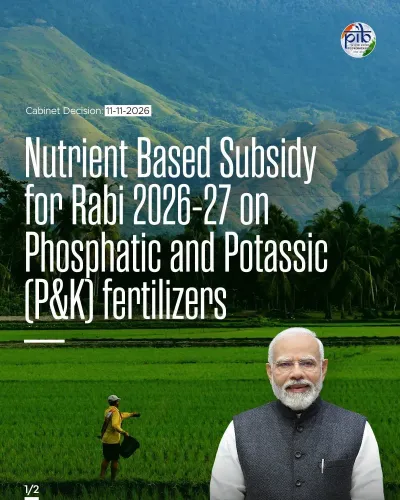
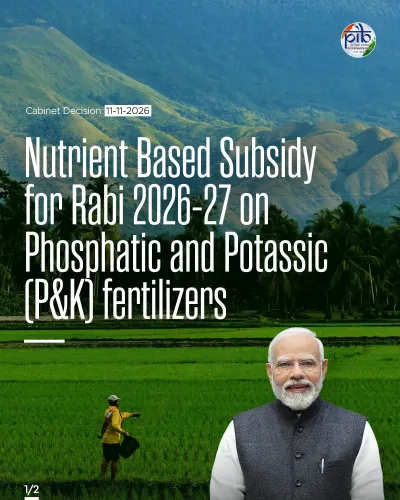
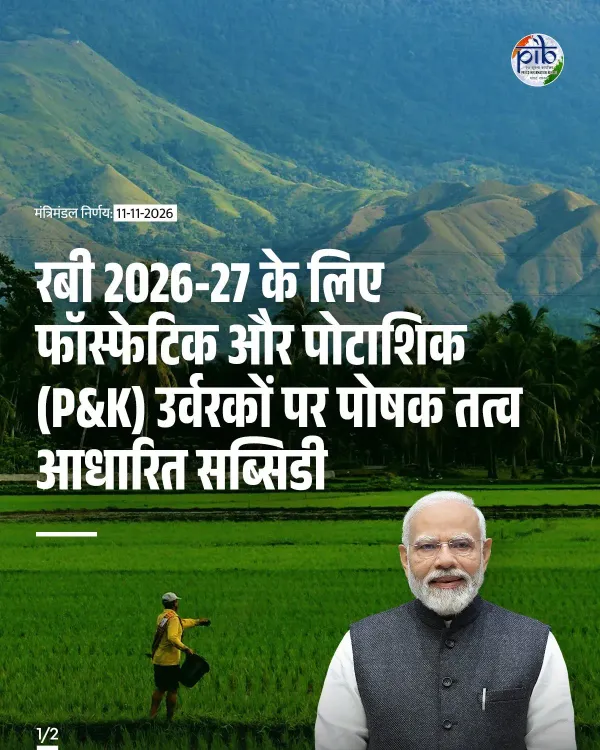
The Modi Cabinet has approved Nutrient Based Subsidy rates for phosphate and potassium fertilizers for Rabi 2026-27, with a projected outlay of ₹62,370 crore. Union Environment Minister Bhupender Yadav announced the decision, reinforcing the government's commitment to keeping farm input costs manageable ahead of the critical winter crop season.
Key Takeaways
The Modi Cabinet approved NBS rates for P&K fertilizers for Rabi 2026-27 on November 11, 2026 .
The projected budgetary requirement stands at ₹62,370 crore .
The Nutrient Based Subsidy (NBS) scheme was introduced in April 2010 to subsidise fertilizers based on nutrient content rather than product price.
Union Environment Minister Bhupender Yadav announced the Cabinet decision on X.
Rabi crops — including wheat, mustard, and pulses — depend heavily on P&K fertilizers during the November-December planting window.
Actual disbursement of funds and on-ground fertilizer availability during the season remain the key metrics to watch.
With the Rabi sowing season approaching, the Modi government has cleared a critical financial lifeline for Indian farmers — approving Nutrient Based Subsidy (NBS) rates for phosphate and potassium (P&K) fertilizers for Rabi 2026-27, with a projected budgetary outlay of ₹62,370 crore. Union Environment Minister Bhupender Yadav announced the Cabinet decision on Wednesday, November 11, 2026, signalling the government's intent to shield cultivators from volatile global input costs ahead of one of India's most important crop cycles.
What the NBS Scheme actually does for farmers
The Nutrient Based Subsidy scheme, introduced in April 2010, replaced an older product-price concession system by anchoring subsidies to the actual nutrient content of a fertilizer — nitrogen (N), phosphorus (P), potassium (K), and sulphur (S) — rather than to the brand or product itself. The intent is to keep retail prices of non-urea fertilizers stable and affordable even when global commodity markets spike. By locking in NBS rates before the season begins, the government gives both farmers and fertilizer manufacturers advance certainty on pricing — a planning tool that matters enormously for a sector where input costs can make or break a crop cycle.
₹62,370 crore and the politics of agricultural welfare
The ₹62,370 crore projected budgetary requirement is a substantial commitment. Successive Indian governments have deployed fertilizer subsidies as a core pillar of agricultural support since the Green Revolution, and the present administration has periodically revised NBS rates in response to global price volatility — particularly the sharp swings triggered by supply-chain disruptions in recent years. Yadav's post frames the decision explicitly as placing 'kisanon ke hiton ko sarvoch prathamikta' (farmers' interests at the highest priority) — a framing consistent with the BJP's sustained political messaging around rural welfare. The scale of the outlay also sets a marker for the next Union Budget, where actual disbursements will be watched closely by both farm groups and fiscal analysts.
Rabi season stakes and what comes next
India's Rabi season — centred on wheat, mustard, pulses, and chickpeas — runs from roughly October through March, making timely fertilizer availability in November and December decisive for yield outcomes. P&K fertilizers are particularly critical for root development and grain fill in these crops. The real test of this approval will be on the ground: whether subsidised fertilizers reach mandis and cooperative stores in adequate quantities before peak application windows close. Actual fund disbursement timelines and supply-chain readiness will determine whether the Cabinet's headline number translates into real relief at the farm gate.
Point of View
370 crore, the commitment is a significant fiscal signal in an election-conscious environment. The NBS framework itself represents a structural shift from blanket product subsidies toward nutrient-linked support, theoretically incentivising efficiency — though critics have long argued that actual retail prices of P&K fertilizers remain erratic in thin rural markets. The real policy question is not the approval but the delivery: whether last-mile supply chains move as fast as Cabinet resolutions.
NationPress
11 Nov 2026
Frequently Asked Questions
What is the Nutrient Based Subsidy (NBS) scheme for fertilizers?
The NBS scheme, introduced in April 2010, provides government subsidies on phosphatic and potassic fertilizers based on their actual nutrient content rather than on the product price, keeping retail costs stable for farmers even when global prices fluctuate.
How much has the government approved for fertilizer subsidy in Rabi 2026-27?
The Modi Cabinet has approved NBS rates for P&K fertilizers for Rabi 2026-27 with a projected budgetary outlay of approximately ₹62,370 crore.
Which crops benefit from phosphate and potash (P&K) fertilizers during Rabi season?
Key Rabi crops like wheat, mustard, chickpeas, and pulses benefit from P&K fertilizers, which support root development and grain fill during the October-to-March winter crop cycle.
Who announced the fertilizer subsidy Cabinet decision?
Union Environment Minister Bhupender Yadav announced the Cabinet's approval of NBS rates for P&K fertilizers for Rabi 2026-27 on his official X account on November 11, 2026.
How is the NBS scheme different from earlier fertilizer subsidies in India?
Before April 2010, India used a product-price concession system where subsidies were fixed per product. The NBS scheme shifted the basis to nutrient content, providing a per-kilogram subsidy on each nutrient, encouraging farmers and manufacturers to focus on actual nutrient value.