Piyush Goyal Confident India-Canada CEPA Will Be Fair, Balanced
Synopsis
Union Commerce Minister Piyush Goyal has expressed strong confidence that India and Canada will conclude a fair, equitable, and balanced Comprehensive Economic Partnership Agreement, calling it a roadmap for both economies. The statement revives focus on bilateral trade talks that were first launched in 2010 and stalled for over a decade.
Key Takeaways
Union Commerce and Industry Minister Piyush Goyal expressed confidence on 26 May 2026 that India and Canada will conclude a 'fair, equitable, and balanced' CEPA.
Formal India-Canada CEPA negotiations were first launched in November 2010 but stalled after several rounds.
India has concluded or advanced trade deals with Australia , the UAE , and the UK since 2022 as part of a broader trade diversification push.
Canada has identified India as a key partner under its Indo-Pacific strategy , creating parallel strategic incentives for a deal.
Key sensitive sectors including dairy and professional services are expected to be the most complex areas in any negotiation.
A concluded CEPA would add a major G7 economy to India's growing network of comprehensive bilateral trade agreements.
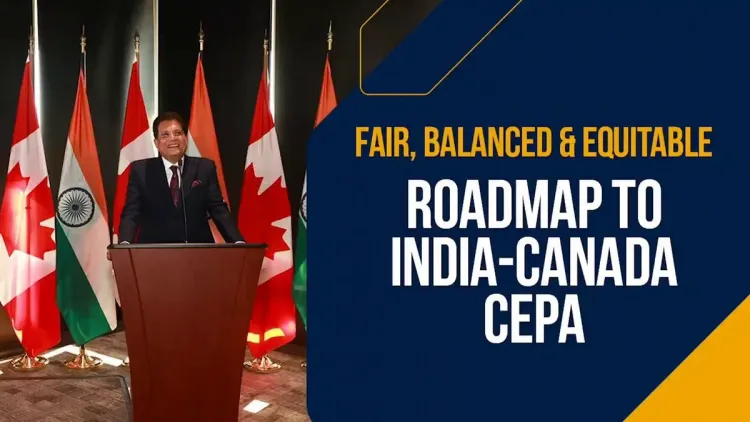
Union Commerce and Industry Minister Piyush Goyal on Tuesday, 26 May 2026, expressed confidence that India and Canada will conclude a 'very good, fair, equitable, and balanced' Comprehensive Economic Partnership Agreement (CEPA), describing the pact as one that will 'define the roadmap as the two economies power on.'
Context
Goyal's post on X comes as India continues to actively pursue bilateral trade agreements with key global partners. In his words, the agreement would be 'fair, equitable, and balanced' — language that signals New Delhi's intent to protect domestic sensitivities while opening up to Canadian goods, services, and investment. The statement stops short of announcing a formal round of talks or a timeline, but the tone is notably optimistic.
India and Canada first launched formal CEPA negotiations in November 2010, going through several rounds before the process stalled. The renewed expression of confidence from a senior cabinet minister suggests the two sides are once again engaged at a substantive level.
Policy Backdrop
Since 2022, India has concluded or significantly advanced trade agreements with Australia, the UAE, and the United Kingdom as part of a deliberate strategy to diversify export markets and build supply-chain resilience. Each of those deals was positioned as a template for further agreements — making a potential India-Canada CEPA a natural next step in that arc.
Canada, a G7 economy with strengths in resources, technology, and agriculture, has simultaneously identified India as a priority partner under its Indo-Pacific strategy. These parallel strategic tracks create a conducive environment for renewed bilateral negotiations, even as the two countries have navigated periodic diplomatic friction in recent years.
A CEPA, if concluded, would go well beyond a simple tariff-reduction deal. It would cover services liberalisation, investment protection, and rules for bilateral economic cooperation — areas of particular interest to Indian information-technology and professional-services exporters, as well as to Canadian resource and agri-business sectors seeking market access.
Stakeholders and Impact
Indian exporters — especially in textiles, pharmaceuticals, engineering goods, and IT services — stand to benefit from reduced Canadian tariffs and a clearer regulatory framework. For Canadian investors, a CEPA would offer greater certainty on entry conditions and intellectual-property protections in one of the world's fastest-growing major economies.
Sensitive sectors, however, remain a sticking point. Dairy has historically been a flashpoint in Canada's trade negotiations, given supply-management protections at home, while professional services and mutual recognition of qualifications are equally complex. Goyal's emphasis on 'balance' and 'equity' likely reflects the need to manage these fault lines on both sides.
The Indian diaspora in Canada — one of the largest and most economically active immigrant communities — also has a direct stake in the outcome, particularly on provisions related to mobility of skilled professionals and students.
What's Next
Goyal's statement sets a political tone but the hard work lies in the technical negotiating rounds that must follow. Watchers of the bilateral relationship will look for announcements of formal negotiation sessions, ministerial-level meetings, and any movement on sensitive chapters such as dairy, professional services, and investment dispute resolution.
If the optimism expressed by the Commerce Minister translates into a concluded agreement, it would mark a significant milestone in India's trade diplomacy — adding a major G7 economy to a growing network of comprehensive bilateral pacts and reinforcing the country's positioning as a globally integrated manufacturing and services hub.
Point of View
Not a routine social-media post — coming from the minister who personally steered deals with Australia, the UAE, and the UK, it carries weight as an indicator of where negotiations stand. The language of 'fair, equitable, and balanced' is calibrated: it reassures domestic constituencies worried about import competition while signalling good faith to Ottawa. This fits a broader pattern in which New Delhi uses ministerial statements to build political momentum ahead of formal negotiating rounds. The timing also suggests both governments are working to insulate economic engagement from the diplomatic turbulence that has periodically strained bilateral ties.
NationPress
10 Oct 2026
Frequently Asked Questions
What is the India-Canada CEPA?
The India-Canada Comprehensive Economic Partnership Agreement (CEPA) is a proposed bilateral trade pact that would reduce tariffs, liberalise services and investment, and establish rules for economic cooperation between the two countries. Negotiations were first launched in November 2010 but stalled after several rounds.
What did Piyush Goyal say about the India-Canada trade deal?
On 26 May 2026, Union Commerce Minister Piyush Goyal posted on X that he is 'confident that India and Canada will achieve a very good, fair, equitable, and balanced CEPA' that will 'define the roadmap as the two economies power on.'
Why did India-Canada trade talks stall earlier?
The original CEPA negotiations launched in 2010 stalled due to differences over sensitive sectors including dairy, professional services, and investment rules, as well as broader diplomatic and political factors affecting the bilateral relationship over the years.
How does a potential India-Canada CEPA fit into India's trade strategy?
India has been actively concluding bilateral trade agreements since 2022, signing deals with Australia, the UAE, and advancing talks with the UK. A Canada CEPA would add a major G7 economy to this network and support India's goal of diversifying export markets.
Who benefits from an India-Canada CEPA?
Indian exporters in sectors like IT services, pharmaceuticals, textiles, and engineering goods would benefit from better Canadian market access, while Canadian investors and resource and agri-business sectors would gain clearer entry conditions into the Indian market.