Goyal Signals India-Canada Trade Push for Shared Growth

Synopsis
Commerce Minister Piyush Goyal on 26 May 2026 publicly signalled momentum in India-Canada economic ties, invoking shared complementarities as the two nations' long-pending CEPA negotiations await a fresh push. The post comes as India advances FTAs with multiple partners globally.
Key Takeaways
Piyush Goyal posted on 26 May 2026 signalling intent to deepen India-Canada economic ties.
The India-Canada CEPA has been under negotiation since 2010 , with talks revived in 2022 after a prolonged pause.
India has concluded or advanced FTAs with Australia, UAE and the UK since 2022 as part of its trade diversification drive.
Key Indian export interests include textiles, pharmaceuticals and IT services ; Canada seeks access for pulses, oilseeds and critical minerals .
A large Indian diaspora in Canada underpins people-to-people and services trade potential.
The ministerial signal is seen as a precursor to formal negotiating rounds gaining fresh political momentum.
Union Commerce and Industry Minister Piyush Goyal on Tuesday, 26 May 2026, signalled a fresh push to deepen economic ties between India and Canada, posting a message of bilateral complementarity on X that underscored the two nations' potential for shared growth.
Context
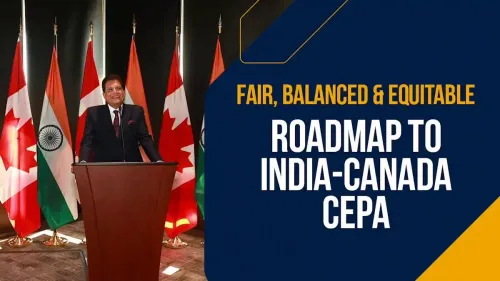
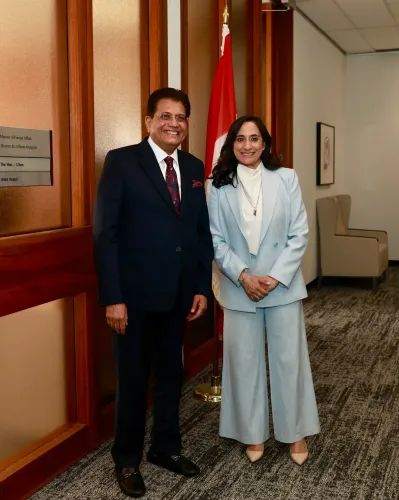
Goyal's post — 'Building on our complementarities for shared growth' accompanied by the Indian and Canadian flags — is a concise but pointed diplomatic signal. The language of 'complementarities' is deliberate: it frames the bilateral relationship as one where each side brings distinct strengths to the table, rather than competing interests.
India is the world's fifth-largest economy, pursuing export-led growth and actively diversifying its trade partnerships. Canada, a G7 member, brings strengths in energy, agricultural products, technology and education services — sectors that align closely with Indian import needs and services-export ambitions.
Policy Backdrop
The post arrives against the backdrop of the long-pending India-Canada Comprehensive Economic Partnership Agreement (CEPA), negotiations for which were formally launched in 2010. After eleven rounds of talks, the process stalled before being revived in 2022 with fresh market-access offers exchanged by both sides.
The CEPA, if concluded, would liberalise goods, services and investment flows between the two countries. India has been on an FTA sprint since 2022, concluding or advancing agreements with Australia, the UAE and the United Kingdom as part of a broader strategy to integrate into global value chains and reduce dependence on any single market.
Canada fits neatly into this pattern — a resource-rich, rules-based economy with a large and influential Indian diaspora that can serve as a natural anchor for services, education and people-to-people trade.
Stakeholders and Impact
Indian exporters in textiles, pharmaceuticals and IT services stand to gain improved market access under a potential CEPA framework. On the Canadian side, exporters of pulses, oilseeds and critical minerals have long sought preferential entry into the Indian market.
The large Indian-origin community in Canada — concentrated in Ontario and British Columbia — adds a human dimension to trade ties, facilitating remittances, education partnerships and professional mobility that formal agreements can codify and expand.
Canadian investors in clean energy and technology also eye India's rapidly growing domestic market, making investment-chapter negotiations a key plank of any eventual deal.
What's Next
Observers will watch for the scheduling of the next formal round of CEPA talks and any outcomes from joint working groups on market access. Goyal's public signal of goodwill is typically a precursor to ministerial-level engagements that give negotiating teams fresh political momentum.
With India's trade diversification strategy now a stated government priority, a minister-level public endorsement of the Canada relationship suggests that CEPA could move higher up the diplomatic agenda in the months ahead.
Point of View
Specific enough to signal intent to trade negotiators on both sides. It fits a clear pattern: the minister has used social media posts to publicly warm up bilateral atmospherics ahead of formal engagement, as seen with the Australia and UAE FTA processes. The invocation of 'complementarities' is also a studied reframe of the India-Canada relationship, which has faced political turbulence in recent years, redirecting the narrative toward economic mutual interest. If CEPA talks do accelerate, this post may be cited as the moment the political signal was sent.
NationPress
10 Oct 2026
Frequently Asked Questions
What is the India-Canada CEPA and what is its current status?
The India-Canada Comprehensive Economic Partnership Agreement (CEPA) is a proposed free trade deal covering goods, services and investment. Negotiations launched in 2010, paused after eleven rounds, and were revived in 2022 with fresh offers exchanged, but a final agreement has not yet been concluded.
Why did Piyush Goyal post about India-Canada trade relations?
Goyal posted on 26 May 2026 highlighting 'complementarities for shared growth' between India and Canada, signalling political support for deeper bilateral economic engagement and potentially laying the groundwork for renewed CEPA negotiations.
What does India export to Canada and what does Canada export to India?
India's key export interests to Canada include textiles, pharmaceuticals and IT services. Canada seeks improved market access in India for pulses, oilseeds and critical minerals, making the two economies broadly complementary rather than directly competitive.
How does India-Canada trade fit into India's broader FTA strategy?
India has been actively concluding FTAs with Australia, the UAE and the UK since 2022 to diversify trade partnerships and integrate into global value chains. Canada, as a G7 economy with complementary strengths, is a natural next step in this strategy.
What role does the Indian diaspora play in India-Canada trade?
The large Indian-origin community in Canada, concentrated in Ontario and British Columbia, facilitates remittances, education partnerships and professional mobility. A formal CEPA could codify and expand these people-to-people economic linkages.