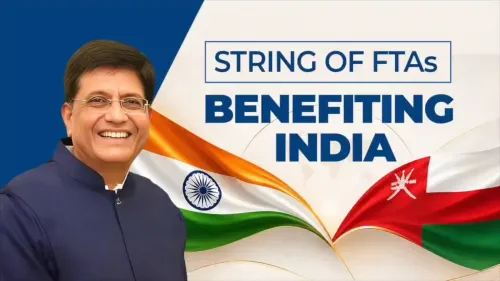
Goyal calls FTAs growth engines for Viksit Bharat
Synopsis
Commerce Minister Piyush Goyal on 30 July 2026 framed Free Trade Agreements as the core growth engines of India's Viksit Bharat vision, signalling that bilateral and regional trade pacts — from the UAE CEPA to ongoing EU and UK talks — are central to India's path to becoming a developed economy by 2047.
Key Takeaways
Commerce Minister Piyush Goyal on 30 July 2026 publicly framed Free Trade Agreements as growth engines for Viksit Bharat , India's developed-economy vision for 2047 .
The India-UAE CEPA and India-Australia ECTA , both operationalised in 2022 , are the flagship agreements underpinning this push.
Ongoing negotiations with the UK (launched January 2022) and the EU (resumed 2022 after a decade-long pause) are the most consequential open deals to watch.
Key beneficiaries include Indian exporters, manufacturers and MSMEs in labour-intensive sectors such as textiles, gems and pharmaceuticals.
India's newer FTA strategy emphasises reciprocity, services access and investment commitments — correcting gaps identified in older pacts like the India-ASEAN FTA of 2009.
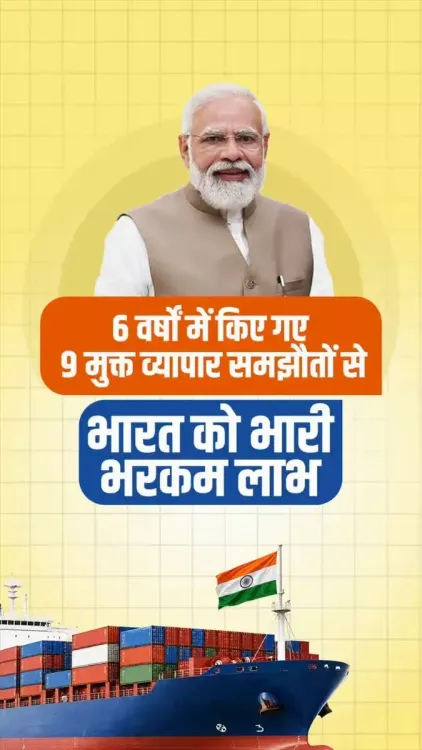
India's trade architecture is being redrawn — one free trade agreement at a time. On Thursday, 30 July 2026, Union Commerce and Industry Minister Piyush Goyal posted a crisp, pointed declaration on X, framing Free Trade Agreements as the growth engines powering India's march toward Viksit Bharat — the government's flagship vision to make India a fully developed economy by 2047.
The post — 'FTAs = विकसित भारत के Growth Engines' (FTAs = Growth Engines of a Developed India) — was brief, but the policy signal it carries is anything but.
From CEPA to ECTA: India's FTA momentum
The assertion lands against a backdrop of real, consequential deals already in motion. The India-UAE Comprehensive Economic Partnership Agreement (CEPA), signed in 2022, gave Indian exporters — particularly in gems, jewellery, textiles and engineering goods — preferential access to one of the Gulf's most dynamic markets. That same year, the India-Australia Economic Cooperation and Trade Agreement (ECTA) entered into force, slashing tariffs on a wide range of Indian exports and opening a new lane into the Indo-Pacific. These are not just diplomatic footnotes. They represent a deliberate pivot: India diversifying its export destinations, reducing dependence on a handful of traditional partners, and embedding itself deeper into global supply chains.The open negotiations: EU, UK and beyond
The bigger bets are still being played. Talks with the United Kingdom, formally launched in January 2022 following Brexit, remain one of the most closely watched bilateral negotiations in South Asian trade diplomacy. Simultaneously, India and the European Union revived their Broad-based Trade and Investment Agreement talks in 2022 — resuming a process that had been frozen for nearly a decade. For Indian MSMEs, manufacturers and exporters, the outcome of these two negotiations could be transformational. Both the EU and UK offer deep consumer markets with high purchasing power, and preferential tariff access — particularly in labour-intensive sectors like textiles, leather, chemicals and pharmaceuticals — could unlock a new tier of export growth.FTAs as the Viksit Bharat toolkit
Goyal's framing is strategic. By explicitly linking FTAs to the Viksit Bharat vision, the Ministry of Commerce is making a public case that trade agreements are not peripheral diplomatic exercises — they are structural levers for economic transformation. The logic: expand market access, attract investment, grow manufacturing, generate jobs, and compound GDP growth over the two decades to 2047. India's older trade record — including the India-ASEAN Free Trade Agreement of 2009 — drew criticism for widening trade deficits with some partners. The newer generation of agreements is being negotiated with sharper attention to reciprocity, services access, and intellectual property commitments, reflecting lessons learned. Watch the EU and UK negotiations for the next major signal — and any new pacts with Latin American or African partners that could further widen India's trade footprint.Point of View
Viksit Bharat 2047. By casting FTAs as 'growth engines' rather than technocratic instruments, the Commerce Ministry is making a popular case for deals that often face domestic pushback from import-sensitive industries. The timing matters: with EU and UK negotiations at delicate junctures, projecting political confidence in the FTA agenda signals to negotiating partners that India's commitment is backed by the highest levels of government. It also pre-empts opposition criticism that India's trade deals benefit foreign exporters at the cost of local industry.
NationPress
30 Jul 2026
Frequently Asked Questions
What did Piyush Goyal say about FTAs and Viksit Bharat?
On 30 July 2026, Minister Piyush Goyal posted on X calling Free Trade Agreements the 'growth engines' of Viksit Bharat, India's vision to become a fully developed economy by 2047.
What is Viksit Bharat and how are FTAs connected to it?
Viksit Bharat is the Indian government's goal to transform India into a developed economy by 2047. FTAs expand export markets, attract investment and boost manufacturing — all of which are seen as essential to achieving that target.
Which FTAs has India signed recently?
India signed the UAE Comprehensive Economic Partnership Agreement (CEPA) in 2022 and the Australia Economic Cooperation and Trade Agreement (ECTA), which entered into force in December 2022. Talks with the UK and EU are ongoing.
What is the status of the India-UK Free Trade Agreement?
India-UK FTA negotiations were formally launched in January 2022 following Brexit. The talks are ongoing and are among the most closely watched in India's current trade diplomacy.
How do FTAs benefit Indian MSMEs and exporters?
FTAs reduce or eliminate tariffs on Indian goods in partner markets, giving MSMEs and exporters in sectors like textiles, gems, pharmaceuticals and engineering goods a competitive price advantage over rivals without such access.