Goyal: NDA freed India from Congress's 'Hindu Growth Rate' stigma
Synopsis
Commerce Minister Piyush Goyal has accused Congress of branding India's decades-long slow growth as the 'Hindu rate of growth,' calling it a stain on the country's Hindu population, and says 12 years of NDA rule have freed India from that legacy.
Key Takeaways
Piyush Goyal posted on June 10, 2026 , marking 12 years of NDA governance with an attack on Congress's economic record.
He argued that Congress coined the term 'Hindu rate of growth' to deflect blame for its own governance failures onto the Hindu community.
The phrase 'Hindu rate of growth' refers to India's roughly 3.5 per cent annual GDP growth during the 1950s–1980s under the License Raj.
The term was academically coined by economist Raj Krishna in 1978 — its attribution as a deliberate Congress political act is contested.
NDA reforms including GST, IBC, and PLI schemes are cited by the government as evidence of a structural break from that era of slow growth.
The remarks signal that economic legacy will be a key battleground in upcoming state assembly elections .
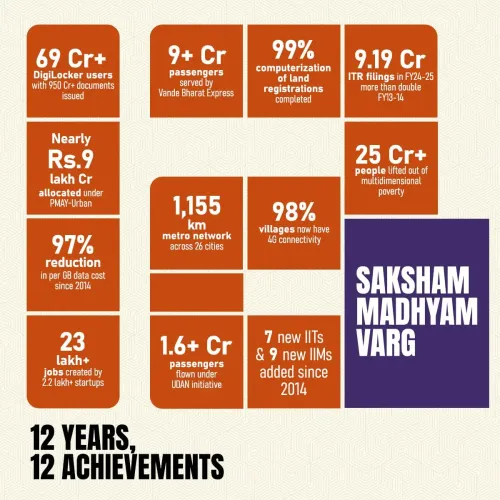
Union Commerce and Industry Minister Piyush Goyal on Wednesday, June 10, 2026, launched a sharp political broadside against the Indian National Congress, asserting that 12 years of NDA rule have liberated the country from what he called Congress's destructive cycle of governance failures.
Context
Posting on X, Goyal wrote: 'NDA ke 12 varshon ki ek badi safalta ye bhi hai ki desh Congress ke kuchakra se aazad hua hai' — 'One of the great successes of NDA's 12 years is that the country has been freed from Congress's vicious cycle.' He then turned his attention to the term 'Hindu rate of growth,' arguing that Congress gave a name to India's sluggish economic performance that unfairly stigmatised the country's large Hindu population. In his words, the 'working style, responsibility and failure were Congress's — but the stain was put in the name of the country's large Hindu population.'
The post, accompanied by a video, was made in Hindi and directed squarely at Congress's economic stewardship during the decades before 2014, when the NDA first came to power under Prime Minister Narendra Modi.
Policy Backdrop
The phrase 'Hindu rate of growth' was coined by economist Raj Krishna in 1978 to describe India's anaemic average GDP growth of roughly 3.5 per cent per annum during the 1950s through the 1980s — a period dominated by the License Raj and heavy state intervention. The term was an academic observation, not a political slogan, and its attribution to Congress as a deliberate act of stigmatisation is contested.
India broke out of that low-growth trap following the landmark 1991 liberalisation, which was itself initiated under a Congress government amid a balance-of-payments crisis. Successive governments, including NDA administrations, built on those reforms. Under the current NDA dispensation, structural measures such as the Goods and Services Tax (GST), the Insolvency and Bankruptcy Code (IBC), and Production-Linked Incentive (PLI) schemes have been cited by the government as drivers of sustained higher trend growth.
Stakeholders and Impact
Goyal's remarks are aimed at a broad domestic audience, particularly ahead of upcoming state assembly elections where economic legacy is expected to be a central campaign theme. The BJP has consistently sought to contrast what it frames as pre-2014 'policy paralysis' with the reform momentum of the NDA years, and Goyal's post reinforces that narrative at the 12-year mark of NDA governance.
For the Congress party, the attack revives a sensitive debate about the ideological underpinnings of India's post-independence economic model. Opposition leaders have previously countered that the 1991 reforms — and the subsequent acceleration in growth — were themselves a Congress legacy. The framing of the 'Hindu rate of growth' as a deliberate communal slur, however, goes beyond mainstream academic interpretation and is likely to draw a sharp rebuttal.
What's Next
The political salience of India's economic growth story is set to intensify as the government approaches the next Union Budget and the release of the Economic Survey, both of which will carry updated growth projections. State assembly elections in the coming months are expected to see both the ruling coalition and the opposition deploy competing narratives around India's economic trajectory — with the 'Hindu rate of growth' debate now freshly reinjected into the discourse by a senior Cabinet minister.
Point of View
Designed to reframe a decades-old academic phrase as evidence of Congress's communal cynicism. By linking low growth to Congress's governance style rather than to any cultural attribute, the BJP seeks to neutralise a term that critics have occasionally used to mock India's economic ambitions. The move fits a broader pattern of the ruling coalition using economic anniversaries to sharpen the contrast with the pre-2014 era ahead of electoral cycles. However, the claim that Congress deliberately used the phrase as a stigma sits on thin historical ice, given that 'Hindu rate of growth' is widely traced to an independent economist's coinage in 1978.
NationPress
25 Oct 2026
Frequently Asked Questions
What is the 'Hindu rate of growth' and who coined it?
The 'Hindu rate of growth' refers to India's sluggish average GDP growth of around 3.5 per cent per year from the 1950s to the 1980s. The term was coined by economist Raj Krishna in 1978 to describe the slow pace of growth under the License Raj regime, and was not originally a political slogan.
What did Piyush Goyal say about Congress and the Hindu rate of growth?
Goyal argued that Congress gave the name 'Hindu rate of growth' to India's slow development, effectively blaming the country's large Hindu population for failures that were Congress's own — in terms of working style, responsibility, and governance.
How long has the NDA been in power and what reforms has it introduced?
The NDA, led by the BJP, has been in power at the Centre since 2014 — completing 12 years as of 2026. Key economic reforms under its tenure include the Goods and Services Tax, the Insolvency and Bankruptcy Code, and Production-Linked Incentive schemes.
Did Congress actually coin the term 'Hindu rate of growth' as a political slur?
This claim is contested. The phrase is widely attributed to economist Raj Krishna in 1978 as an academic description of India's low growth trajectory. Attributing it to Congress as a deliberate communal stigma is not supported by the mainstream historical record.
Why is Goyal raising the Hindu rate of growth issue now?
The remarks come at the 12-year milestone of NDA governance and ahead of state assembly elections, where the BJP is expected to contrast its economic record with Congress-era growth. It is part of a broader BJP narrative distinguishing post-2014 reforms from pre-2014 'policy paralysis.'