Nadda Slams 'Hindu Growth Rate' Tag, Credits NDA's 12-Year Record
Synopsis
BJP president and Union Minister J. P. Nadda has attacked Congress's economic record, arguing the 'Hindu rate of growth' phrase was a deliberate attempt to blame Congress's governance failures on India's Hindu majority, and contrasting it with NDA's 12-year development record.
Key Takeaways
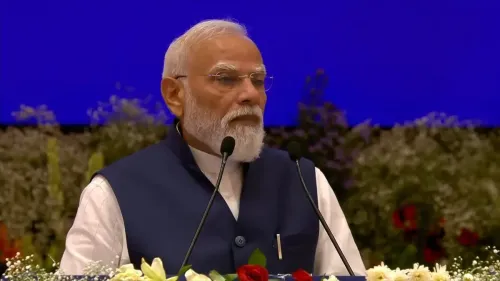
Nadda , BJP national president and Union Health Minister, posted on 10 June 2026 attributing sharp criticism of the Congress era to PM Narendra Modi .
The post argues that 12 years of NDA rule have freed India from what it calls Congress's 'vicious cycle' of helplessness and slow growth.
Nadda claims the term 'Hindu rate of growth' — originally coined by economist Raj Krishna in the 1970s — was used to pin Congress's own governance failures on India's Hindu population.
He frames the 2014–2026 period as the story of India 'running at its full potential for the first time.' The post is tagged #LongestServingElectedPMModi , signalling a broader BJP campaign around the Prime Minister's governance milestone.
Upcoming GDP figures and the Economic Survey will be key to testing the NDA's growth-rate claims quantitatively.
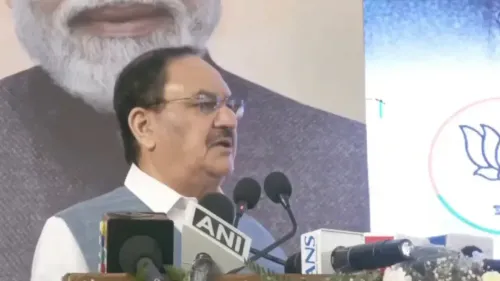
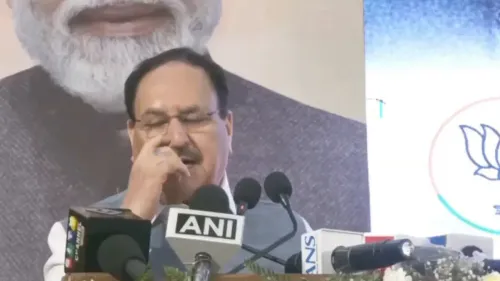
Union Health Minister and BJP National President J. P. Nadda on Wednesday, 10 June 2026, launched a sharp political broadside against the Indian National Congress, arguing that 12 years of NDA rule have freed India from what he called Congress's cycle of helplessness and slow growth — and that the much-cited phrase 'Hindu rate of growth' was a deliberate attempt to pin Congress's own governance failures on India's Hindu majority.
Context
Nadda's post, attributed in part to Prime Minister Narendra Modi and tagged #LongestServingElectedPMModi, quotes a sharp critique of the Congress era. Translated from Hindi, the post reads: 'NDA ke 12 varshon ki ek badi safalta ye bhi hai ki desh Congress ke kuchakra se azad hua hai' — 'One of the great achievements of NDA's 12 years is that the country has been freed from Congress's vicious cycle.' It goes on to argue that Congress had pushed India into a 'pit of helplessness, pitifulness, and inferiority,' conditioning citizens to believe that rapid development was simply not possible in India.
The post then turns to the phrase 'Hindu rate of growth,' calling it a cleverly crafted label that transferred blame for Congress's own slow-growth record onto the country's large Hindu population. Nadda counters this with what he terms the 'Congress growth rate' versus the 'NDA growth rate,' framing the period from 2014 to 2026 as the story of an India finally running at its full potential.
Policy Backdrop
The phrase 'Hindu rate of growth' was originally coined by economist Raj Krishna in the 1970s to describe India's average annual GDP expansion of roughly 3.5 percent between the 1950s and the early 1980s — a period dominated by Congress governments. The term described a structural sluggishness in the economy, though its attribution to Hindu culture was always contested. In 1991, the Congress government under Prime Minister P. V. Narasimha Rao initiated landmark economic liberalisation, which helped lift growth rates into the 6–8 percent range in subsequent decades.
When Narendra Modi led the NDA to power in 2014, the coalition campaigned explicitly on accelerating development, expanding infrastructure, and repositioning India's global standing. Successive governments since then have highlighted faster GDP expansion and large-scale infrastructure investment as evidence of a decisive break from earlier constraints. Nadda's post continues this well-established political narrative, sharpening it with the argument that the 'Hindu rate of growth' label was not an economic descriptor but a political deflection.
Stakeholders and Impact
The post is aimed squarely at Indian voters and economic policymakers, framing the 2014–2026 arc as a civilisational shift rather than a routine change of government. By reclaiming the 'Hindu rate of growth' debate, the BJP is signalling that it intends to contest not just economic statistics but the very framing of India's modern economic history. The argument carries particular resonance with the BJP's core voter base, which has long viewed the phrase as culturally loaded.
For the Congress, the attack revives a sensitive debate about the party's pre-liberalisation economic record and its use of academic terminology in political discourse. The opposition is likely to counter that post-1991 liberalisation — initiated under Congress — laid the foundations for the growth the NDA now claims credit for.
What's Next
With the #LongestServingElectedPMModi hashtag trending alongside this post, the BJP appears to be building a sustained political campaign around Prime Minister Modi's governance milestone. Upcoming GDP data releases, the next Economic Survey, and any mid-term policy reviews will be closely watched to see whether the NDA's growth narrative can be quantitatively reinforced. The framing of 'Congress growth rate' versus 'NDA growth rate' is likely to become a recurring motif in BJP's communication ahead of future electoral cycles.
Point of View
The BJP is trying to convert a neutral academic phrase into an electoral liability for the opposition. This fits a broader BJP pattern of contesting not just policy outcomes but the cultural and ideological framing of India's post-independence narrative. The timing, tied to a milestone for PM Modi's tenure, suggests the party is building a long-cycle political argument that will intensify as the next electoral season approaches.
NationPress
26 Oct 2026
Frequently Asked Questions
What is the 'Hindu rate of growth' and why is it controversial?
The 'Hindu rate of growth' is a phrase coined by economist Raj Krishna in the 1970s to describe India's sluggish average GDP growth of about 3.5 percent per year during the Congress-dominated decades of the 1950s to early 1980s. It is controversial because critics argue it unfairly attributed an economic policy failure to Hindu culture rather than to government choices.
What did JP Nadda say about Congress and India's economic growth?
Nadda argued that Congress deliberately used the 'Hindu rate of growth' label to deflect blame for its own governance failures onto India's Hindu majority, and that NDA's 12 years in power have broken that cycle and allowed India to grow at its full potential.
What is the NDA's growth rate claim compared to Congress?
The NDA has consistently argued that post-2014 India has grown significantly faster than during the pre-2014 Congress era, citing infrastructure expansion and higher GDP growth rates, though specific figures in this post were not cited and await verification through official data releases.
What does #LongestServingElectedPMModi mean?
The hashtag refers to Prime Minister Narendra Modi's record as the longest-serving elected Prime Minister of India, a milestone the BJP is highlighting as part of a broader political campaign around his governance achievements since 2014.
How did Congress respond to Nadda's 'Congress growth rate' attack?
Congress has not yet formally responded to this specific post, but the party has historically argued that post-1991 economic liberalisation — initiated under a Congress government — laid the structural foundation for the higher growth rates that subsequent governments, including the NDA, have benefited from.