Goyal at Bharatiya Vyapar Mahotsav: Local to Global
Synopsis
At the Bharatiya Vyapar Mahotsav, Commerce Minister Piyush Goyal declared India's traders and manufacturers the nation's strength, citing recent FTAs with the UAE and Australia as the bridge carrying India's 'Vocal for Local' momentum into global export markets under PM Modi's Atmanirbhar Bharat vision.
Key Takeaways
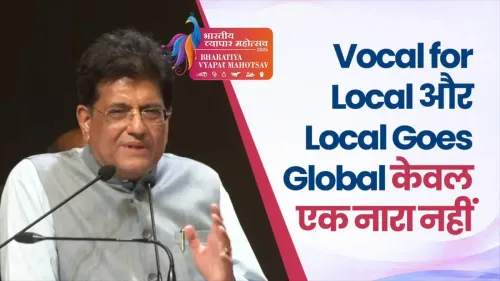
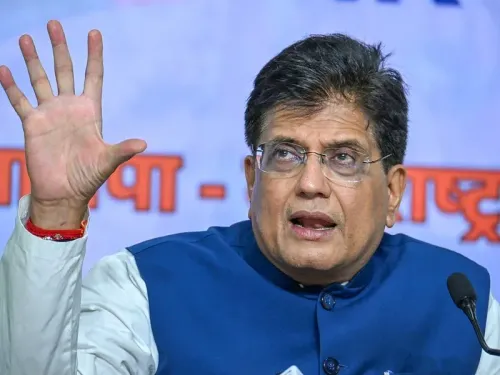
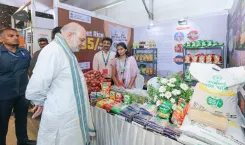
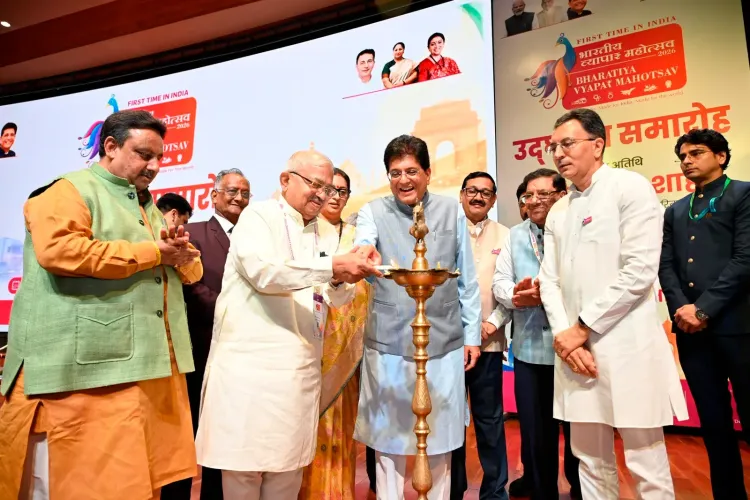
Commerce Minister Piyush Goyal addressed the Bharatiya Vyapar Mahotsav on 12 August 2026 , reaffirming the government's commitment to Indian traders and manufacturers.
He framed India's domestic production drive as evolving from 'Vocal for Local' to 'Local to Global,' with Indian goods becoming a global mark of trust and quality.
The India-UAE CEPA (February 2022) and India-Australia ECTA (April 2022) were cited as key FTAs opening international markets to Indian exporters.
The overarching policy framework combines Atmanirbhar Bharat Abhiyan (May 2020) for domestic supply-side strength with FTAs for demand-side export access.
India's MSME sector stands as the primary stakeholder, with the event signalling continued political backing for domestic manufacturers and traders.
Pending FTA negotiations with the UK and EU remain the next frontier for testing the 'Local to Global' doctrine in practice.
India's traders and manufacturers are no longer just supplying the domestic market — they are staking a claim on the world's shelves. Union Commerce and Industry Minister Piyush Goyal used the platform of the Bharatiya Vyapar Mahotsav on Wednesday, 12 August 2026 to deliver that message with force, framing India's business community as the engine of a national transformation from self-reliance to global export power.
From 'Vocal for Local' to the world's marketplace
Posting in Hindi and English, Goyal declared: 'India's trader and producer is India's strength' — 'भारत का व्यापारी और उत्पादक, भारत की ताकत है' — and said the event gave him a fresh opportunity to connect with his 'trader and producer brothers.' The tricolour-tagged rallying cry 'Made in India. Made for India. Made for the World.' captured the arc he described: a journey that began with encouraging Indians to buy local and is now aimed at planting an Indian footprint in global markets.
The minister credited the trajectory to Prime Minister Narendra Modi's leadership, arguing that indigenous Indian products are becoming synonymous with 'trust, quality, and self-reliance' — not just within India's borders but internationally. That framing echoes the foundational logic of the Make in India initiative, launched in September 2014, which sought to position India as a global manufacturing hub from the outset.
FTAs as the bridge between ambition and export reality
The policy instrument Goyal highlighted most sharply was India's recent wave of Free Trade Agreements. The India-UAE Comprehensive Economic Partnership Agreement (CEPA), signed in February 2022, and the India-Australia Economic Cooperation and Trade Agreement (ECTA), signed in April 2022, opened duty-free or preferential channels for a wide range of Indian goods — giving MSME exporters and domestic manufacturers real market access, not just rhetorical encouragement.
Goyal framed these agreements as the structural scaffolding that converts the Vocal for Local campaign's domestic momentum into hard export gains. India's entrepreneurs, he said, are now 'leaving an indelible mark in the markets of the world' — 'दुनिया के बाजारों में अपनी अमिट छाप छोड़ रहा है' — through precisely this dual-track strategy: shield and strengthen at home, then compete and win abroad.
The dual-track bet India is making
The broader pattern is deliberate. India's trade policy under the current government pairs the Atmanirbhar Bharat Abhiyan — the self-reliant India campaign announced in May 2020 — with an active FTA push designed to open export markets for the producers that campaign nurtured. The logic: domestic production incentives build the supply base; trade agreements build the demand base abroad.
For India's vast MSME sector, which forms the backbone of both domestic manufacturing and export supply chains, the Bharatiya Vyapar Mahotsav serves as a periodic pulse-check — a moment for the government to signal continued political commitment to traders who were among the hardest hit during the pandemic years. Goyal's appearance and messaging reinforce that the 'Local to Global' framing is now the government's settled export doctrine, not a slogan in transition.
With pending FTA negotiations with the United Kingdom, the European Union, and other partners still in play, the real test will arrive in export data — whether utilisation rates of signed agreements translate the minister's platform energy into measurable trade gains for Indian producers.
Point of View
The BJP shores up a constituency that felt the acute pain of GST rollout and pandemic disruptions. The 'Local to Global' framing is also a strategic rebranding — it repositions Atmanirbhar Bharat away from any perception of protectionist insularity and toward an outward-looking export ambition. With UK and EU FTA talks still unresolved, Goyal is simultaneously celebrating wins and building public pressure for the next round of agreements. The Mahotsav platform gives that messaging a grassroots, trader-facing legitimacy that a press conference alone cannot.
NationPress
26 Sept 2026
Frequently Asked Questions
What is the Bharatiya Vyapar Mahotsav?
The Bharatiya Vyapar Mahotsav is a trade event that brings together Indian traders, producers, and manufacturers, providing a platform for the government to engage with the business community and showcase domestic enterprise. Commerce Minister Piyush Goyal addressed the event on 12 August 2026.
What is the 'Local to Global' initiative Piyush Goyal mentioned?
'Local to Global' describes the Indian government's strategy of first building domestic production strength through the Vocal for Local and Atmanirbhar Bharat campaigns, then using Free Trade Agreements to open international markets for Indian goods. Goyal used the phrase to describe the journey of Indian entrepreneurs into global markets.
Which FTAs has India signed recently to boost exports?
India signed the Comprehensive Economic Partnership Agreement (CEPA) with the UAE in February 2022 and the Economic Cooperation and Trade Agreement (ECTA) with Australia in April 2022. Both provide preferential or duty-free market access for a range of Indian products, particularly benefiting MSME exporters.
What is Atmanirbhar Bharat and how does it relate to trade?
Atmanirbhar Bharat Abhiyan, launched by PM Modi in May 2020, is a self-reliant India campaign that combines domestic manufacturing incentives with export promotion. It forms the policy backbone of India's dual-track trade strategy: strengthen production at home while pursuing FTAs to compete globally.
What does Make in India mean for Indian traders and manufacturers?
Launched in September 2014, Make in India aims to position India as a global manufacturing hub by attracting investment and boosting domestic production. For traders and manufacturers, it represents government support for scaling up production quality and competitiveness to meet both domestic demand and international export standards.