Piyush Goyal: India-UK trade pact opens new markets for MSMEs, exporters
Synopsis
At the PHDCCI's 121st annual session, Commerce Minister Piyush Goyal framed the India-UK trade deal as a template for India's broader market-access push — with a $1 trillion export target for FY 2026-27 and a $10 trillion economy goal on the horizon. The catch: he insists every deal must deliver for MSMEs and farmers, not just large exporters.
Key Takeaways
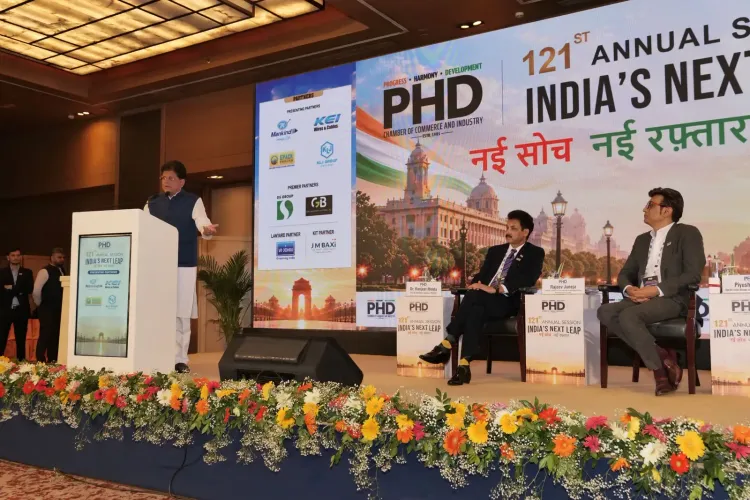
Commerce Minister Piyush Goyal addressed the 121st Annual Session of PHDCCI in New Delhi on 10 October .
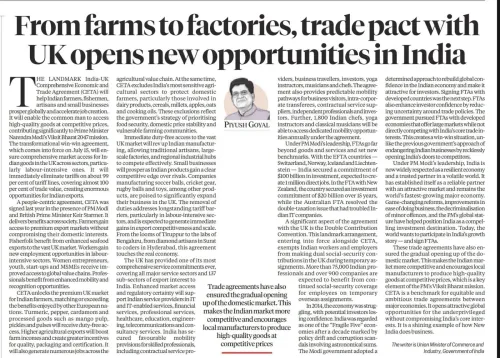
He described the India–UK Comprehensive Economic and Trade Agreement as a significant step in bilateral trade engagement.
India is also engaged in trade negotiations with Canada as part of a broader market-access strategy.
Goyal reaffirmed India's target of $1 trillion in exports by FY 2026–27 , with a 15 per cent growth rate target.
The minister stressed that trade deals must deliver tangible benefits for MSMEs, farmers, and exporters , not just large industry.
India's long-term goal of becoming a $10 trillion economy will require investment, productivity gains, and infrastructure improvements, he said.
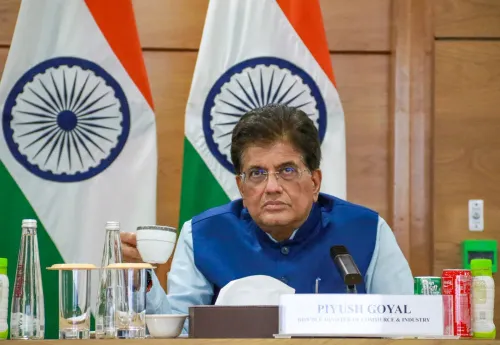
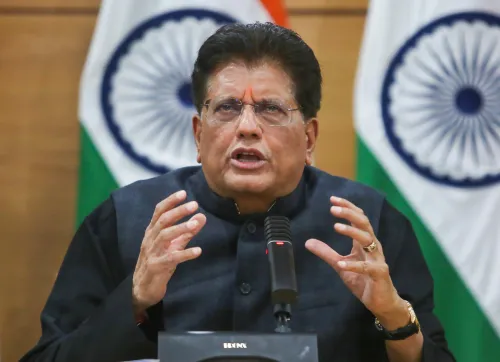
Commerce and Industry Minister Piyush Goyal on Saturday, 10 October said that trade agreements can open new markets for Indian businesses, diversify the country's export basket, and deepen integration with global supply chains. Speaking at the 121st Annual Session of the PHD Chamber of Commerce and Industry (PHDCCI) in New Delhi, Goyal described the recently signed India–UK Comprehensive Economic and Trade Agreement as a significant milestone in bilateral economic engagement.
Key Developments on Trade Agreements
The minister underscored that ongoing and prospective negotiations — including India's engagement with Canada — reflect a broader national objective of expanding market access and forging mutually beneficial economic partnerships. He was emphatic, however, that such agreements must deliver concrete results: tangible opportunities for Indian industry, exporters, farmers, and MSMEs, while safeguarding the interests of domestic stakeholders.
Goyal stressed that consultations with MSMEs, farmers, industry representatives, and other stakeholders must be central to shaping trade and development priorities. 'Their participation is essential to ensure that the benefits of international trade reach businesses of different sizes, support employment generation, and strengthen domestic productive capacity,' he said.
India's $10 Trillion Economy Ambition
'India's aspiration to become a $10 trillion economy will require sustained investment, higher productivity, technological advancement, innovation and a competitive manufacturing and services ecosystem. Achieving this ambition will depend on expanding productive capacity, improving the ease of doing business, strengthening infrastructure and enabling enterprises to scale up,' Goyal emphasised.
He positioned export expansion as a core pillar of this growth trajectory, noting that India aims to increase its global market share and improve the competitiveness of Indian products and services on the back of recent export performance gains.
The $1 Trillion Export Target
India has set an ambitious target of reaching $1 trillion in exports in FY 2026–27, with a targeted growth rate of 15 per cent. Goyal said achieving this will require market diversification, quality improvement, reliable delivery, technology adoption, and stronger participation in global value chains.
He noted that progress towards this goal would demand coordinated efforts from the government, industry, exporters, and trade-support institutions — signalling that the policy push must be matched by execution on the ground.
What This Means for Indian Industry
The India–UK trade deal, if it delivers on stated objectives, could be particularly consequential for sectors such as textiles, pharmaceuticals, IT services, and engineering goods — areas where Indian exporters have historically faced tariff and non-tariff barriers in the UK market. Notably, this comes amid a broader global shift toward bilateral trade arrangements as multilateral frameworks under the WTO face persistent gridlock.
For MSMEs — which account for a significant share of India's export workforce — the minister's emphasis on stakeholder consultation signals an attempt to ensure that trade liberalisation does not bypass smaller enterprises. How effectively that intent translates into policy design will be closely watched by industry bodies in the months ahead.
Point of View
But the real test lies in sectoral implementation: whether tariff concessions translate into actual order flows for textile mills in Surat or pharma units in Hyderabad. Without a robust MSME-specific trade facilitation mechanism, the gap between ministerial ambition and ground-level reality could widen.
NationPress
11 Oct 2026
Frequently Asked Questions
What did Piyush Goyal say about the India-UK trade agreement?
Commerce and Industry Minister Piyush Goyal described the India-UK Comprehensive Economic and Trade Agreement as an important development in India's trade engagement with the United Kingdom. He said the deal can create opportunities for Indian businesses to access new markets, diversify exports, and strengthen integration with global supply chains.
What is India's export target for FY 2026-27?
India has set a target of $1 trillion in exports for FY 2026-27, with a targeted annual growth rate of 15 per cent. Achieving this will require market diversification, quality improvement, technology adoption, and stronger participation in global value chains, according to Goyal.
How will MSMEs benefit from India's trade agreements?
Goyal stressed that trade deals must translate into tangible opportunities for MSMEs, farmers, and exporters — not just large industry. He called for structured consultations with MSMEs and other stakeholders to ensure trade benefits reach businesses of all sizes and support employment generation.
Which other countries is India negotiating trade agreements with?
Beyond the India-UK deal, India is engaged in ongoing trade negotiations with Canada, among others. Goyal described these engagements as part of a broader objective to expand market access and establish mutually beneficial economic partnerships.
What is India's $10 trillion economy goal and how does trade fit in?
India aspires to become a $10 trillion economy, and Goyal said achieving this will require sustained investment, higher productivity, technological advancement, and a competitive manufacturing and services ecosystem. Export expansion — driven by trade agreements and improved global competitiveness — is a central component of that growth strategy.