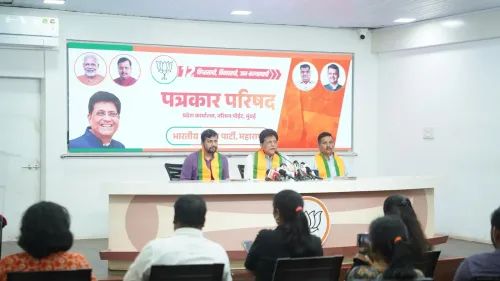
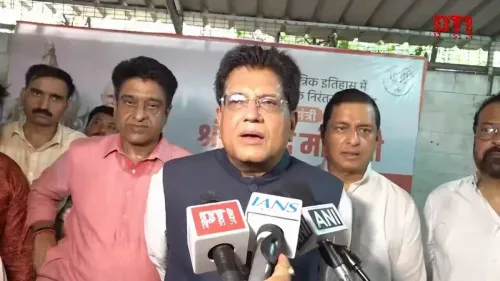
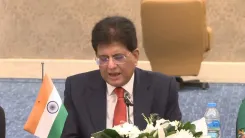
Goyal links Modi's governance to Gandhi's vision of India

Synopsis
Commerce Minister Piyush Goyal shared a video on November 15, 2026, claiming PM Modi has transformed India's image, character and future by following Mahatma Gandhi's principles — a recurring BJP narrative that links contemporary governance to Gandhian ideals.
Key Takeaways
Union Minister Piyush Goyal posted a video on November 15, 2026 linking PM Modi's governance to Mahatma Gandhi's principles.
The post argues Modi has changed India's ' chitra, charitra aur bhavishy ' — image, character and future — by following Gandhi's path.
The Swachh Bharat Mission (launched 2014 ) is the most prominent example of the BJP framing policy in explicitly Gandhian terms.
The 150th birth anniversary of Gandhi in 2019 was a key moment when the government reinforced this narrative nationally.
Goyal, as Leader of the House in the Rajya Sabha , is a senior party communicator who regularly shapes the BJP's macro-narrative.
The use of a video over text reflects the government's preference for short-form visual content in political messaging.
Invoking the Father of the Nation as a governing compass, Union Commerce and Industry Minister Piyush Goyal on Sunday, November 15, 2026, argued that Prime Minister Narendra Modi has transformed the country's image, character and future by walking the path laid down by Mahatma Gandhi.
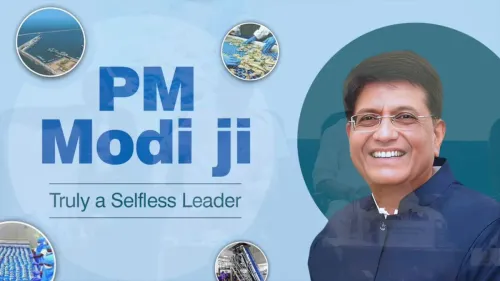
Goyal's post, shared in Hindi, asked viewers to see for themselves how following Gandhi's principles had reshaped the nation: 'देखिए, गाँधीजी के बताए रास्ते पर चलकर कैसे प्रधानमंत्री @NarendraModi जी ने बदला देश का चित्र, चरित्र और भविष्य...' — 'See how Prime Minister Modi, by walking the path shown by Gandhiji, has changed the image, character and future of the country.' The post was accompanied by a video, suggesting a curated reel of policy milestones presented through a Gandhian lens.
Gandhi's ideals as a BJP policy frame
The invocation is not new, but it is deliberate. Since 2014, the BJP-led government has consistently anchored flagship programmes in Gandhian vocabulary — most visibly through the Swachh Bharat Mission, launched explicitly as a homage to Gandhi's lifelong emphasis on sanitation and cleanliness. The 150th birth anniversary of Gandhi in 2019 became a nationwide moment to link the government's agenda — from open defecation-free villages to rural self-reliance — to the Mahatma's original vision.
Goyal, as Leader of the House in the Rajya Sabha and one of the BJP's most prominent communicators, frequently shapes the party's macro-narrative on social media. Framing contemporary governance through the moral authority of Gandhi is a well-worn but effective political register — it simultaneously claims historical legitimacy and inoculates against the charge that development-centric politics has abandoned older Indian values.
The 'chitra, charitra, bhavishy' formulation
The three-word triad Goyal uses — chitra (image), charitra (character), bhavishy (future) — is rhetorically compact in the way political Hindi often is. It signals a comprehensive claim: that the transformation is not merely infrastructural or economic but also moral and civilisational. Such language is characteristic of the BJP's broader effort to present governance as a form of national renewal rooted in pre-Independence ideals.
Whether the video elaborates specific schemes, data points or scenes from across India is not immediately clear — but the choice to package the message as a visual rather than a text thread underscores the government's growing preference for short-form video as a primary communication tool heading into an era of intensified political messaging.
Gandhi's path, it seems, is being mapped in pixels — and the BJP intends to keep pointing the direction.
Point of View
Character and future signals that the party is widening its pitch beyond economics to a civilisational narrative. As the government approaches future electoral cycles, expect this Gandhian-frame messaging to intensify, particularly in audio-visual formats that bypass traditional intermediaries. The choice of Gandhi remains shrewd: his authority transcends party lines, making him the safest possible validator for any government's self-portrait.
NationPress
15 Nov 2026
Frequently Asked Questions
What did Piyush Goyal post about Mahatma Gandhi and PM Modi?
Goyal shared a video on November 15, 2026, claiming that PM Modi has transformed India's image, character and future by following the path shown by Mahatma Gandhi.
How has the BJP linked its policies to Gandhian principles?
The BJP launched the Swachh Bharat Mission in 2014 explicitly invoking Gandhi's emphasis on sanitation, and used Gandhi's 150th birth anniversary in 2019 to frame rural and social programmes in Gandhian terms.
What does 'chitra, charitra, bhavishy' mean in Goyal's post?
The Hindi phrase translates to 'image, character and future' — Goyal's shorthand for a comprehensive claim that Modi's governance has transformed India morally, socially and economically.
What is Piyush Goyal's current role in the Indian government?
Piyush Goyal serves as Union Minister of Commerce and Industry and is also the Leader of the House in the Rajya Sabha, making him one of the BJP's most senior political communicators.
Why do BJP leaders frequently invoke Mahatma Gandhi?
Invoking Gandhi allows the BJP to claim moral and historical legitimacy for its governance agenda, framing current policies as a continuation of the independence movement's ideals rather than a departure from them.