Goyal Marks GeM's 10 Years as a Procurement Revolution
Synopsis
Union Commerce Minister Piyush Goyal marked the tenth anniversary of the Government e-Marketplace on 11 August 2026, calling it PM Modi's vision turned success story and highlighting GeM's decade of gains in transparency, inclusivity, and procurement efficiency.
Key Takeaways
GeM was launched on 9 August 2016 as India's national digital public procurement portal.
Minister Piyush Goyal credited PM Narendra Modi's decade-old vision for the platform's success.
GeM was designed to enhance transparency, speed, quality, inclusivity, and accountability in government buying.
MSME suppliers are among the primary beneficiaries, gaining access to government contracts through the digital platform.
GeM is part of India's broader push to use digital infrastructure to curb leakages in public spending.
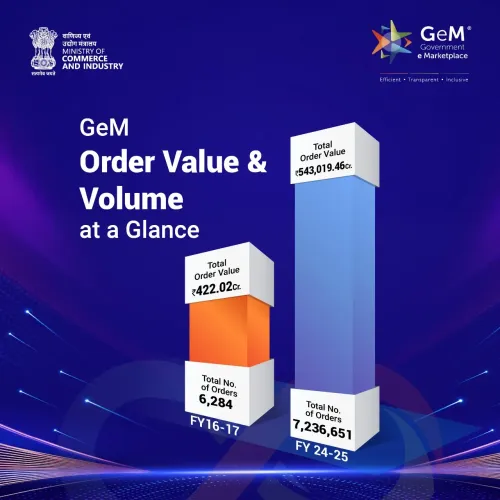
The platform's second decade will be watched for expanded mandatory procurement categories and official tenth-year performance data.
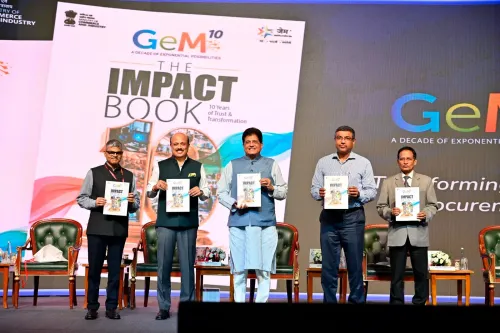
Ten years after Prime Minister Narendra Modi seeded the idea of a unified digital marketplace for government buying, Union Commerce and Industry Minister Piyush Goyal on Tuesday, 11 August 2026, called the Government e-Marketplace (GeM) a 'gem of a success story' — and the platform's decade-long journey from a niche procurement portal to a national reform pillar gives him every reason to say so.
From a 2016 launch to a decade of digital procurement
GeM was launched on 9 August 2016 to replace the opaque, paper-heavy government tendering system with an open, rules-bound online marketplace. The mandate was straightforward: let central and state government departments buy goods and services directly from verified sellers, cutting out middlemen and the discretionary dealings that had long plagued public procurement. Minister Goyal reflected on the platform's gains in transparency, speed, quality, inclusivity, and accountability — five pillars that define what GeM was always meant to fix.
Why MSMEs and small sellers became the real story
The platform's biggest structural achievement has been widening the vendor base. Before GeM, small manufacturers and micro-enterprises had little realistic shot at government contracts — the paperwork alone was a barrier. By digitising onboarding and standardising product categories, GeM pulled in MSME suppliers at scale, turning public procurement into an engine of small-business growth. That inclusivity angle — not just efficiency, but equity — is what separates GeM from a routine e-tendering upgrade.
GeM inside India's larger digital governance push
GeM sits alongside platforms like PFMS, UPI, and the JAM trinity in India's decade-long project of using technology to plug leakages in public spending. The logic is consistent: when transactions move onto auditable digital rails, discretion shrinks and accountability grows. Goyal's post frames GeM not as a standalone portal but as proof of concept for that entire governance philosophy — a model that other countries watching India's digital-public-infrastructure story have noted with interest.
As GeM enters its second decade, the immediate question is whether the government will expand mandatory procurement categories and release granular tenth-year performance data. The platform's credibility now rests on whether the numbers it publishes match the ambition of the anniversary rhetoric. If they do, the 'gem' label will be well-earned.
Point of View
GeM also represents institutional ownership: Goyal has championed the platform as a tool for MSME empowerment, linking procurement reform to the party's small-business constituency. The real test of the narrative will come when tenth-year procurement figures are published and scrutinised against the scale of the claims being made.
NationPress
11 Aug 2026
Frequently Asked Questions
What is GeM India and what does it do?
GeM, or the Government e-Marketplace, is India's national online portal for government procurement of goods and services, launched on 9 August 2016 to make public buying transparent, efficient, and accessible to a wider range of suppliers including MSMEs.
When was GeM launched and who started it?
GeM was launched on 9 August 2016 under the vision of Prime Minister Narendra Modi , with the goal of replacing opaque paper-based government tendering with a rules-bound digital marketplace.
What did Piyush Goyal say about GeM's 10th anniversary?
On 11 August 2026 , Minister Piyush Goyal called GeM 'a gem of a success story,' reflecting on its gains in transparency, speed, quality, inclusivity, and accountability over the past decade.
How has GeM helped MSMEs and small businesses in India?
By digitising vendor onboarding and standardising product categories, GeM has allowed small manufacturers and micro-enterprises to compete for government contracts that were previously dominated by larger, better-connected suppliers.
What is next for GeM in its second decade?
Observers are watching for the release of official tenth-year performance data and potential government announcements expanding the list of mandatory procurement categories on the platform.