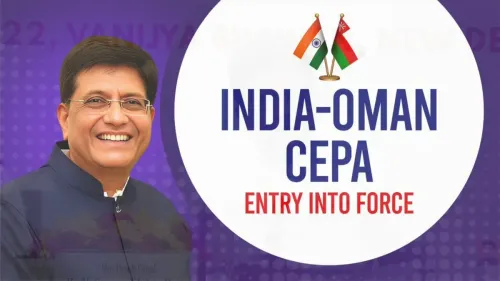
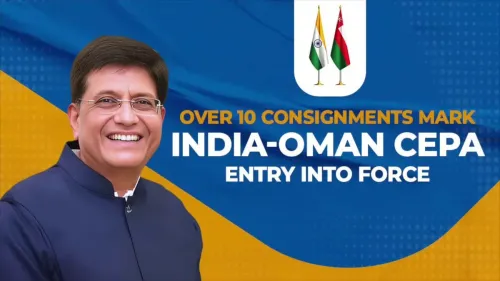
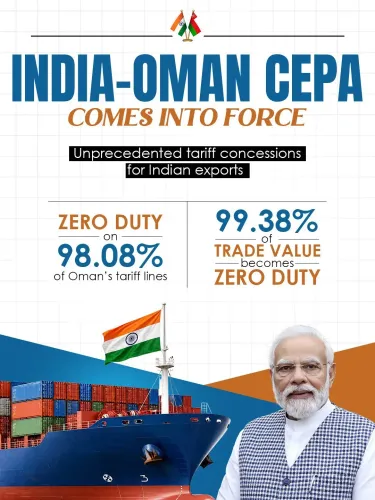
Piyush Goyal Marks India-Oman CEPA Entry Into Force
Synopsis
Union Commerce Minister Piyush Goyal on June 1, 2026 marked the entry into force of the India-Oman CEPA, presiding over a ceremony that saw inaugural export consignments depart for Oman. He urged exporters to use facilitation desks and explore food security, co-manufacturing, and green hydrogen collaboration under the landmark pact.
Key Takeaways
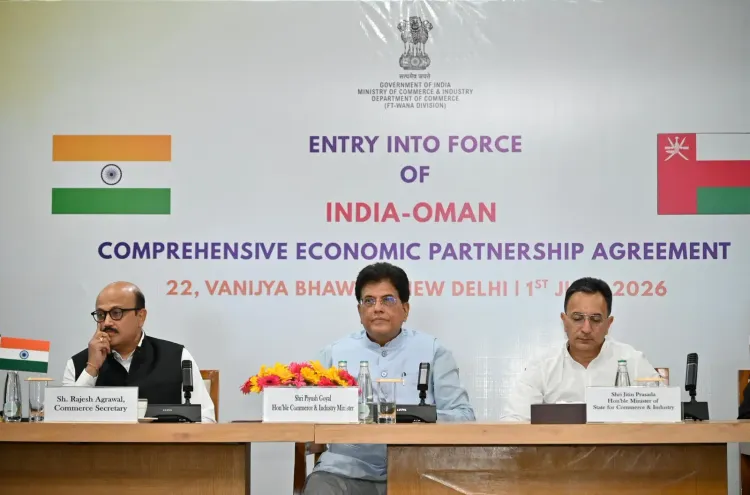
The India-Oman CEPA officially entered into force on June 1, 2026 , with a formal ceremony presided over by Minister Piyush Goyal and MoS Jitin Prasada .
Multiple export consignments from various parts of India departed for Oman on the same day, benefiting from preferential tariff access.
Goyal called on Indian exporters to engage with export facilitation desks to maximise benefits under the agreement.
Priority areas for India-Oman collaboration identified include food security , co-manufacturing , green hydrogen , and the services sector .
The pact follows the model of the India-UAE CEPA (in force since May 2022) and is part of India's broader Gulf trade strategy.
Indian MSMEs and exporters in labour-intensive sectors are among the primary intended beneficiaries of the agreement.
Union Commerce and Industry Minister Piyush Goyal on Monday, June 1, 2026, presided over the ceremony marking the entry into force of the India-Oman Comprehensive Economic Partnership Agreement (CEPA), alongside Minister of State Jitin Prasada. The event was accompanied by the simultaneous dispatch of multiple export consignments from various parts of India to Oman, benefiting from preferential tariff access under the landmark pact.
Context
The ceremony formalised the operational start of the India-Oman CEPA, a bilateral trade agreement designed to reduce tariffs and expand market access for goods, services, and investments between the two countries. Goyal noted that exporters from across India participated in the inaugural dispatch, signalling early commercial uptake of the agreement's concessions.
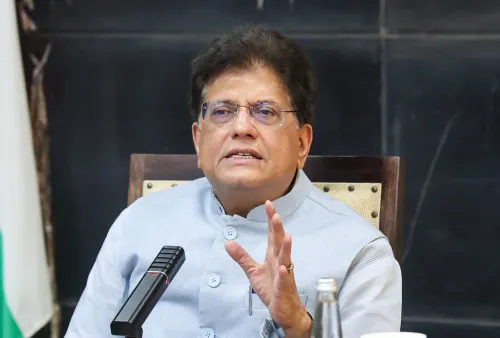
Speaking at the event, the minister urged Indian exporters to 'fully leverage the opportunities created by this landmark Agreement by engaging with export facilitation desks.' He also encouraged stakeholders to explore collaboration in food security, co-manufacturing, and green hydrogen, as well as unlocking opportunities in the services sector.
Policy Backdrop
The India-Oman CEPA follows the template established by the India-UAE CEPA, which was signed in February 2022 and entered into force in May 2022 — the first such agreement India concluded with a Gulf country in the modern era. Oman, a member of the Gulf Cooperation Council (GCC), has long been a significant trade and energy partner for India, with established logistics and diaspora links.
India's accelerated pursuit of CEPAs with Gulf nations reflects a broader strategy to diversify export markets and secure preferential access for labour-intensive sectors, including textiles, engineering goods, and processed foods. The emphasis on green hydrogen signals India's intent to use bilateral frameworks to anchor itself in the Gulf's emerging clean-energy supply chains.
Stakeholders and Impact
Indian MSMEs and larger exporters stand to gain most immediately from reduced tariffs on goods entering Oman. Export facilitation desks — referenced by Goyal in his address — are positioned as the primary interface for businesses seeking to navigate preferential rules of origin and documentation requirements under the pact.
Beyond goods trade, the minister's call for deeper engagement in food security and co-manufacturing points to an ambition to embed Indian industry into Gulf value chains, while green hydrogen cooperation could attract Omani sovereign and private capital into Indian production projects. The services sector, a traditional Indian strength, was also highlighted as an underutilised avenue under the agreement.
What's Next
Attention will now turn to early utilisation data — specifically how many exporters activate tariff concessions through the facilitation desks in the weeks following entry into force. Follow-up business forums and bilateral working groups are expected to operationalise the food security and green hydrogen cooperation streams flagged by Goyal.
The India-Oman CEPA adds to a growing network of Indian trade pacts that also includes agreements with Australia and the UAE, as well as ongoing negotiations with other partners. Sustained exporter outreach and streamlined customs procedures will be critical to translating the agreement's preferential terms into measurable trade gains.
Point of View
2026 represents another concrete step in India's methodical effort to build a preferential trade architecture across the Gulf, a region that absorbs a significant share of Indian exports and remittances. By pairing the formal ceremony with live export dispatches, the government is signalling implementation readiness rather than merely diplomatic achievement. The push into green hydrogen and co-manufacturing suggests New Delhi is using these bilateral frameworks not just to open markets but to position India within Gulf-led supply chains of the future. Whether exporter uptake matches the political momentum will be the real test in the months ahead.
NationPress
15 Oct 2026
Frequently Asked Questions
What is the India-Oman CEPA?
The India-Oman Comprehensive Economic Partnership Agreement (CEPA) is a bilateral trade pact between India and Oman that reduces tariffs and expands market access for goods, services, and investments between the two countries. It entered into force on June 1, 2026.
When did the India-Oman CEPA come into force?
The India-Oman CEPA entered into force on June 1, 2026, marked by a formal ceremony presided over by Union Commerce Minister Piyush Goyal and Minister of State Jitin Prasada.
How does the India-Oman CEPA benefit Indian exporters?
Indian exporters gain preferential tariff access to the Omani market under the CEPA. The government has set up export facilitation desks to help businesses navigate rules of origin and documentation requirements to claim these concessions.
What sectors will India and Oman focus on under the CEPA?
Beyond goods trade, Minister Piyush Goyal highlighted food security, co-manufacturing, green hydrogen, and the services sector as key areas for deeper India-Oman collaboration under the agreement.
How does the India-Oman CEPA compare to the India-UAE CEPA?
The India-UAE CEPA, signed in February 2022 and in force from May 2022, served as the model for the India-Oman agreement. Both are part of India's broader strategy to build preferential trade ties across Gulf Cooperation Council member states.